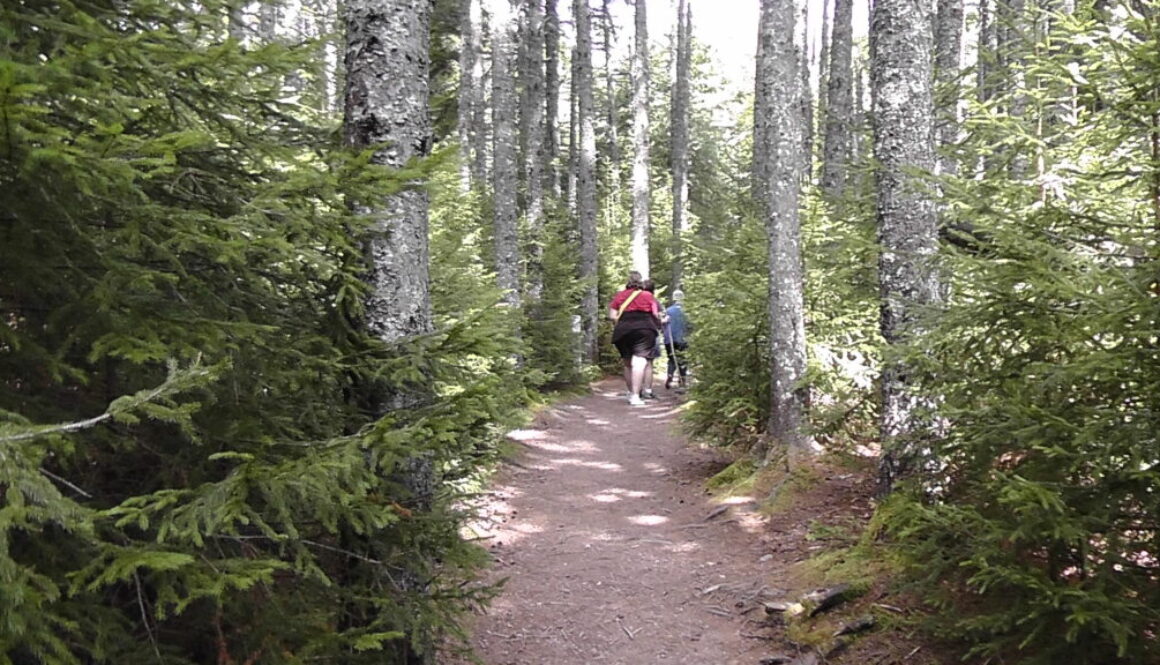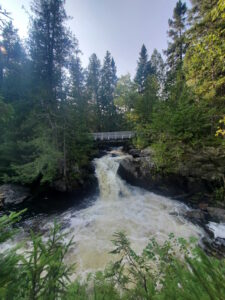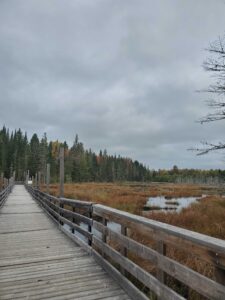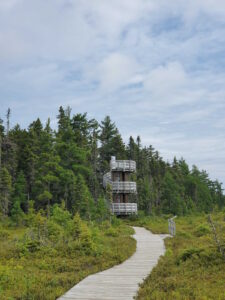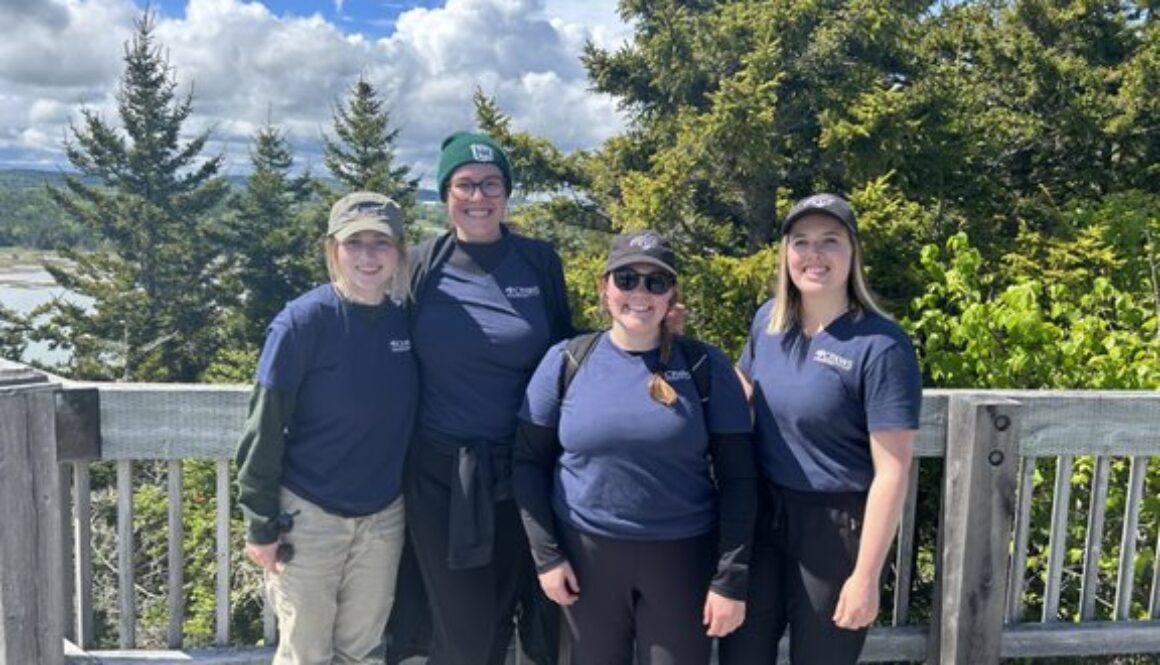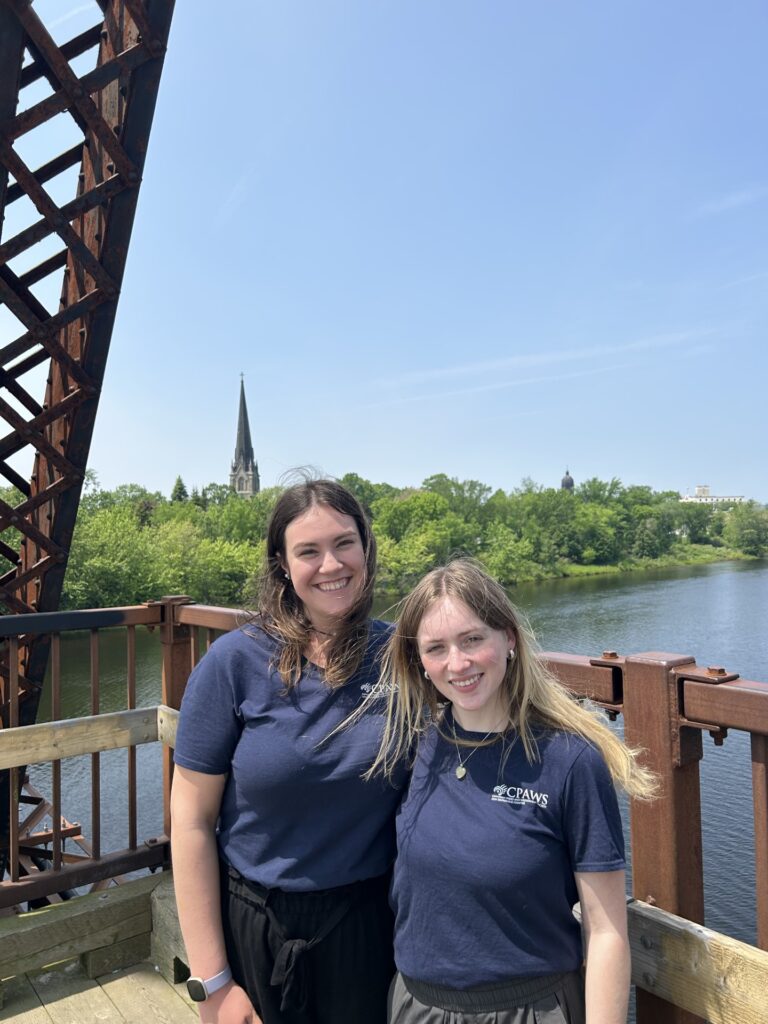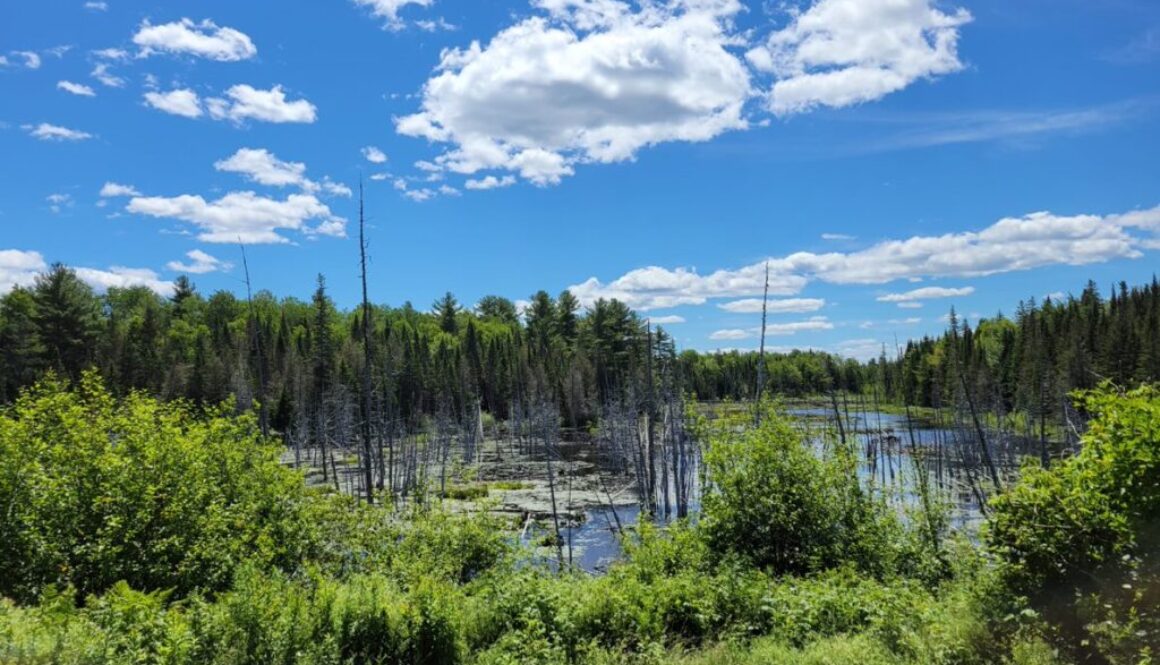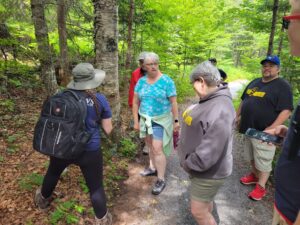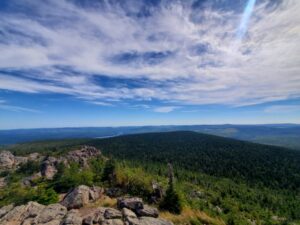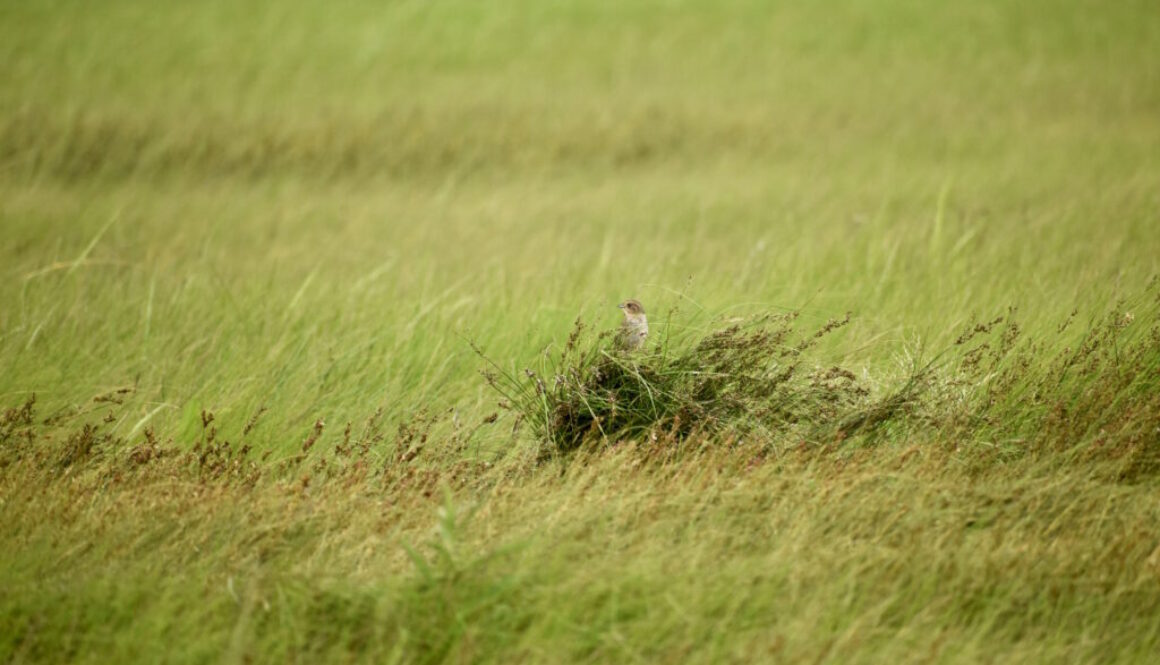

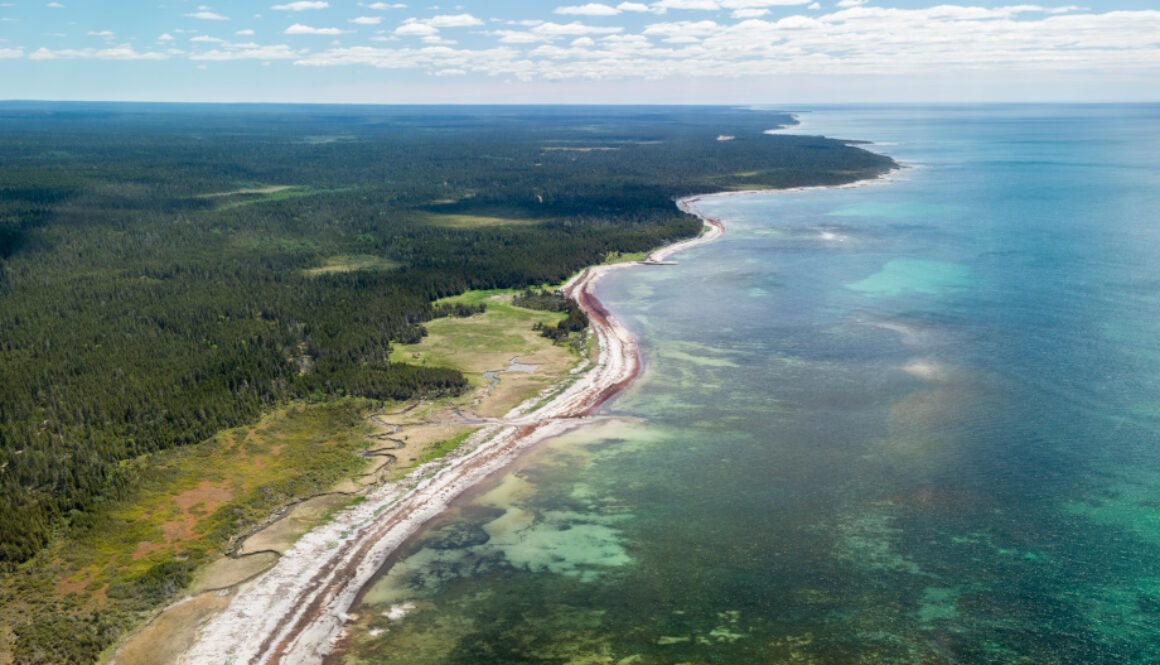
Are you passionate about helping nature, but don’t know where to start? Here is a list of 7 ways to start this spring. This list is intended for those new to nature exploration or conservation advocacy.
1. Join us at the Parks and connect with Nature
One of the best ways to help nature is to first get to know nature! New Brunswick is full of natural beauty to explore, and our Provincial and Nationals Parks offer a safe way to explore many of the different habitats here in the province. CPAWS NB runs free* educational and family friendly activities throughout the summer. Here is the link to our schedule. For those with accessibility needs, New Brunswick parks do have accessibility features and equipment, visit Parks NB for details on what is available at each park. *Park admissions fees still apply.
2. Learn as you explore! – INaturalist
While exploring nature, you can learn as you go! INaturalist is a free app, available for both iPhone and Android, and allows the user to take photos and identify almost anything that can be found in nature. From fungi, trees, plants, birds, insects and more, INaturalist is a great tool to have while outdoors!
3. Support Indigenous Conservation
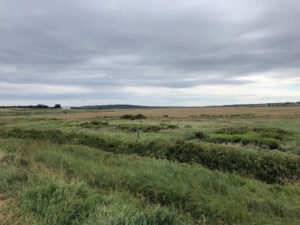
Indigenous lead conservation is crucial to the conservation of lands, waters, and everything in between. Supporting Indigenous conservation initiatives can look like volunteering for an event, contributing financially, educating yourself on Indigenous culture, supporting Indigenous Treaty rights, and voicing support when communities need it. For more information on how to be an ally of Indigenous led Conservation check out this guide by Land Needs Guardians.
4. We Can’t Wait Campaign
Another way to help nature is to get involved in the CPAWS’ “We Can’t Wait Campaign”. The campaign is designed to draw attention to the need protect at least 30% of land and ocean in Canada by 2023 and ensure the federal, provincial, and territorial governments deliver on this pledge! For more information or to sign the pledge please visit here.
5. Contact a Representative
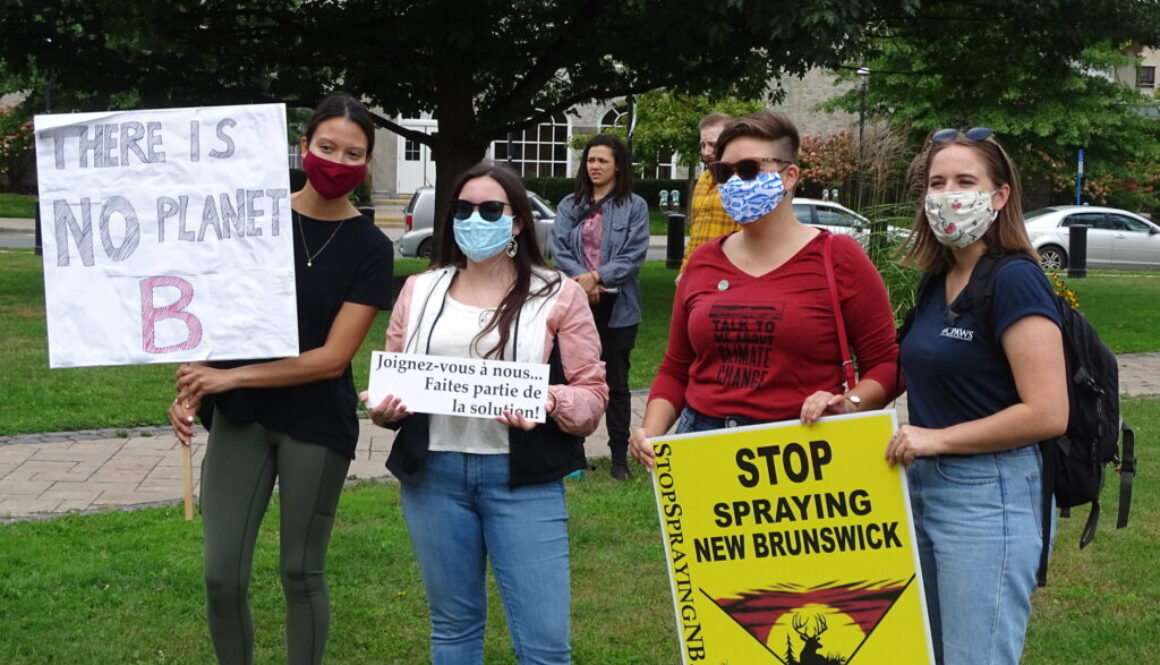
Is there a specific nature issue you would like to see addressed? Write a letter, call, sign a petition, there are many ways to take action for nature. Check out CPAWS NB’s Speak Up for Nature Action Toolkit! This toolkit takes the guess work of how to contact an elected official and is a great tool for those who are new to political advocacy.
6. Share the Joy of Nature!
Talking about nature and why it is important to you is a powerful way to raise awareness about nature and all of the positive things that nature does for us. You can use platforms like social media, or simply have conversations with family and friends to share your favourite things about nature, like favourite places, favourite activities or favourite animals. Sharing your passion can help others spark their own interest in nature!
7. Make a donation
Financial contributions help fund the work we do to encourage governments to protect nature and to educate people of all ages about our connections to nature … and we make it go a long way. CPAWS NB spends over 90 percent of each dollar we raise on conservation and education. When you make a donation of $20 or more, you will receive the following benefits for one year: A tax receipt, two issues per year of our information-packed national newsletter, Canadian Wilderness and chapter newsletter, WildNB.
When you think about the wildlife of the Bay of Fundy, images of whales breaching in the ocean, seals sunbathing on the rocks, or flocks of shorebirds in the mudflats might come to mind. However, Kiirsti Owen – a PhD candidate at the University of New Brunswick and Acadia University – might picture a Nelson’s Sparrow darting through the grasses of the salt marshes that surround the Bay. Her research has brought her up-close to this cryptic species of songbird and she has become quite attuned to their unique traits.
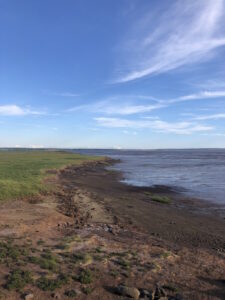
Where the Bay of Fundy meets the saltmarsh (Photo credit: Meghan Oliver)
“They’re not a very striking bird visually…but their sound is really cool!” explained Kiirsti. Their song is truly unique as it doesn’t sound like the melodic chirping of most birds. It was described to her as the noise a pop can makes when it opens, and that description has stuck.
Behaviour-wise, Nelson’s Sparrows aren’t quite bird-like either. They stay fairly low to the ground, and Kiirsti described their movements as more rodent than bird. They will often scurry around the grass and fly short distances before landing back into the thick vegetation.
As part of her doctoral research, Kiirsti has spent the last two summers studying these birds in the salt marshes near Sackville, New Brunswick, and this part of the province is the optimal area to address one of her main research questions: how do wetland birds use human-created landscapes? This is because of the prevalence of agriculture in the region. Dykes were constructed in parts of the salt marsh so the nutrient-rich soil could be used for farming, and the presence of both salt marshes and agricultural land allows Kiirsti to compare the ways that Nelson’s Sparrows use these natural and human-made landscapes, respectively.
Nelson’s Sparrows are typically considered a “salt marsh specialist”, meaning their breeding habitat is usually limited to salt marshes. However, this Maritime population of sparrows also nests in the agricultural land that lies inland, and Kiirsti isn’t sure why these birds choose to breed outside of the marsh.
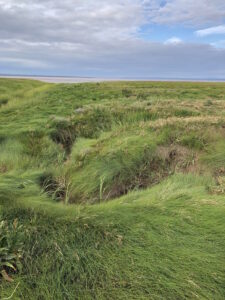
Saltmarsh (Photo credit: Meghan Oliver)
To investigate this, Kiirsti tracks the movements of Nelson’s Sparrows using radiotelemetry. In short, she attaches lightweight transmitters to the birds. Each transmitter emits a unique radio signal which can then be picked up by a handheld receiver. By trudging around the salt marsh and agricultural land, Kiirsti and her team can resight the birds and map their movements, ultimately revealing the habitats that the birds prefer.
Her days tracking birds can be long and demanding; in the height of the breeding season, her and her team wake up around 3:30 AM and are already busy at work before the sun comes up. The uneven terrain and abundance of water can make it difficult to navigate around her study sites, but Kiirsti’s fondness for the salt marshes and the sparrows that are able to subsist there is incredibly apparent.
“Salt marshes look like such a benign landscape, but once you start working it you realize that this is a harsh environment,” she commented. “It takes a lot for something to be able to make it there.”
This challenge of surviving in such a salty environment would be difficult on its own, but the population of Nelson’s Sparrows that Kiirsti studies has the added difficulty of dealing with the high tides that are emblematic of the Bay of Fundy. When the tide comes in, the salt marsh can flood and the nests of the sparrows – which are on the ground – could be inundated. With water levels rising due to climate change, birds that nest in the salt marsh could have higher instances of nest failure due to flooding compared to those that nest in the agricultural land. As such, it will become increasingly important to understand the factors that determine how birds select nesting habitat.
Agricultural land (Photo credit: Meghan Oliver)
“Maybe the salt marsh is really important habitat now for Nelson’s Sparrows,” Kiirsti said, “but are they going to be successful 50 years from now in the same spots if the sea level keeps rising?”
While Kiirsti’s research highlights one way that the salt marshes of the Bay of Fundy are useful for wildlife, there are many more instances that illustrate the services that this ecosystem offers. Not only do they provide habitat for many organisms, but salt marshes also protect and stabilize coastlines, filter sediments and pollutants, sequester carbon, provide nutrients, and minimize the effects of ocean acidification on local areas. In fact, these coastal protection benefits may also help to mitigate the threats faced by the wildlife that use the salt marshes.
In a landscape facing agricultural development, restoration efforts, and a changing climate, studies like Kiirsti’s will allow us to understand how and why animals like the Nelson’s Sparrow use these salt marshes in the Bay of Fundy. While her current findings suggest that these birds prefer the salt marsh over human-made landscapes, it’s unclear if this affinity will change in the coming decades. However, the ecosystem services provided by salt marshes are clear, and by protecting these landscapes, we can in turn protect these benefits for the decades to come.
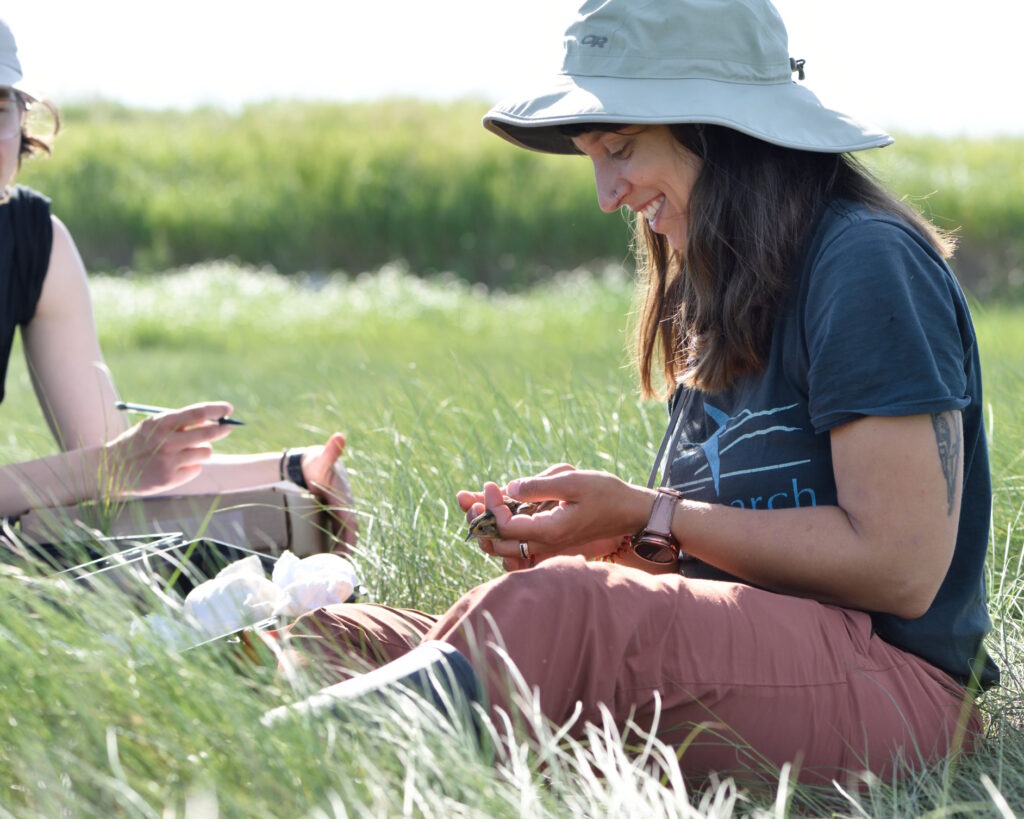
Kiirsti Owen holding a Nelson’s Sparrow. All birds are handled for research purposes and with all necessary permits. (Photo credit: Kirby Morrill)
Banner photo: A male Nelson’s Sparrow in the Beausejour Marsh near Sackville, NB. (Photo credit: Kiirsti Owen)
With the onset of cold weather and shorter days, the forests, covered in snow, may seem lifeless. Wildlife have found many ways to adapt to the harsh winter conditions. Some animals leave for warmer places, while others find a cozy den to hibernate in until warmer weather returns. However, some animals stay right under our noses. Just below our feet, under the snow, is teeming with life. Welcome to the Subnivean Zone!
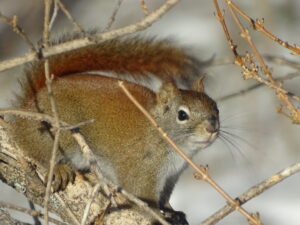
Red Squirrel by Steve Reid
What is the Subnivean Zone?
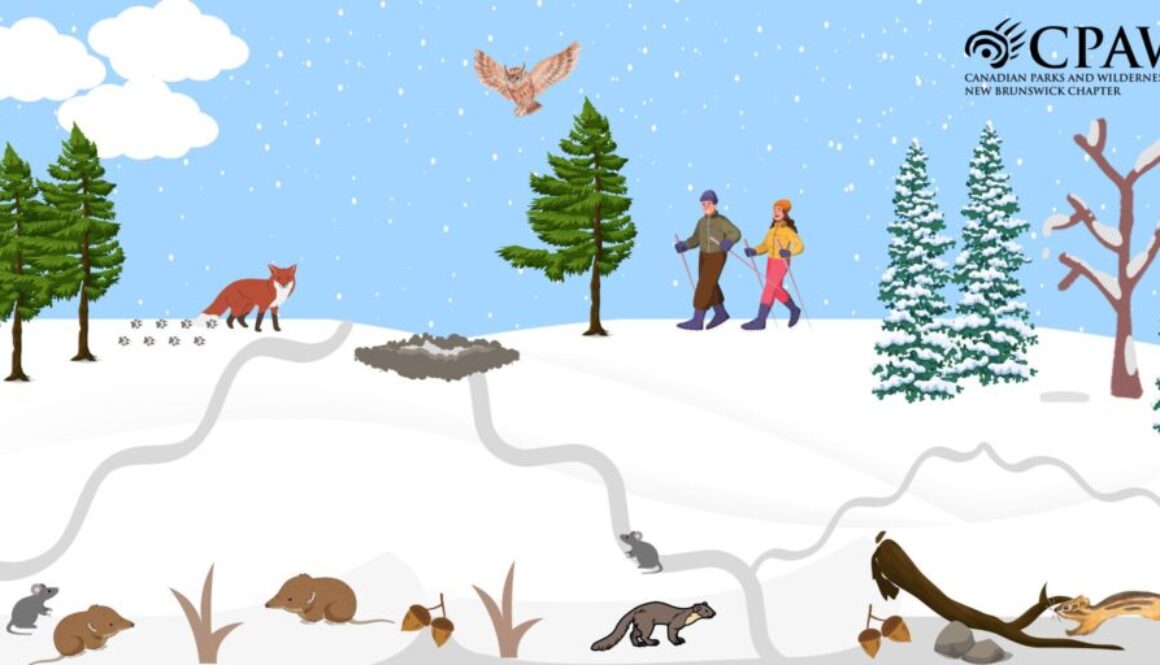
The space in between the snow and the ground is called the subnivean zone. The subnivean zone is formed in two ways:
As snow falls and it piles onto dense vegetation, rocks, branches and logs, the snow does not directly touch the ground. This makes a layer of space between the ground and snow.
The ground is warmer than the surrounding air because it gets heat from the earth’s core, causing the lowest layer of snow to turn from a solid into water vapour! The water vapour then re-freezes creating a hard roof-like structure with space underneath.
The hidden habitat is almost like an apartment building! The subnivean zone has a maze of tunnels and rooms, and it is not only used for shelter from the cold –some small mammals even use these spaces to store food, use the washroom, sleep, and even eat.
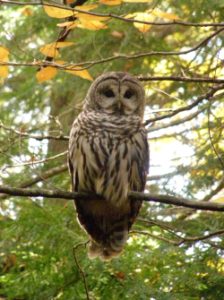
Barred Owl, photo by Steve Reid
Who lives in the Subnivean Zone?
Many of New Brunswick’s small mammals use this hidden habitat. Chipmunks, Deer Mice, Shrews and Pine Marten, among many others. Without the Subnivean space, animals that stay throughout the winter months would have no home, no safe space to eat or sleep – it ultimately affects their survival.
Not only do small mammals rely on this habitat but larger mammals and birds like Foxes, Owls and Coyotes do, too. They can use their keen sense of hearing to find food in the subnivean zone, and this is an extremely important food source.
Climate Change and the Underground Habitat
Climate change is causing the weather to swing in extremes, especially in the winter months. An increase in warmer temperatures is causing less snowfall, and shorter winters.
The biggest threats that climate change poses to the subnivean zone are:
The length of time the Subnivean zone exists
The quality of habitat and shelter for the subnivean dwellers
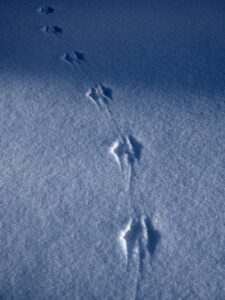
Photo by Steve Reid
As the winters are getting warmer, the amount of precipitation coming down in the form of snow is decreasing and instead, is coming in the form of rain. Think of this as a “snow drought”. With a lack of snow, the subnivean dwellers do not have enough room to be underneath the snow and it can make them colder! Without the shelter of the habitat, they are vulnerable to cold temperatures and wind. Increasing rain and snow melt can also flood the tunnels and ruin food that has been stored under the snow.
Although the subnivean zone is under stress because of climate change, there is one important step that can help the animals – Protected Areas!
Protected Areas:
Provide enough space for wildlife to adapt to a changing environment.
Lessen the impacts of climate change.
Keep habitats connected and stop habitat loss.
Reduce the impact of extreme weather.
CPAWS New Brunswick works across the province to encourage our government to protect more nature through protected areas. Click here to learn more.
As we start a new year, many people take the time to set intentions for the upcoming 12 months. At CPAWS NB one of our goals every year is to see more natural areas across the province protected and managed so wildlife and habitats can thrive. This year is no different and we are starting 2023 with marine and coastal habitats front of mind.
In February, CPAWS NB staff will be traveling to Vancouver BC, along with environmental groups from across Canada and around the world, to participate in the Fifth International Marine Protected Areas Congress (IMPAC 5).
What is IMPAC 5?
IMPAC 5 (or the Fifth International Marine Protected Areas Congress) will bring together the world’s leading professionals on ocean protection, including ocean conservation professionals, Indigenous Elders and Knowledge Holders, young professionals, policy experts, and international government leaders.
While gathered in Vancouver, participants will share knowledge and discuss opportunities to ensure more ocean wildlife and habitats are protected, as well as develop actions to address marine biodiversity loss and the climate crisis.
The Congress will be hosted by the Government of Canada, Province of British Columbia and host First Nations—xʷməθkʷəy̓əm (Musqueam), Sḵwx̱wú7mesh (Squamish), and səlilwətaɬ (Tsleil-Waututh), in partnership with the International Union for the Conservation of Nature (IUCN) and the Canadian Parks and Wilderness Society (CPAWS).
Why is IMPAC 5 important?
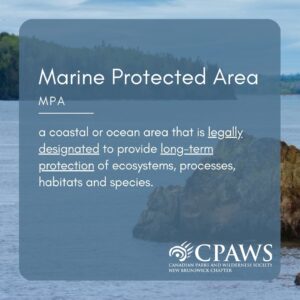
The decisions made at this congress will have far reaching impacts for Marine Protected Areas (MPAs) across the country and world.
Photo by Justin Dutcher
Strong protection for marine ecosystems has far reaching benefits for:
Nature – by protecting habitats that are crucial for marine wildlife;
Communities – by protecting habitats, such as saltmarshes and wetlands, that help reduce the impacts of climate change;
Local economies and tourism – by safeguarding natural areas, and protecting wildlife and habitats that tourism needs to thrive;
Fishing – by protecting the health of commercially important species and ensuring their populations can be restored and replenished;
Culture – by ensuring that culturally significant areas and species are protected.
The congress will be an important step in advancing ocean protection, as participants will create a path forward to protect 30% of the ocean by 2030, a target recently agreed upon at Nature COP.
Why is marine protection important for New Brunswick?
With 5,500 km of coastline, the ocean is a central piece of New Brunswick’s identity.
Coastal and ocean areas in the province:
Provide habitat and food for 22 species at risk and 2 million migratory shore birds;
Support 18,000 jobs in tourism, recreation, fishing and seafood processing;
Generated $1,740 million in seafood exports in 2019 and $125 million from the Bay of Fundy tourism industry.
Marine Protection helps ensure the health of wildlife that make their homes in the Bay of Fundy and Gulf of St. Lawrence. It is also important for protecting coastal communities against climate change and reducing climate-related impacts, benefiting all New Brunswickers.
Use the CPAWS NB ACTION TOOLKIT to learn about how you can advocate for more marine protection in New Brunswick and #SpeakUpForNature.
Celebrate the ocean and coast with CPAWS NB! Share your stories or memories on social media, tagging @CPAWSNB, @IMPAC5 and #CelebratingOurCoast to have your voice heard about why the ocean is important to you!
Follow CPAWS NB on Facebook, Instagram, and Twitter for updates on IMPAC5 and the work we are doing to strengthen protection for coastal and marine areas across New Brunswick.
Are you looking for environmentally friendly and local gifts this holiday season? You are in the right place! CPAWS NB’s Holiday Gift Guide has gifts for kids, teens, and adults alike.
Gift Ideas
Image by Parks Canada
1. Discovery Parks Pass
Feed your body, mind, and soul. You can do it ALL with the pass to Canada’s National Parks. Parks. By purchasing a Discovery Pass gets you added perks like faster entry and some cost savings. Plus, your contributions help maintain and protect the Parks Canada administered places you love!
Get yours here: https://bit.ly/3VQZpSg and remember to be #ParksSmart on all your upcoming adventures!
2. Atlantic Canada Nature Guides
Are you eager to learn more about the nature around you? Whether you are interested in animal tracks, bees, bugs, or the night sky, the Outdoor Learning Store has you covered! There are a number of different guides for Atlantic Canada, so while you are out adventuring, you can use Nature Guides to learn as you go!
Where do our names come from? Where did you get yours? Follow along as Moonbeam learns where her name comes from and awaits to name a newborn. This story was created by a Wolastoqi woman, Gail Francis from Negotkuk and her niece Tara Audibert as illustrator. Moonbeam is the perfect gift for kids and adults alike!
If you are looking for a guided tour of the Bay of Fundy UNESCO Biosphere Reserve, then Baymont Outdoor Adventures is the place to look. Baymont Outdoor Adventures offers sea kayaking tours, which consist of a 2-hour paddle around the Hopewell Rocks Provincial Park! Booking a tour for the nature adventurer in your life is the perfect gift.
Looking to give a gift of a unique experience? How about a tour of Odell Park in Fredericton with Wabanaki Tree Spirit Tours! Cecelia and Anthony Brooks are dedicated to the preservation and advancement of indigenous values through cultural events and experience, and offer medicine walks, workshops and culinary experiences, all with the hope of creating dialogue that leads to a more harmonious world.
Want to purchase a present for the entire family? How about a seasonal park pass to New Brunswick’s Provincial Parks? https://www.parcsnbparks.info/
Get outside in 2023 and explore a park in this beautiful province you haven’t visited yet!
Photo by Arielle DeMerchant
7. Arielle DeMerchant New Brunswick wildlife calendar
Arielle DeMerchant is a New Brunswick based wildlife photographer that captures an array of wildlife, landscape, and natural macro photos, taken to share the magnificence of nature They are $20 each and can be shipped to anywhere in Canada for $4.
If you are interested in buying a 2023 calendar, you can send Arielle a message on her facebook page.
8. Outdoor Nature Tours
Outdoor Nature Tours can give you a variety of experiences! First Nation Tourism (or SP First Nations Outdoor Tours) specializes in outdoor recreation tours. They offer Elders Medicine Tours, Authentic Indigenous Dining, Indigenous Craft Workshop, Breadonastick Tours, and even Ice Fishing Tours!
While most provincial parsks are claosed this time of year, Mactaquac Provincial Park is open in the winter so you can enjoy some outdoor activities and relax in the warm, welcoming lodge. There is a skating pond, sledding hill, well-maintained trails for walking and skiing. Cross-country skis and snowshoes are available courtesy of the Friends of Mactaquac on a first come, first served basis. To learn more and plan ahead, visit https://www.nbparks.ca/en/parks/10/mactaquac-provincial-park
10. Donate to CPAWS NB
Give the gift of nature protection by making a donation in a friend or family member’s name to CPAWS NB. Your donations support our local conservation work, environmental education programs, and ensure the long-term protection of the natural areas in New Brunswick you love.
The hustle and bustle of the holiday season is approaching, and people are getting ready to spend time with family and friends. However, many governments and environmental groups are preparing for a different type of gathering – one with nature as the main focus.
This December, governments, Indigenous Nations, and organizations from all over the world will be attending the UN Conference on Biological Diversity, in Montreal, to discuss the importance of protecting nature for the future of the planet. This is more commonly known as COP-15 or Nature COP.
What is COP-15 or Nature COP?
COP means Conference of the Parties, and it’s a conference that brings together signatory countries (parties) of a convention. In this case it is the Convention on Biological Diversity (CBD). The CBD was adopted in 1992 at the United Nations Earth Summit in Rio de Janeiro, Brazil. Main goals of the CBD include:
The conservation of biodiversity
Sustainable use of the components of biodiversity
Equitable sharing of information related to biodiversity
This is the 15th meeting that will discuss all things related to the CBD, hence the name Nature COP or COP-15.
To advance the goals of the CBD, biodiversity targets were created to guide the world’s actions from 2011-2020. Now, two years into a new decade, a Global Biodiversity Framework will be created to serve as a guide until 2030. This framework will outline new targets for nature protection, pollution reduction and sustainable management of natural resources, as well as recognize nature as a key player in solutions to climate change. It will also contain actions that will help achieve the new targets, such as suggestions on policies for industry and financial commitments required to achieve the targets.
Nature COP will be a place for Canada to announce its targets in relation to fulfilling its promise to halt and reverse biodiversity loss by 2030.
Why is it important?
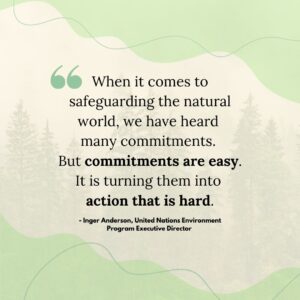
Nature is the planet’s life support system – it produces the air we breathe, the food we eat and the water we drink. We are a part of nature and can influence it in both positive and negative ways. We are currently in a dual crisis of climate change and biodiversity loss and protecting nature is one of the best solutions to help both. By committing to a global biodiversity framework, we can step up efforts to ensure nature is protected. This can only happen if the commitments agreed upon are turned into meaningful and effective action.
Canada must do its part to help protect the earth, our home. However, the targets Canada sets can only be achieved with the help of the provinces and territories, as they have the primary responsibility for public land and water protection.
What does this mean for New Brunswick?
New Brunswick will have a significant role to play, as what happens here affects the world and what happens to the world affects New Brunswick. The province is home to stunning forests, rivers, lakes, coastline and ocean. This abundance of nature is worth protecting. Not only does it provide food and habitat for wildlife, it has cultural and spiritual significance, helps to keep us healthy physically and mentally, provides us with recreation opportunities, allows us to connect to the land, each other and ourselves and provides a livelihood to communities. We must ensure we are taking care of nature, just as nature takes care of us.
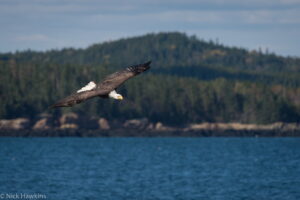
Photo by Nick Hawkins
Some of the best ways we can work towards safeguarding nature include:
stewarding lands and waters in an ecologically responsible manner
CPAWS NB is looking to the province of New Brunswick to set a positive example when it comes to nature conservation by fulfilling their promise of 10% protection of public lands and waters, building relationships with Indigenous Nations, and setting ambitious targets for future land/water protection and ecologically responsible management of forests and other natural resources.
The hard work never stops. It will take collective action from individuals, organizations and governments doing the work on the ground to achieve a place where we live in harmony with nature.
What can You do?
CPAWS NB staff, photo by Steve Reid
SEND A LETTER telling the New Brunswick Government you support fulfilling their promise of 10% public land protection in the province and relationship building with Indigenous Nations.
Review our ACTION TOOLKIT to learn about actions you can take to #SpeakUpForNature and ensure New Brunswick plays its part in nature conservation.
Follow CPAWS NB on Facebook, Instagram and Twitter to stay up to date on what’s happening with Nature COP and New Brunswick.
Follow the hashtag #COP15 to stay updated on what’s happening in relation to the conference.
It’s summer and the national and provincial parks are open to the public! People are excited to get outside, enjoy what nature has to offer and go on some well-needed adventures.
To aid CPAWS NB in our mission to protect our environment and educate the public about natural spaces, we have brought on two summer students to help run our outreach programs. Corrine Donovan and Meriet (Gray) Miller are thrilled to share with you why they care so much about conservation in our province!
What makes you passionate about conservation and wilderness in New Brunswick?
Gray – No matter where I go or live, I will always care about the land around me. Every ecosystem and environment are unique, and as a New Brunswicker I feel it is my duty to protect our ecosystem.
Corrine – I was born and raised in New Brunswick. I grew up going camping, hiking and going on adventures around the province. Knowing the hidden beauties of the province, I have been interested in what opportunities are offered to help preserve and restore the wilderness around us. It is important to me that the environment we love is protected.
What do you love about working with CPAWS NB?
Gray – I love having the opportunity to interact and educate young families and children about the importance of environmental conservation. The more we can educate the future generations and people about the importance of conservation, the easier it will be to push policies makers to protect our forests and ocean.
Corrine – I’ve always had an interest in working for an organization that focuses on the conservation and restoration of New Brunswick; specifically, as I’ve always wanted my home province to be recognized for its unique environment. Helping promote and educate the public about not being afraid to interact with nature but also giving them a better understanding of how to go about it is very important for future generations. Working with CPAWS NB is an amazing opportunity for me as the organization is filled with passionate, motivated and positive people that all have the goal to make New Brunswick’s wilderness better and brighter.
What are your plans for school/work after your work period with CPAWS NB?
Gray – After I am done working for CPAWS I am going into my 4th year of Biology at UNB Fredericton. I am hoping to study Ecology and use the knowledge I gained at CPAWS to help establish pollinator habitat around the campus.
Corrine – I am entering my final year of Environmental Technology at New Brunswick Community College this coming fall semester. My goal is to enter the workforce after graduation as an Environmental Technologist; however, I am considering going to University for Natural Resources after a number of years in the field. My ultimate goal is to go into the conservation and restoration career field as a Technologist to help preserve and/or restore the environment of Canada.
How do you like to get out and enjoy New Brunswick’s nature?
Gray – I love the hidden beauty of New Brunswick’s nature, from our many waterfalls to our vast diversity of wildflowers.
Corrine – I frequently go to the provincial and national parks for camping and hiking. I try to make it a goal to visit as many times as possible in each season. Part of my education and career is to enter the wilderness as well, so it works well for my need to be outside and for my studies/career.
One thing many creatures living on earth have in common is the need for freshwater. It is a precious resource that flows through living and non-living things alike. Thanks to modern plumbing, we have instant access to cold and hot fresh water whenever we need it.
We have all likely heard that 70% of the earth’s surface is covered in water. However, this statistic is a bit misleading. It gives the impression that water is an infinite resource, and while some water is abundant, not all water is the same.
Photo Credit – Emily Ruttan
Of the water on earth, 97% is salt water in the ocean, and while this supports marine life, salt water is unusable to humans, terrestrial and aquatic life, who need freshwater to survive.
Only approximately 2.5% of the water on earth is freshwater and close to 70% of that freshwater is frozen in glaciers and ice caps, while ~30% is groundwater (water held underground between soil and rocks) and only ~1% is found in rivers, lakes, and wetlands.
These numbers paint a vastly different picture of our “Water Planet” and the abundance and availability of freshwater.
In New Brunswick, we are lucky to have a landscape flowing with rivers and lakes teeming with life. We have roughly 60,000 kilometers of rivers and streams, including our major rivers, the Wolastoq (Saint John River) and the Lustēgoocheechk (Miramichi River). We also have over 2400 lakes and ponds, 53 different species of fish, and many other freshwater animals and plants.
Unfortunately, there are many threats to the freshwater in the province.
Threats to Freshwater in NB
Climate Change
Photo Credit – Emily Fox
With climate change comes warmer temperatures. New Brunswick is predicted to have a 2-4°C degree increase in summer temperatures and a 2-6°C degree increase in the winter.
This means that in the summer, there will be more evapotranspiration (water evaporating into the air) and decrease the amount of water in rivers and lakes. The number of droughts throughout the province will increase and impact the availability and quality of drinking water.
Similarly, in the winter, it will increase the amount of rain and snow coming down at once, causing major flooding events and increasing erosion in riverbanks.
Paradoxically, while we may have more droughts, we will also experience severe flooding at different times of the year. A solution to droughts and increased flooding is to manage the areas beside the rivers and lakes. Through forest conservation and ecological management, we can ensure that there are wide canopies of trees and shrubs, whose roots can hold the soil in place, and absorb extra water during floods.
Temperature Rise
Photo Credit – Danielle Hak
Along with climate change, not only will the weather become warmer, but so will the temperature of our waters. This is especially concerning because we have many aquatic animals that need cold water to survive. Fish such as the Atlantic Salmon and Brook Trout are not adapted to be in water warmer than 25°C and the number of days the rivers are reaching these temperatures is increasing. The thermal stress on our fish is reaching lethal levels and will impact their survival.
Thermal stress on fish can be reduced by the tree canopy! Mature trees along rivers and lakes provide shade for the water and regulate the temperature. That tree canopy is essential to provide cold water refuges for cold water wildlife.
Species at Risk
Several of New Brunswick’s at-risk species live in freshwater. The Atlantic Salmon, Striped Bass, American Eel, Yellow Lampmussel, Wood Turtle and Parker’s Pipewort are listed under the Species at Risk Act in New Brunswick. Not only are the species integral to the food web but some of the wildlife are also significant to Indigenous Communities for ceremonial and spiritual purposes.
The water of New Brunswick has economic, cultural, ceremonial, and social value. It is a part of our identity and history and is an invaluable resource. Our waters and the creatures within it will soon face many threats and how we act now will determine its survival. The best way we can help our waters is to create protected areas and manage forests ecologically to keep these life-support systems.
Water gives us life and in return, it is our responsibility to protect it.
For more information on what CPAWS NB is doing to protect forests and rivers visit here.
New River Beach Nature Trail, New River Beach Provincial Park
Winter has transitioned to spring, creating a shift, not only in nature, but in ourselves. As the weather changes people are beginning to spend more and more time outside. Thoughts are turning to outdoor activities and plans for summer adventures. This means there will be more visitors frequenting trails, parks and campgrounds. It is important to remember when visiting these places to be respectful of your surroundings – this includes plants, animals and fellow humans!
Follow these 5 steps to ‘Watch Your Paws’ in nature and have a great time discovering what adventures await you in the great outdoors.
Plan Your Time in Nature
Always be prepared before you go! It is a good idea to plan out your route and activities, especially in more remote areas where you might not have access to cell service. This might mean researching what hiking trail you want to take or which campsite to book before arriving. Be sure to also choose trails suited to you and your group’s ability. Always bring a map (paper or digital) with you and tell someone where you will be. Make sure to have all the supplies you will need for your trip including a first aid kit, food and water. It is also important to check the weather and dress appropriately for the conditions.
Tip: Always pack a hat (for sun protection) and raincoat (if the weather changes) just in case.
Use Marked Trails, Campsites and Firepits
Hiking Mt. Carleton, Mt. Carleton Provincial Park
Thinking about minimizing damage to the environment is important when spending time outside. Stay on trails and campsites to avoid stepping on wildlife and plants or sensitive habitat. Make sure to keep fires small, use fit pits if they are available, and completely extinguish them when done to prevent the possibility of forest fires. It is also important to camp well away from any water source to protect water quality.
Tip: Use wood from a campground for fires to avoid the spread of invasive species.
Pack It In-Pack It Out
Everything that you bring on your outdoor adventure should also come back with you – never leave anything behind. We all know garbage is not good for the environment. It can harm habitats, animals can be attracted to smells which can cause more human-wildlife encounters and no one wants to feel responsible for picking up someone else’s garbage. This also applies to organic or biodegradable items. Contrary to popular belief, it is not a good idea to throw organics into the woods. They take a long time to break down and may land in places where that is not even possible. Organics can also build up in places frequented by many visitors, attracting animals. Biodegradable items can also be an issue. Biodegradable labels are used on many products, but can mean different things. It is best to bring these items out with you as they may only be designed to biodegrade in certain environments (such as specialized waste facilities) and you do not want animals to find them before they break down.
Tip: Once finished eating, use the container or bag from your food to store your garbage until you can dispose of it properly.
Respect Wildlife and Plants
Pitcher Plant, New River Beach Provincial Park
Nature is everyone’s home and it is important to respect all plants and animals when spending time outside. It can be fun to explore all the treasures nature has to offer, but remember not to pick living plants and keep your distance from animals so you don’t disturb them. You should also leave behind any sticks, rocks or plants you find along the way. These are all part of the natural environment – providing habitat for many animals or enriching the soil when they decompose. If you are exploring an area, be sure to put back anything you picked up.
Tip: Pack a pair of binoculars – it will let you view wildlife without having to get too close and disturb them.
Be considerate of your fellow visitors
Everyone deserves to feel safe and enjoy their time outdoors. Be respectful of those you may be sharing the trail, park or campground with by not being disruptive of others and minimizing noise. On trails, yield to those who are looking to pass you or are going in the opposite direction. Always leave a place as you found it – consider picking up any garbage you find to dispose of properly. Remember to also check if pets are allowed where you want to visit and keep them on a leash.
Tip: If you like listening to music, a podcast, etc. while outdoors, bring headphones so that you can enjoy it without disturbing others.
With these 5 steps to ‘Watch Your Paws’ in nature, you are ready to have fun outside. All that’s left is to plan your visit and enjoy the many benefits nature has to offer!
For many of us living in New Brunswick, the amount of time we spend outside in the winter months dramatically decreases. There are many reasons why staying inside your warm home is appealing at this time of year, but there are so many things to experience in the forest in winter that are unlike at any other time of the year.
As the days start to get slightly longer, but winter weather continues, now is a perfect time to get out, explore a forest near you and take in all of its winter beauty. As you are able, and when it is safe to do so, take some time to explore all your senses. The forest provides so many wonderful opportunities to experience each of your senses and more deeply connect to the environment around you. We recommend bringing a notebook/journal to record some of the senses you experience and how you feel being still and present in nature.
Hear
Have you ever noticed the quiet sensation of the forest in the winter? There is a distinct absence of noises, movements, and songs that you might hear other times of the year. Temperature plays a big role in the movement of sound waves, and sound moves slower through colder air, making it easier to hear noises from further away[1]. On your next trip into the forest, take a moment to be silent and observe what you hear around you.
Black-Capped Chickadee sitting on an icy branch, by Brittany Crossman
Winter in the forest is a beautiful time to listen to bird’s songs! While you might be able to hear more birds in the spring and summer, the winter provides a unique opportunity to listen to the calls of birds that do not migrate with the seasons.
While you are on a hike, tap into your sense of sound, to listen to the birds around you. What kinds of songs do you hear? Are there many birds, calling to each other, or a few marking their territory? Do they sound playful and upbeat, or distressed, possibly warning of danger? Are they long calls, or short chirps? These distinctions can tell you a lot about what bird you are listening to.
Identifying bird calls is an impressive skill to master, but with a bit of practice, and quiet time listening in nature, you can begin to hear the different sounds that make each bird species unique.
See
Sight is the predominant sense that most people rely on when out in the forest. But how often do you take a closer look off the trail, to see what is hiding deeper in the forest? While snow buries many plants and wildlife close to the ground in the winter months, there are still many animals that are active when temperatures drop. While many people believe that animals go into a full sleep for the winter, very few animals are true hibernators (meaning they are dormant through the entire winter) and most maintain some level of activity in the winter to find food, find shelter and protect themselves.
Many animals that remain active in the winter months have adapted to camouflage into their surroundings. The snowshoe hare is one example of this, where in spring and summer they can be observed with brown hair, but shed the brown for a white coat in the winter, to better blend in with the snow. Instead of direct animal signings, next time you are out in the forest, put your detective skills to the test and look for other signs of wildlife.
Some indicators that an animal might be nearby include tracks in the snow, animal scat, remains of nests or dens, and shedding of fur or feathers. Remember, it is always important to keep your distance from animals, and not disturb them while you are in their home.
Smell
Hiking trail in the winter at Mactaquac Provincial Park , by Danielle Hak
Take a deep breath in. Not only can this help you relax, but you may also notice some different scents in the forest! You may notice the towering Pine trees, the winding Cedars, the conical Spruces, and the narrow Firs. At first, they may smell the same, but the coniferous trees in New Brunswick have some unique aromas!
Trees and plants get their scents from chemical compounds called Terpenes. Each tree has its own special make-up of terpenes, which not only give trees their scent, but it also acts as a deterrent to insects and some types of fungi[2]! Test and see if you can smell the difference between the conifers!
Do any of these scents remind you of anything you may keep in your home? Some may remind you of the Holiday season. Pine trees, Spruce trees and Balsam Fir are often used as Christmas trees and used to make wreaths and garlands as festive decorations! You may also recognize cedar as it is very fragrant and one of the four sacred medicines used in Indigenous cultures for smudging.
Taste
When was the last time you tried to catch snowflakes on your tongue? In heavy snowfalls, we often try to keep our head down, avoiding winds and snow on our face, but you could be missing some of the beauty that is unfolding around you. This classic childhood activity of catching snowflakes is fun for all ages and can be quite a peaceful way to spend your time in the forest.
If you find yourself on a forest walk during a snowfall, try to stand as still as you can and see how many snowflakes you can catch. Notice how cold it is around you, as you monitor your breath in the frosty air.
This is an especially fun activity during snowfalls with large snowflakes. Did you know that a snowflake’s size correlates to the temperature? As snow crystals fall, many can collide together, giving the appearance of larger snowflakes. This is most likely to happen right around freezing (0 degrees Celsius) because as the temperature gets colder the snow crystals are drier and less likely to stick together, making snowflakes look smaller[3].
Touch
Look around at all the trees. Some may have dropped their leaves; some may still have their needles, but no matter what happens in the winter, all trees keep their bark! Have you ever noticed the differences between the bark? Have you ever seen the different patterns and textures? Can you feel the difference between them?
Most trees have unique differences in their bark that distinguish them from each other, even if it may not be obvious at first. For example, both Aspen and Birch trees have similar white bark, but Birch has lots of little pores called “lenticels” and the bark often peels away from the tree. Other trees have defining patterns, like Ash trees that have deep diamond ridges in the bark, or Ironwood trees that have long strips of bark that are loose at either end.
Take some time to explore trees through touch and note any differences in patterns, edges, textures, bumps, and thickness. It is best to be careful when touching the trees, so as not to cut yourself on anything sharp, like any twigs or Spruce needles. It is also best to bring hand sanitizer to clean your hands after feeling the tree bark. Some trees might leave you with sticky sap residue on your hands, but this is all a part of the fun of exploring different trees!
Close up photos of tree Bark (from left to right): White Birch, Mountain Ash, Trembling Aspen
Photo credit: Emily Ruttan
If you go out on a 5-senses walk, we would love to hear about it. Tag us on Facebook (@CPAWSNewBrunswick) or Instagram (@cpawsnb) and share your experience. While you are out in nature, remember to always pay attention to where you are, avoid stepping on any wildlife, and do not intentionally disturb the habitat. This includes picking plants, removing bark, or chasing any animals. It is especially important to keep your distance from any animals you might encounter.
We hope you are inspired to get outside this winter and cannot wait to hear about all what our supporters have found in the forests near them!