*Registration is required, to provide registrants event information and updates in the case of inclement weather. In the case of inclement weather, the event will be postponed to a later date and registrants will be contacted.
We can’t wait to share our love for the Bay of Fundy with you!
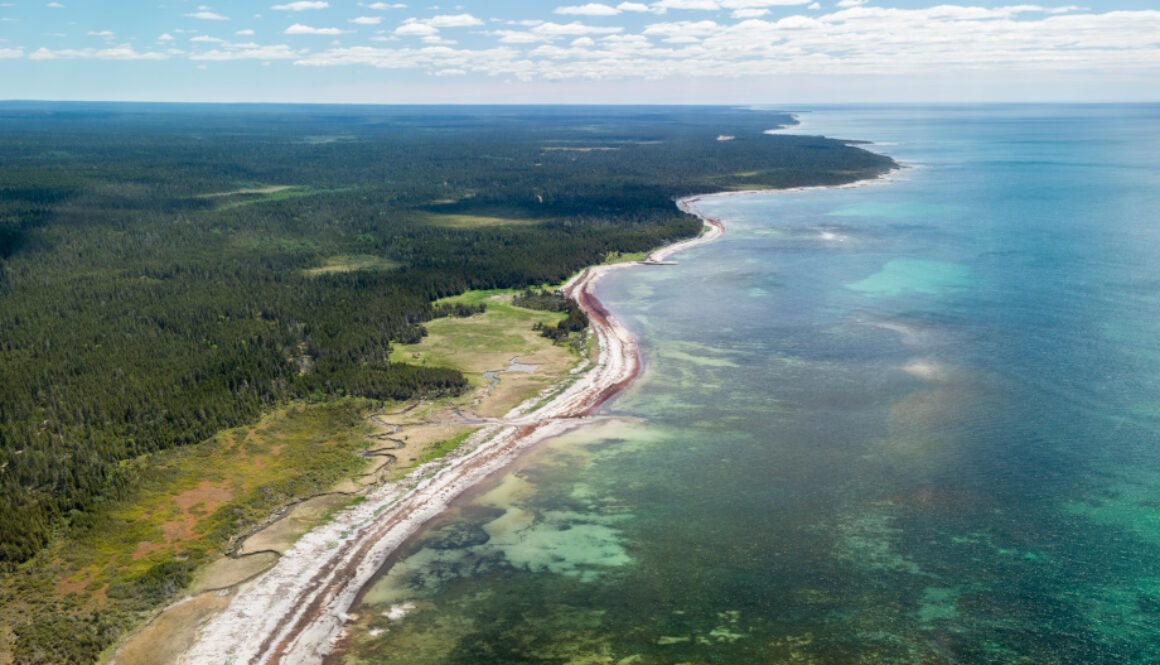
New River Beach Provincial Park by Kristen Hopkins
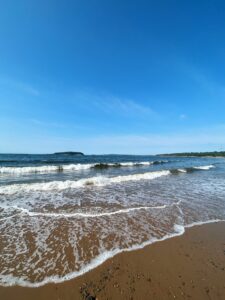
You may or may not already know, but some incredible natural spaces are silently working to help us fight the climate crisis simply by performing their natural function. Like nature’s secret weapon against the changing climate, these places, such as forests and the soil beneath, wetlands, the ocean and the magical places where ocean meets land, are all climate superheroes. From buffering against storms and protecting from floods to creating habitats and exceling at carbon storage, these spaces make up nature’s toolkit for safeguarding the planet! And the best part? It’s all done naturally and for free – by simply allowing natural spaces be.
Each of these climate superheroes is unique and works collaboratively to mitigate the effects of the climate change. These also happen to be beautiful places that offer people opportunities for relaxation, and recreational, emotional, and spiritual experiences which can catalyze human connections to nature. These places also provide wildlife with a habitat to live in.
The Ocean
The ocean takes first prize for the largest carbon sink in the world. It’s a silent superstar in the fight against climate change in two ways. First, the ocean dissolves and absorbs carbon by simply reacting with water. Second, aquatic plants and vegetation act as carbon sponges, absorbing carbon through photosynthesis. These processes come together to create a climate-regulating masterpiece that can help mitigate the impacts of climate change.
However, carbon loves the company of heat. When the ocean absorbs carbon, it latches on to the carbon molecules and does not like to let go. Hence, the more carbon the ocean absorbs, the warmer it will become. The ocean can help protect us from the changing climate, but only if we speak up for marine protection in return.
Seagrass Meadows
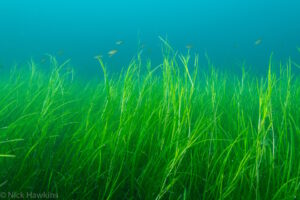
Photo by Nick Hawkins
Seagrass meadows are an important coastal ecosystem for humans and the rest of nature! Often mistaken for seaweed, seagrasses grow from root systems that reach beneath the ocean floor. Seagrasses have stems, roots and leaves and even produce flowers and seeds – just like trees do! This climate superhero is hidden just below the surface of the water and is among the most productive habitats in the world.
Seagrass meadows provide habitat for fish, crabs, sea birds and other sea life, which is important for biodiversity, the food chain and commercial fisheries. These meadows store large amounts of carbon in their root systems and surrounding sediment. They also help buffer storms and slow erosion of the coastline. These are some of the reasons that it’s important to protect this ecosystem, as many seagrass meadows are disappearing due to pollution and increasing development.
Kelp Forests
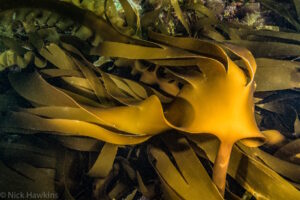
Photo by Nick Hawkins
New Brunswick is blessed with an abundance of forested areas, but did you know that forests grow in the ocean as well? In clear and cool, nutrient-rich water along shore, kelp forests grow. Unlike the trees on land, kelp is not a plant or a tree for that matter… it’s algae! This means that kelp lacks the same physical properties as plants, such as a root system, which is what allows trees to carry nutrients from one part of the plant to the other. Since kelp doesn’t have an established root system, it gets all its nutrients directly from the water. Kelp forests only form in areas where high amounts of sunlight can shine through the water. Through photosynthesis, kelp harvests energy from the sun and relies on sunlight to generate food and energy to survive. In optimal conditions, these plants can grow up to 2 feet in a single day!
As these plants grow to form forests underwater, they provide a special marine habitat, home to sea otters, thousands of invertebrates, and sea urchins. They are important breeding grounds for fish and a place to hunt for seals, sharks and other marine mammals.
Murray Beach Provincial Park by Kristen Hopkins
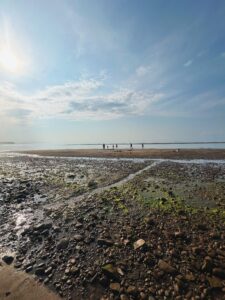
The next time you find yourself wandering in the forest, soaking up the beauty of a wetland, or pondering on the beach while admiring the ocean, remember that nature is actively working, always behind the scenes, to protect the planet, a shared habitat in the face of change. Beneath the ocean’s waves and in the veins of the leaves growing on trees, nature is emitting forces of energy to fight the battle against the changing climate. Sometimes the most effective solutions are the ones that have been there all along, just waiting for their turn in the spotlight.
Although summer has ended, there is no better time than the present to go hiking. New Brunswick boasts some of the most spectacular Fall views and many of the trails are perfect for those who are new to hiking. We have selected 5 beginner friendly trails, as well as some tips for getting outside.
Williams Falls
Before jumping in, one of the most important parts of hiking is to be prepared. Planning your time in nature is what keeps you safe in the wilderness. Safety concerns can arise when folks are ill prepared for a hike. That is why we highly recommend you check out our previous blog on how to “Watch Your Paws” while in nature. This article dives into preparation for time spent in nature, as well as keeping yourself, others, and wildlife around you safe.
Aside from “watching your paws”, here is a list of some items we highly recommend you bring along with you for your time in nature:
Water – at least ½ a liter for every hour you will be outside
Sunglasses
Sunscreen and a hat for sun protection
Sturdy shoes
First aid kit
Beaver Pond trail
Sunscreen
Bug spray
Emergency rain gear
If you plan on going to a beach, think about adding the following to that list:
Bathing suit
Towel
Water shoes or sandals
Keeping all of that in mind, here are 5 of our favourite beginner friendly hikes in New Brunswick.
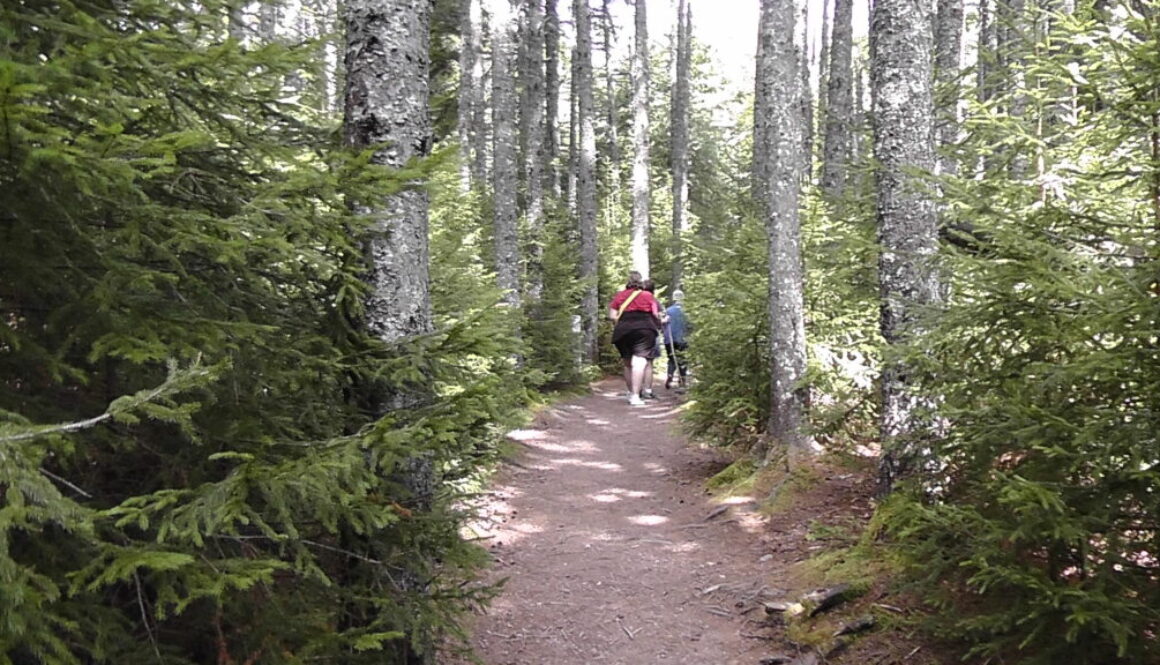
1. Williams Falls – Mount Carleton Provincial Park
Kouchibouguac Bog Trail
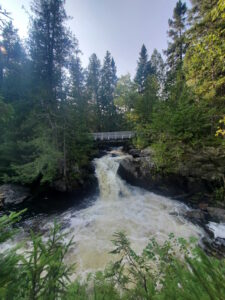
Williams Falls is located in Mount Carleton Provincial Park. The park is home to the highest peak in the Maritimes and attracts many hikers. Mount Carleton is part of the Canadian Appalachian Mountains and is habitat for many New Brunswick animals. Williams Falls is a short 0.5km hike that leads to a beautiful view of the falls over a bridge and an additional platform for added views. This trail is noted to be accessible for some and takes around 20 minutes to complete out and back. Dogs are welcome as long as they are on a leash and the park entry fee for one vehicle is $13.04. This trail is a perfect opportunity to check out the natural beauty in Mount Carleton Provincial Park without embarking on a hike up the mountain!
2. Beaver Pond trail – Mactaquac Provincial Park
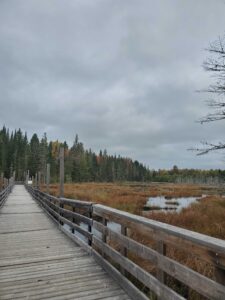
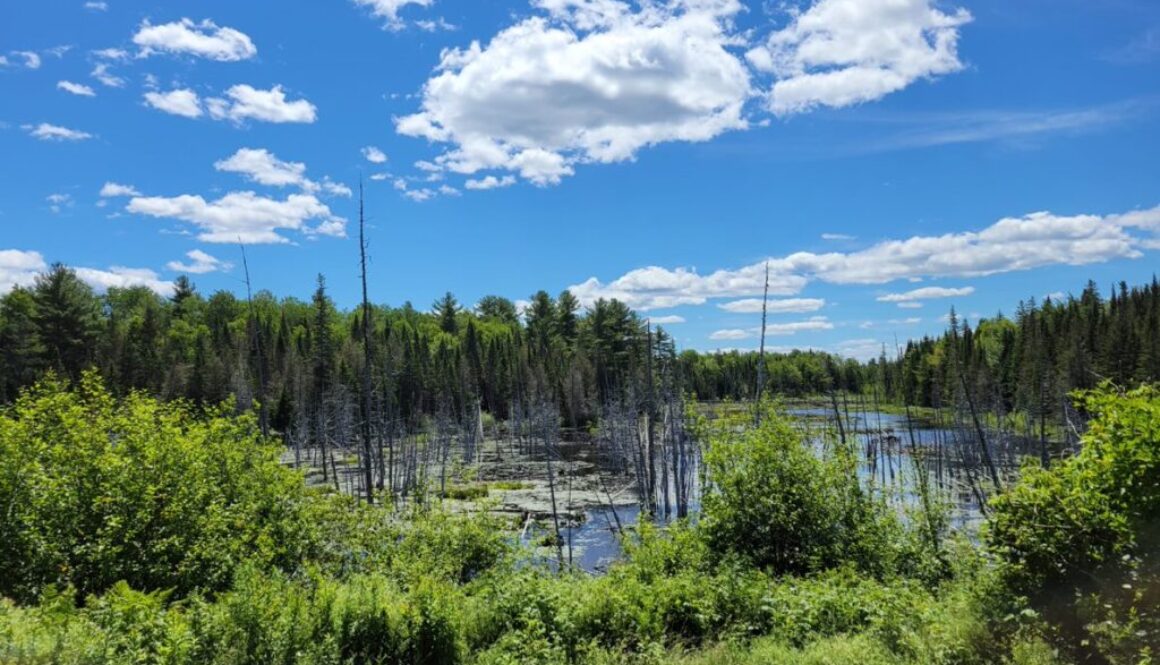
The Mactaquac Beaver Pond trail is a 1km loop around a beautiful beaver pond, and home to amphibians like bull frogs and green frogs, as well as breathtaking views of beaver lodges. Enjoy looking out onto Fall colours while walking the boardwalk along this trail. The walk takes roughly a half hour, and no park entry fees are required. Stop for a picnic at the shelter and be sure to take some time to listen to the ample bird calls around the pond. Dogs are welcome on a leash and this trail is noted to be accessible for some.
3. Bog trail – Kouchibouguac
Dickson Falls, by Kristen Hopkins
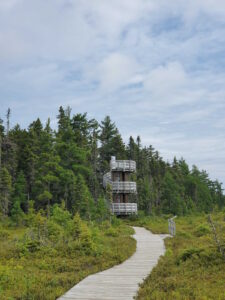
Kouchibouguac National Park is known for magnificent sand dunes off the shore of vibrant ocean waters, but the hike that we suggest highlights another neat feature: a peat bog. Peat bogs are often home to carnivorous plants like pitcher plants, as well as sphagnum moss. They also prevent flooding and store carbon dioxide, making them climate superheroes. The peat bog trail is roughly 2km out and back and takes between 45 minutes – 1 hour. Please note that dogs are welcome on a leash and there is a section of the trail that contains stairs leading to a lookout point. The daily park entrance fee for a family/group is $8.50 in the Fall season.
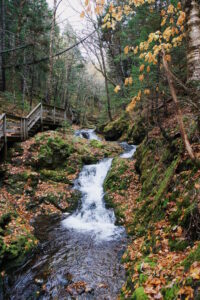
4. Dickson Falls – Fundy National Park
Dickson Falls is the most popular hiking trail at Fundy National Park. The trail is a 1.5km loop estimated to take 30 minutes. Fundy National Park is home to beautiful cliffside views of coastal forests and the renowned Bay of Fundy. The rich forests in the park are essential habitats for creatures like chipmunks, deer, and black bears. This particular hike follows the Dickson Brook and leads to a breathtaking lookout of the 9-meter-high falls over a stunning mossy background. Dogs are welcome on a leash, and please note this hike contains stairs. The fee for daily admission to Fundy National Park is $16.75 for a group.
5. Chitticks Beach Trail – New River Beach
Chitticks Beach, by Kristen Hopkins
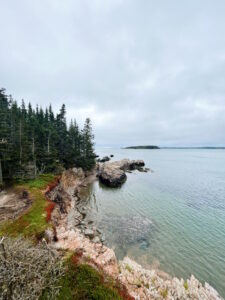
The Chitticks Beach trail is a 2km loop and is part of the longer Barnaby Head trail where lookout points of the extraordinary Bay of Fundy are plentiful. Remarkable cliffside lookout points offer views of the bay, coastal forests and sea creatures like harbour seals and porpoises. This trail also features a stunning bog with a boardwalk. Chitticks Beach trail is a short drive from the main beach at New River Beach Provincial Park, the entrance fee for one vehicle is $13.04, and dogs are welcome on a leash.
Looking for a challenge? Perhaps you are feeling confident in your hiking and are looking for a longer trip. Consider hiking past Chitticks Beach to complete the entire Barnaby Head trail as a day trip! This 5km hike can take upwards of 2 hours and is perfect for ambitious novice hikers.
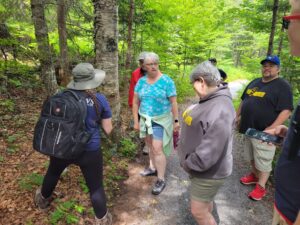
Fall is a perfect season to get outside and explore the beautiful scenery in New Brunswick. We hope that these suggestions inspire you to organize a hike this Fall season. Remember to select hikes that are at an appropriate level of challenge for you and to bring everything you will need along with you. We also recommend hiking with a buddy or group, and to stay tuned to our events page in the future for more nature walks led by CPAWS NB staff. Happy hiking!
Summer weather is here in New Brunswick, which brings many opportunities to get out and explore nature! There are so many different ways that we can connect to nature, but one of our favorite ways at CPAWS NB is to go on a ‘Five Senses nature walk’ and use all our senses to explore natural areas around us.
You might think you know all there is to know about in your favorite park, but when you take the time to slow down, you will be amazed at how many incredible details are hiding, that require just a little closer look. Whether you live along the coast, near a bog or wetland, or in the middle of the Wabanaki/Acadian forest, next time you’re out for a walk try these tips!
See
Sight is one of the most used senses, but we rarely take the time to take a closer look at the natural world around us. Next time you are out in nature, focus on the beautiful and intricate details of the plants, insects, and water around you.
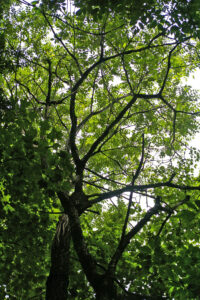
While many trees might look similar at first glance, each tree species has its own unique characteristics to tell it apart from the others. You don’t need to be an expert to notice what makes the many trees in New Brunswick unique!
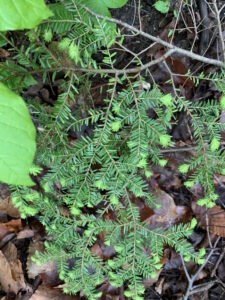
Can you see the different shades of green on the trees? On many coniferous trees (trees with needles) the new growth each spring is a lighter or more vibrant shade of green, which will darken over the summer and rest of the year before it begins the new growth process over again.
Taking a closer look at the bark will also reveal unique patterns that can tell you more about the tree’s health, growth and if there are any insects or animals living on or in the tree.
Looking at the plants around you, are you able to see the growth pattern of the flowers or leaves? Some plants will have leaves on each side, while others will grow in a spiral around the stem.
Consider bringing an identification book or use the iNaturalist app to ID the plants you have observed.
Touch
Our sense of touch is used less often when we are outside. However, there are many ways that you can use touch to explore and learn more about the nature around you!
If it is safe to do so, explore how the water feels on your hands or feet. What is the water temperature – is it the same temperature at the shore and when you are in deeper water?
Touch is also a great way to explore the trees around you:
How do the leaves on deciduous trees feel?
How do the needles on coniferous trees feel? Some needles can be soft while others are more pointy. Is there a difference feeling between older growth and the new growth on the tree?
Can you feel the differences between the bark on the trees?
Do any trees have sap or a sticky residue on their needles or bark?
When touching any plants or trees, be careful not to hurt the plant, remove and leaves or break of any branches or other parts of the plant. And it is important that you DO NOT touch any animals and give them lots of space!
Photo by Eric Prouzet
Smell
Our sense of smell can often be strong when we are out in nature, but with so many fragrant flowers, the smell of salt water near the ocean, or fresh buds of new growth on trees and plants, it can sometimes be hard to identify what we are smelling. Animals use their sense of smell to find food, to know if there is a predator or danger in the area, and to communicate with each other. And we can too!
Next time you are out in nature, take the time to get up close to smell different trees and plants.
Can you smell the difference between different species of trees. Do deciduous and coniferous trees smell the same or different? Does the scent remind you of a favorite food, or holiday, or place you love to visit?
Animals can also leave behind a scent that can tell us they are near!
Finally, can you use your sense of smell to know how close you are to the ocean? Scent can bring back a lot of memories, and can remind us of past experiences outside, or help us to build new memories made in nature.
Taste
Exploring nature through your sense of taste can be a little trickier than the other senses. While there are many edible plants, others can make you sick, or are toxic for humans to eat.
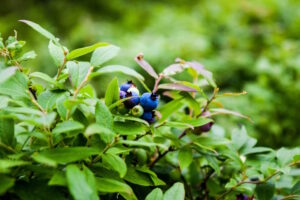
Many different types of tree needles can be made into a tea and berries make a tasty snack along the trail.
Before you taste anything while you are out in nature, it is very important that you are 100% sure you know what it is, and if the plant is edible! If you want to explore your sense of taste, pick up an edible plants or foraging guide from your local library or bookstore.
Photo by Kristen Hopkins
Hear
Finally, next time you are out in nature take the time to focus on the sounds around you! Our days are often filled with human-made sounds, like cars, construction, or music, and it can sometimes be hard to hear the sounds of nature around us. Pick a spot to be still and just listen to what is around you.
You might hear different animal calls. Depending on the type of habitat you are in, you might hear insects, birds, frogs, or larger animals like moose or coyotes. Each species has its own distinct call to be able to communicate with others, find a mate, and warn about danger in the area.
Can you identify what type of birds or frogs you might be listening too, based on their calls? Helpful apps like the Merlin app that can help you identify what birds are around!
What other sounds can you hear that you might not pick up at first?
What does the wind sound like amongst the trees?
Can you hear any water flowing or crashing into the shore?
Are there any animals moving around you? Can you hear how they move through the forest?
There are so many sounds we naturally tune out, and you might even experience the sounds of nature becoming louder the longer you listen.
Conclusion
This summer, take some time to explore the natural areas around you in a new way! If you go on a Five Senses walk, share your discoveries by tagging @CPAWS NB.
Follow CPAWS NB on social media for more ideas on how you can explore the nature around you, learn more about NB wildlife, and learn about ways that you can take action to help natural areas in New Brunswick.
As the seasons transition from spring to summer, people across New Brunswick flock to parks to experience beautiful beaches, lakes and rivers, and tranquil forests. Here at CPAWS NB, we are preparing for a summer full of Get Outside! events and we have welcomed two eager and passionate students to our team, to help bring these activities to a park near you!
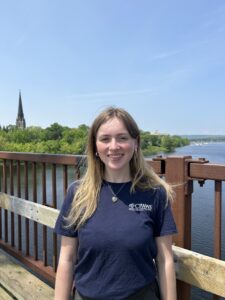
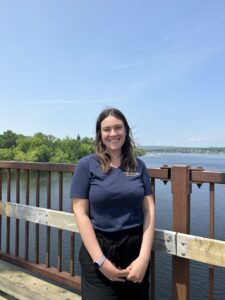
Without further ado, let us introduce Maddie and Kristen! With these two around, you will be able to feel their enthusiasm and love for nature. They are excited to share how they feel connected to nature, and why they feel so passionate about the environment.
About Maddie:
My name is Madeline Yerxa, and I am thrilled to be working with CPAWS NB this summer. I am from Fredericton, New Brunswick and entering my third year of Environment and Natural Resources with a major in wildlife conservation at the University of New Brunswick (UNB). My favourite things to learn about are wildlife ecology and environmental sociology. I am passionate about outdoor education and have spent the past five summers instructing youth in camping skills and earth education. I love to spend time in nature, whether that is on a canoe trip, going for a hike or sitting outside for a while – nothing compares to how I feel when I am outside. I am grateful that I can spend this summer working outdoors with the GetOutside! NB program. I believe that the outdoors is for everyone, and I am looking forward to creating a safe space for all to connect with nature this summer.
About Kristen:
My name is Kristen Hopkins. I am originally from the small town of Lunenburg, Nova Scotia. Having grown up with the outdoors as the backdrop for my childhood and am a lover of hiking, camping, nature photography and strolls along beautiful beaches with my dog(s). I am a passionate student working towards my BSc. Environmental Management (EM) with a major in People, Policy and Planning, as well as my BSc. Forestry at UNB. I am particularly interested in the social aspects of environmental issues and solutions. For my capstone project of my EM undergraduate degree, I worked with the Native Women’s Association of Canada to design an agroforest for the Wabanaki Resiliency Lodge in the Village of Gagetown, New Brunswick. I am a firm believer that we all have a connection to nature, but sometimes that connection is more of a challenge to experience when individuals lack access to, or awareness of local nature. I am so excited to be working with the CPAWS NB team to learn how to facilitate connections to nature for others.
What experiences have led to your passion for this field of work?
Maddie – I feel fortunate to have grown up surrounded by the beautiful wilderness of New Brunswick. I also feel fortunate to have learned through my studies how unique the Wabanaki forest is. My passion for protecting New Brunswick’s natural spaces has grown from learning and spending time in nature. Through working as an earth educator in the past, I have also developed a passion for outdoor education. Watching individuals flourish in these programs has made me aware of how crucial nature education is in conservation work – after all, our lived experiences in nature are what drives our passion to protect it!
Kristen – My passion for nature was initially sparked by the connections I felt with animals – my pets first, and then wildlife. This passion grew as I spent more time experiencing nature and wildlife. When I was 16 years old, I was lucky enough to go on a trip to Alberta and see the Rocky Mountains for the first time. On this trip, I also met someone who told me they had never gotten to see or touch the ocean for themselves. Growing up by the ocean, I had never realized how much I took it for granted. To this day, I feel that this was a pivotal point in the development of my passion for conservation, and when I returned home, I began to see the world very differently. I also became very attached to a specific conservation campaign – Jumbo Wild, which advanced my passion for nature and helped me decide that I wanted to learn more about conservation in university. It has also solidified my understanding of the importance of collaborating with Indigenous nations and has opened my eyes to the need for reconciliation in Canada and the opportunity offered to work towards this as part of the work I will do in conservation.
All of this has led me to who and where I am now. I believe that each time in nature is a different experience and a new reconnection, which is why it is so important to help people learn to care about protecting nature. I am incredibly thankful to have had these experiences. I cannot express enough how important it is for all of us to learn how we connect to nature in our own ways, for our own health and for the health of the natural world.
What is your favourite part about working for CPAWS NB? / What are you most looking forward to as a CPAWS NB summer student?
Maddie – I am thrilled to be representing such an incredible organization that gives New Brunswickers the tools to take action and protect the wilderness they love and need. As a young person, I often feel overwhelmed when it comes to speaking up for nature. In the past, I have felt that my voice was insignificant in the grand scheme of things, and that it was pointless to stand up for what I believed in. In my short time working with CPAWS NB, I already feel like that idea has been proven wrong, and now, more than ever, I feel empowered to act and protect the spaces I care about. I also think that it is very special to be in a position that can inspire people to connect with nature. I am a firm believer that nature can be enjoyed by anyone. I am looking forward to a summer filled with GetOutside! NB activities and encouraging participants of all ages and backgrounds to connect with nature!
Kristen – CPAWS NB is a wonderful organization for many reasons and is an ENGO that I have admired since I entered the conservation world as a student. I like to think of my position with CPAWS as having the responsibility to spread love and passion for nature, and to provide the necessary education and awareness to hold this passion safely and responsibly. Everyone deserves to feel connected to nature, and nature deserves to have a voice. Through the Get Outside! NB program, CPAWS NB helps people understand that they can be part of this voice, and that wildlife and nature in New Brunswick needs them to speak up. There are so many opportunities planned in the Get Outside! NB schedule where Maddie and I will get to share this important message and learn more about conservation in New Brunswick from the rest of the team. I am so excited to be a part of this work and to have this experience!
What is your favourite way to enjoy nature in New Brunswick?
Maddie – I enjoy nature in New Brunswick in many ways! I absolutely love camping – overnight hiking and canoe trips are always my favourite camping trips! On beautiful sunny days, my friends and I also like to hunt for waterfalls. I love to practice identifying plants and sharing that knowledge with friends and family. I find this helps me connect with nature and is a way for me to share my appreciation of this province with people I care about. Above all, I love relaxing, breathing, and exploring all of my senses in nature.
As someone who has lived here her whole life, it is sometimes easy to take this province for granted. That is why I love to discover new places in New Brunswick, whether that is sightseeing, camping, or hiking. This province never ceases to amaze me, and I am always finding something new to love about New Brunswick.
Kristen – I love going on hikes with an awesome view at the end or meditative strolls along quiet trails in nature, always with my border collie, Rory! Every province in Canada has its own unique nature which I think is beautiful. I also think it is very important to experience this nature for myself, so I can maintain and develop new connections, which will in turn fuel my love and desire to protect nature. My dog and I are both lovers of the beach and other coastal adventures. I am looking forward to experiencing some of New Brunswick’s provincial and national parks for the first time as well this summer!
Watch for our CPAWS NB team at provincial parks across the province this summer! If you haven’t already, check out the Get Outside! NB summer programming schedule. We can’t wait to see you out in nature this summer!
N.B. conservation groups call on provincial government to commit to transparent and integrated forest management strategy rooted in biodiversity, conservation, Indigenous co-stewardship, and ecological forestry practices
Traditional territory of the Wabanaki Peoples/Fredericton — As New Brunswick hosts forest ministers from across the country in St. Andrews this week, conservation groups are calling on the provincial government to step into its leadership role and fulfill previous commitments to climate action for forests, conservation targets, biodiversity and sustainable logging. This needs to be done through one integrated, ecologically-based management strategy for the forests of New Brunswick, with transparent consultation and engagement of Indigenous people and the public.
The organizations—the Canadian Parks and Wilderness Society-New Brunswick Chapter, Nature Trust of New Brunswick, Conservation Council of New Brunswick, and Nature NB—are united in the belief that New Brunswick needs a new way to manage the forests that surround us and support us all. The development of an ecological forestry strategy for Crown forest management should be achieved through a cohesive public process driven by strategies and initiatives already promised or underway by the provincial government, including:
Photo by Jamie SimpsonA state of the forest report promised since 2016, and most recently committed for release by April 2023, as a starting point for forest conditions and how well it is meeting the needs of nature and people;
The updated climate action plan committed to renewing the nearly 14-year-old Biodiversity Strategy by 2025, publishing an assessment of the carbon stock value of N.B.’s forests and wetlands by 2025, and setting a new protected areas target by 2024;
A new Private Woodlot Sustainability Act with commitments to new funding to support woodlot owners in managing private forests; and,
A Crown forest advisory board that will involve experts representing the diversity of public values to guide the direction of forest management.
If New Brunswick updates the province’s forestry strategy separate from these other critical and related commitments, we risk a strategy that is patchy, ineffective and nothing more than a tree-cutting plan.
Conservation groups call for significant reduction in clear-cuts, elimination of glyphosate-based herbicides in forests, legislated targets for increasing selective cutting, new protected areas to safeguard wildlife habitat, and provision of more fairness and opportunity for private woodlot owners and Indigenous communities. These steps would go a long way toward addressing the failures of New Brunswick’s current, old-fashioned and big industry-favored approach to Crown forest management.
“The loss of plants and animals around the world and in our own woods is staggering, and we can no longer ignore the need for change. New Brunswick has an opportunity to be a leader in sustainable forest management by developing a new strategy framed by biodiversity and conservation goals,” says Stephanie Merrill, Chief Executive Officer of the Nature Trust of New Brunswick. “It is critical that government works together with Indigenous Nations and private woodlot owners to set ourselves on a path toward healthy, climate-resilient forests. These rich habitats are the foundation of our communities and provide refuge for the species we cherish in our province. It’s time to manage them in a way that ensures they remain forests for everyone.”
“The critical goals for a forest management strategy are to ensure New Brunswick does its part to halt and reverse nature loss, to protect more diverse forest and wetlands, and to be fair with Indigenous communities, private woodlot owners and recreational forest users, in addition to promoting a sustainable timber industry,” says Roberta Clowater, Executive Director of the Canadian Parks and Wilderness Society-NB Chapter. “If the province develops a new forest management strategy separate from nature and climate strategies, it will be doomed to fail the forest, its critters, and New Brunswickers.”
“Peer-reviewed research led by University of New Brunswick scientists and published last month in Nature found that a diverse, mixedwood forest is significantly better than monoculture softwood plantations at storing carbon, a crucial element and commitment of the government’s climate change mitigation work,” says Louise Comeau, Co-Executive Director of the Conservation Council of New Brunswick. “A healthy Wabanaki/Acadian forest is an asset when it comes to climate action in New Brunswick—it should be protected as such.”
“This government has shown a strong commitment to protecting nature by meeting its promise to double protected areas to 10 per cent late last year, but there’s still so much more we need to do to meet the historic nature protection goals established last December when Montreal hosted the U.N.’s global biodiversity conference,” says Vanessa Roy-McDougall, Executive Director of Nature NB. “Let’s build on the momentum of New Brunswick’s Nature Legacy program and chart a course for meeting the international target of protecting 30 per cent of lands and waters by 2030.”
Clowater and Merrill are in St. Andrews today and Tuesday to participate in Forest Forum sessions and are available for interviews.
-30-
QUICK FACTS
Public opinion polling conducted by Oracle for Research in 2022 showed that 75 per cent of New Brunswickers support reviewing the Crown Lands and Forests Act to establish a new, ecologically-based forestry system in New Brunswick. Seventy-eight per cent want N.B. to match the federal government commitment to protect 25 per cent for nature by 2025.
Even with newly-created Crown conserved areas established in 2022 that doubled protected areas to 10 per cent, New Brunswick still ranks close to last in the country in terms of the proportion of legally-binding conservation land within its borders.
The Standing Committee on Climate Change and Environmental Stewardship’s November 2021 report to the legislature recommended implementing a combination of ecological forestry and new, interconnected protected areas to ensure New Brunswick’s remaining deciduous and mixed forests are not converted to softwood plantations.
The N.B. Auditor General reported in 2015 and again in 2021 that around 80 per cent of the Crown forest is harvested by clearcut while selective and partial cuts decline significantly, even though the latter methods are recognized as best management practices because they protect wetlands and waterways, wildlife habitat, and preserve a healthy range of plant and animal life in the woods.
In 2022, glyphosate-based herbicide spraying on New Brunswick’s Crown forest was up 30 per cent compared to 2005 levels, according to data from the National Forestry Database and GeoNB.
In 2016, New Brunswick’s Chief Medical Officer of Health’s Action Plan on Glyphosate found that New Brunswick uses more glyphosate per hectare of harvested forest than any province in Canada.
New Brunswick’s updated climate action plan, released September 2022, committed to updating the Biodiversity Strategy by 2025, publishing an assessment of the carbon stock value of N.B.’s forests and wetlands by 2025 (including regular tracking and reporting on the forest’s carbon value), and setting a new protected areas target by 2024.
New peer-reviewed research led by UNB scientists shows that a functionally-diverse and evenly-mixed forest, such as the natural, mixed coniferous/deciduous Wabanaki/Acadian forest, can enhance mineral soil carbon sequestration by up to 32 per cent and nitrogen sequestration by up to 50 per cent, highlighting the importance of conserving and promoting forest biodiversity for mitigating climate change.
MEDIA CONTACTS:
Roberta Clowater, Canadian Parks and Wilderness Society – NB Chapter | rclowater@cpaws.org | (506) 449-5106
Des groupes de conservation du N.-B. demandent au gouvernement provincial de s’engager à mettre en place une stratégie de gestion forestière transparente et intégrée, ancrée dans la biodiversité, la conservation, la co-gérance autochtone et les pratiques forestières écologiques.
Territoire traditionnel des peuples Wabanaki/Fredericton — Alors que le Nouveau-Brunswick accueille cette semaine à St. Andrews les ministres des forêts de tout le pays, des groupes de conservation demandent au gouvernement provincial d’assumer son rôle de chef de file et de respecter ses engagements antérieurs en matière d’action climatique pour les forêts, d’objectifs de conservation, de biodiversité et d’exploitation forestière durable. Cela doit se faire par le biais d’une stratégie de gestion intégrée et écologique pour les forêts du Nouveau-Brunswick, avec consultation et engagement transparents auprès des peuples autochtones et du public.
Les organisations – la Société pour la nature et les parcs du Canada – section du Nouveau-Brunswick, la Fondation pour la protection des sites naturels du Nouveau-Brunswick, le Conseil de conservation du Nouveau-Brunswick et Nature NB – sont unies dans la conviction que le Nouveau-Brunswick a besoin d’une nouvelle façon de gérer les forêts qui nous entourent et qui nous soutiennent tous. L’élaboration d’une stratégie de foresterie écologique pour la gestion des forêts de la Couronne devrait se faire par le biais d’un processus public cohésif axé sur les stratégies et les initiatives déjà promises ou en cours par le gouvernement provincial, notamment :
Photo by Jamie SimpsonUn rapport sur l’état des forêts, promis depuis 2016 et dont la plus récente publication était prévue pour avril 2023, servira de point de départ pour évaluer l’état des forêts et la mesure dans laquelle elles répondent aux besoins de la nature et des gens ;
Le plan d’action sur les changements climatiques mis à jour s’est engagé à renouveler la stratégie sur la biodiversité qui date de près de 14 ans d’ici 2025, à publier une évaluation de la valeur du stock de carbone des forêts et des terres humides du N.-B. d’ici 2025 et à fixer un nouvel objectif en matière d’aires protégées d’ici 2024 ;
Une nouvelle Loi sur la durabilité des terrains boisés avec des engagements de nouveaux financements pour aider les propriétaires de boisés à gérer les forêts privées; et,
Un conseil consultatif des forêts de la Couronne qui impliquera des experts représentant la diversité des valeurs publiques afin de guider l’orientation de la gestion forestière.
Si le Nouveau-Brunswick met à jour la stratégie forestière de la province sans tenir compte de ces autres engagements essentiels et connexes, nous risquons d’avoir une stratégie disparate, inefficace et qui n’est rien d’autre qu’un plan de coupe d’arbres.
Les groupes de conservation demandent une réduction significative des coupes à blanc, l’élimination des herbicides à base de glyphosate dans les forêts, des objectifs légiférés pour augmenter la coupe sélective, de nouvelles aires protégées pour sauvegarder l’habitat de la faune et de la flore, et plus d’équité et d’opportunités pour les propriétaires de boisés privés et les communautés autochtones. Ces mesures contribueraient grandement à remédier aux échecs de l’approche actuelle de la gestion des forêts de la Couronne au Nouveau-Brunswick, une approche démodée qui favorise les grandes industries.
« La perte de plantes et d’animaux dans le monde entier et dans nos propres forêts est énorme, et nous ne pouvons plus ignorer la nécessité d’un changement. Le Nouveau-Brunswick a l’occasion d’être un chef de file en matière de gestion durable des forêts en élaborant une nouvelle stratégie encadrée par des objectifs de biodiversité et de conservation, » déclare Stephanie Merrill, directrice générale de la Fondation pour la protection des sites naturels du Nouveau-Brunswick. « Il est essentiel que le gouvernement collabore avec les nations autochtones et les propriétaires de boisés privés pour nous mettre sur la voie de forêts saines et résilientes aux changements climatiques. Ces riches habitats sont la base de nos communautés et servent de refuge aux espèces que nous chérissons dans notre province. Il est temps de les gérer de manière à ce qu’ils restent des forêts pour tout le monde. »
« Les objectifs essentiels d’une stratégie de gestion forestière sont de veiller à ce que le Nouveau-Brunswick fasse sa part pour arrêter et inverser la perte de nature, pour protéger des forêts et des terres humides plus diversifiées, et pour être juste avec les communautés autochtones, les propriétaires de boisés privés et les utilisateurs récréatifs des forêts, en plus de promouvoir une industrie du bois durable, » déclare Roberta Clowater, directrice exécutive de la Société pour la nature et les parcs du Canada – Section N.-B. « Si la province élabore une nouvelle stratégie de gestion forestière distincte des stratégies relatives à la nature et au climat, elle sera vouée à l’échec pour la forêt, ses animaux et les Néo-Brunswickois. »
« Une recherche évaluée par un comité de lecture, menée par des scientifiques de l’Université du Nouveau-Brunswick et publiée le mois dernier dans Nature, a révélé qu’une forêt mixte diversifiée est nettement meilleure que les plantations de résineux en monoculture pour stocker le carbone, un élément crucial et un engagement du travail d’atténuation des changements climatiques du gouvernement, » déclare Louise Comeau, codirectrice exécutive du Conseil de conservation du Nouveau-Brunswick. « Une forêt Wabanaki/acadienne saine est un atout pour l’action climatique au Nouveau-Brunswick et doit être protégée en tant que telle. »
« Le gouvernement a fait preuve d’un engagement ferme à l’égard de la protection de la nature en respectant sa promesse de doubler le nombre d’aires protégées à 10 % à la fin de l’année dernière, mais il reste encore beaucoup à faire pour atteindre les objectifs historiques de protection de la nature établis en décembre dernier lorsque Montréal a accueilli la conférence mondiale de l’ONU sur la biodiversité, » déclare Vanessa Roy-McDougall, directrice générale de Nature NB. « Tirons parti de l’élan du programme Patrimoine naturel du Nouveau-Brunswick et traçons la voie pour atteindre l’objectif international de protection de 30 % des terres et des eaux d’ici 2030. »
Clowater et Merrill sont à St. Andrews aujourd’hui et mardi pour participer aux sessions du Forum forestier et sont disponibles pour des entrevues.
-30-
FAITS EN BREF
Un sondage d’opinion mené par Oracle for Research en 2022 a montré que 75 % des Néo-Brunswickois sont favorables à la révision de la Loi sur les terres et forêts de la Couronne afin d’établir un nouveau système forestier écologique au Nouveau-Brunswick. Soixante-dix-huit pour cent souhaitent que le Nouveau-Brunswick respecte l’engagement du gouvernement fédéral de protéger 25 % de son territoire pour la nature d’ici 2025.
Même avec les nouvelles zones de conservation de la Couronne créées en 2022 qui ont doublé les aires protégées à 10 %, le Nouveau-Brunswick se classe toujours près de la dernière place au pays en termes de proportion de terres de conservation juridiquement contraignantes à l’intérieur de ses frontières.
Dans son rapport de novembre 2021 à l’Assemblée législative, le Comité permanent des changements climatiques et de l’intendance de l’environnement a recommandé la mise en œuvre d’une combinaison de foresterie écologique et de nouvelles zones protégées interconnectées pour veiller à ce que les forêts de feuillus et les forêts mixtes restantes du Nouveau-Brunswick ne soient pas converties en plantations de résineux.
Le vérificateur général du Nouveau-Brunswick a signalé en 2015, puis en 2021, qu’environ 80 % des forêts de la Couronne sont exploitées par coupe à blanc, tandis que les coupes sélectives et partielles diminuent considérablement, même si ces dernières méthodes sont reconnues comme des pratiques de gestion optimales parce qu’elles protègent les terres humides et les cours d’eau, l’habitat de la faune et préservent une gamme saine de plantes et d’animaux dans les bois.
En 2022, la pulvérisation d’herbicides à base de glyphosate sur les forêts de la Couronne du Nouveau-Brunswick a augmenté de 30 % par rapport aux niveaux de 2005, selon les données de la Base de données nationale sur les forêts et de GeoNB.
En 2016, le plan d’action sur le glyphosate du médecin hygiéniste en chef du Nouveau-Brunswick a révélé que le Nouveau-Brunswick utilise plus de glyphosate par hectare de forêt récoltée que n’importe quelle autre province du Canada.
Le plan d’action sur les changements climatiques révisé du Nouveau-Brunswick, publié en septembre 2022, s’est engagé à mettre à jour la stratégie sur la biodiversité d’ici 2025, à publier une évaluation de la valeur du stock de carbone des forêts et des terres humides du Nouveau-Brunswick d’ici 2025 (y compris un suivi et des rapports réguliers sur la valeur du carbone de la forêt), et à fixer un nouvel objectif en matière d’aires protégées d’ici 2024.
De nouvelles recherches évaluées par un comité de lecture et menées par des scientifiques de l’UNB montrent qu’une forêt fonctionnellement diversifiée et uniformément mélangée, telle que la forêt Wabanaki/acadienne naturelle et mixte, peut améliorer la séquestration du carbone dans le sol minéral jusqu’à 32 % et la séquestration de l’azote jusqu’à 50 %, ce qui souligne l’importance de la conservation et de la promotion de la biodiversité forestière pour atténuer les changements climatiques.
CONTACTS DES MÉDIAS:
Roberta Clowater, directrice exécutive de la Société pour la nature et les parcs du Canada – section N.-B | rclowater@cpaws.org | (506) 449-5106
Are you passionate about helping nature, but don’t know where to start? Here is a list of 7 ways to start this spring. This list is intended for those new to nature exploration or conservation advocacy.
1. Join us at the Parks and connect with Nature
One of the best ways to help nature is to first get to know nature! New Brunswick is full of natural beauty to explore, and our Provincial and Nationals Parks offer a safe way to explore many of the different habitats here in the province. CPAWS NB runs free* educational and family friendly activities throughout the summer. Here is the link to our schedule. For those with accessibility needs, New Brunswick parks do have accessibility features and equipment, visit Parks NB for details on what is available at each park. *Park admissions fees still apply.
2. Learn as you explore! – INaturalist
While exploring nature, you can learn as you go! INaturalist is a free app, available for both iPhone and Android, and allows the user to take photos and identify almost anything that can be found in nature. From fungi, trees, plants, birds, insects and more, INaturalist is a great tool to have while outdoors!
3. Support Indigenous Conservation
Indigenous lead conservation is crucial to the conservation of lands, waters, and everything in between. Supporting Indigenous conservation initiatives can look like volunteering for an event, contributing financially, educating yourself on Indigenous culture, supporting Indigenous Treaty rights, and voicing support when communities need it. For more information on how to be an ally of Indigenous led Conservation check out this guide by Land Needs Guardians.
4. We Can’t Wait Campaign
Another way to help nature is to get involved in the CPAWS’ “We Can’t Wait Campaign”. The campaign is designed to draw attention to the need protect at least 30% of land and ocean in Canada by 2023 and ensure the federal, provincial, and territorial governments deliver on this pledge! For more information or to sign the pledge please visit here.
5. Contact a Representative
Is there a specific nature issue you would like to see addressed? Write a letter, call, sign a petition, there are many ways to take action for nature. Check out CPAWS NB’s Speak Up for Nature Action Toolkit! This toolkit takes the guess work of how to contact an elected official and is a great tool for those who are new to political advocacy.
6. Share the Joy of Nature!
Talking about nature and why it is important to you is a powerful way to raise awareness about nature and all of the positive things that nature does for us. You can use platforms like social media, or simply have conversations with family and friends to share your favourite things about nature, like favourite places, favourite activities or favourite animals. Sharing your passion can help others spark their own interest in nature!
7. Make a donation
Financial contributions help fund the work we do to encourage governments to protect nature and to educate people of all ages about our connections to nature … and we make it go a long way. CPAWS NB spends over 90 percent of each dollar we raise on conservation and education. When you make a donation of $20 or more, you will receive the following benefits for one year: A tax receipt, two issues per year of our information-packed national newsletter, Canadian Wilderness and chapter newsletter, WildNB.
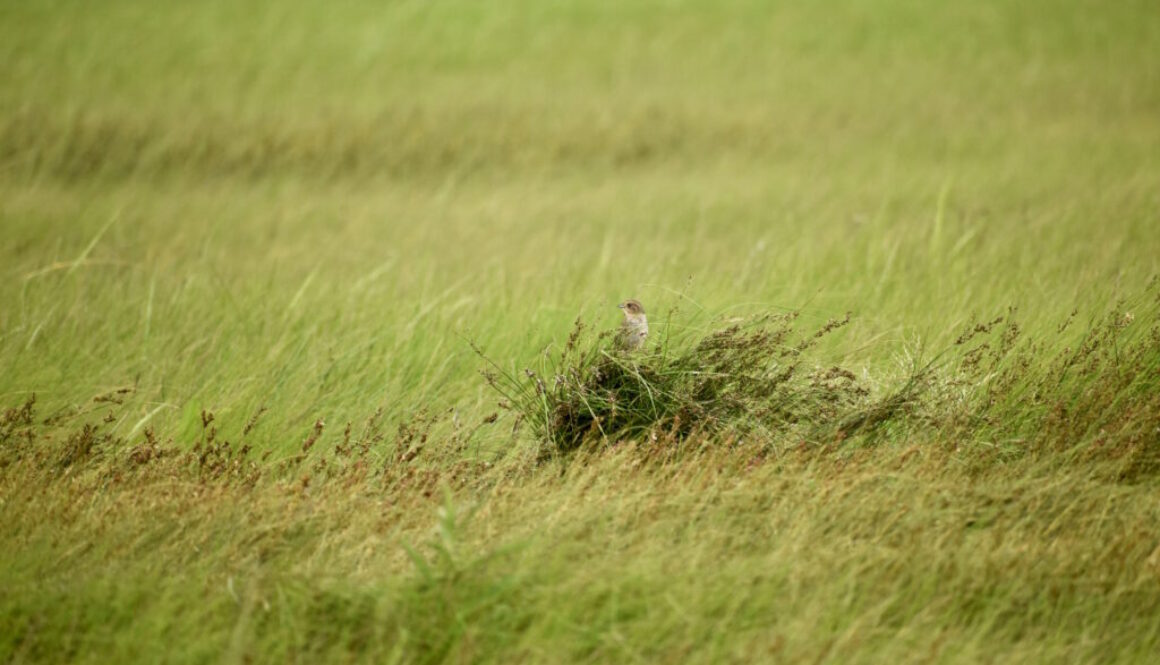
When you think about the wildlife of the Bay of Fundy, images of whales breaching in the ocean, seals sunbathing on the rocks, or flocks of shorebirds in the mudflats might come to mind. However, Kiirsti Owen – a PhD candidate at the University of New Brunswick and Acadia University – might picture a Nelson’s Sparrow darting through the grasses of the salt marshes that surround the Bay. Her research has brought her up-close to this cryptic species of songbird and she has become quite attuned to their unique traits.
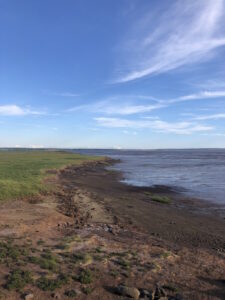
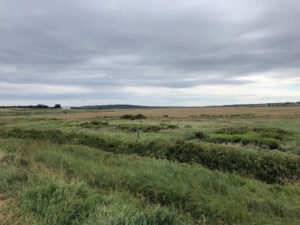
Where the Bay of Fundy meets the saltmarsh (Photo credit: Meghan Oliver)
“They’re not a very striking bird visually…but their sound is really cool!” explained Kiirsti. Their song is truly unique as it doesn’t sound like the melodic chirping of most birds. It was described to her as the noise a pop can makes when it opens, and that description has stuck.
Behaviour-wise, Nelson’s Sparrows aren’t quite bird-like either. They stay fairly low to the ground, and Kiirsti described their movements as more rodent than bird. They will often scurry around the grass and fly short distances before landing back into the thick vegetation.
As part of her doctoral research, Kiirsti has spent the last two summers studying these birds in the salt marshes near Sackville, New Brunswick, and this part of the province is the optimal area to address one of her main research questions: how do wetland birds use human-created landscapes? This is because of the prevalence of agriculture in the region. Dykes were constructed in parts of the salt marsh so the nutrient-rich soil could be used for farming, and the presence of both salt marshes and agricultural land allows Kiirsti to compare the ways that Nelson’s Sparrows use these natural and human-made landscapes, respectively.
Nelson’s Sparrows are typically considered a “salt marsh specialist”, meaning their breeding habitat is usually limited to salt marshes. However, this Maritime population of sparrows also nests in the agricultural land that lies inland, and Kiirsti isn’t sure why these birds choose to breed outside of the marsh.
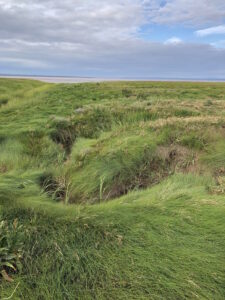
Saltmarsh (Photo credit: Meghan Oliver)
To investigate this, Kiirsti tracks the movements of Nelson’s Sparrows using radiotelemetry. In short, she attaches lightweight transmitters to the birds. Each transmitter emits a unique radio signal which can then be picked up by a handheld receiver. By trudging around the salt marsh and agricultural land, Kiirsti and her team can resight the birds and map their movements, ultimately revealing the habitats that the birds prefer.
Her days tracking birds can be long and demanding; in the height of the breeding season, her and her team wake up around 3:30 AM and are already busy at work before the sun comes up. The uneven terrain and abundance of water can make it difficult to navigate around her study sites, but Kiirsti’s fondness for the salt marshes and the sparrows that are able to subsist there is incredibly apparent.
“Salt marshes look like such a benign landscape, but once you start working it you realize that this is a harsh environment,” she commented. “It takes a lot for something to be able to make it there.”
This challenge of surviving in such a salty environment would be difficult on its own, but the population of Nelson’s Sparrows that Kiirsti studies has the added difficulty of dealing with the high tides that are emblematic of the Bay of Fundy. When the tide comes in, the salt marsh can flood and the nests of the sparrows – which are on the ground – could be inundated. With water levels rising due to climate change, birds that nest in the salt marsh could have higher instances of nest failure due to flooding compared to those that nest in the agricultural land. As such, it will become increasingly important to understand the factors that determine how birds select nesting habitat.
Agricultural land (Photo credit: Meghan Oliver)
“Maybe the salt marsh is really important habitat now for Nelson’s Sparrows,” Kiirsti said, “but are they going to be successful 50 years from now in the same spots if the sea level keeps rising?”
While Kiirsti’s research highlights one way that the salt marshes of the Bay of Fundy are useful for wildlife, there are many more instances that illustrate the services that this ecosystem offers. Not only do they provide habitat for many organisms, but salt marshes also protect and stabilize coastlines, filter sediments and pollutants, sequester carbon, provide nutrients, and minimize the effects of ocean acidification on local areas. In fact, these coastal protection benefits may also help to mitigate the threats faced by the wildlife that use the salt marshes.
In a landscape facing agricultural development, restoration efforts, and a changing climate, studies like Kiirsti’s will allow us to understand how and why animals like the Nelson’s Sparrow use these salt marshes in the Bay of Fundy. While her current findings suggest that these birds prefer the salt marsh over human-made landscapes, it’s unclear if this affinity will change in the coming decades. However, the ecosystem services provided by salt marshes are clear, and by protecting these landscapes, we can in turn protect these benefits for the decades to come.
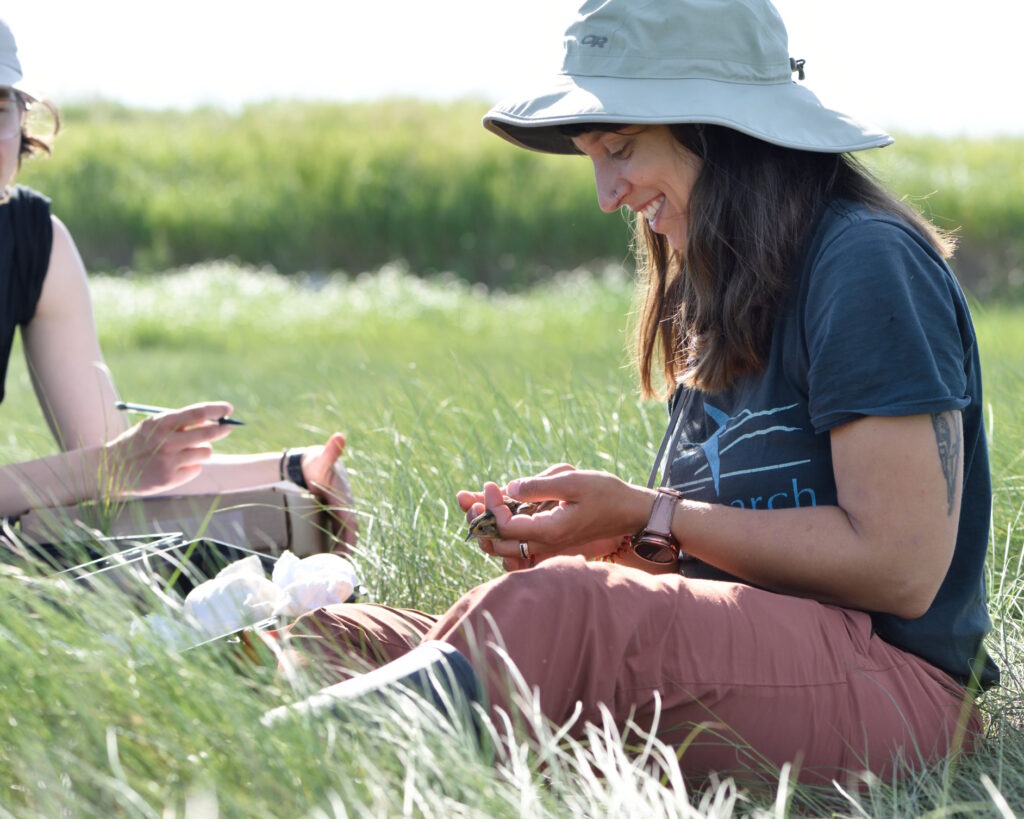
Kiirsti Owen holding a Nelson’s Sparrow. All birds are handled for research purposes and with all necessary permits. (Photo credit: Kirby Morrill)
Banner photo: A male Nelson’s Sparrow in the Beausejour Marsh near Sackville, NB. (Photo credit: Kiirsti Owen)
With the onset of cold weather and shorter days, the forests, covered in snow, may seem lifeless. Wildlife have found many ways to adapt to the harsh winter conditions. Some animals leave for warmer places, while others find a cozy den to hibernate in until warmer weather returns. However, some animals stay right under our noses. Just below our feet, under the snow, is teeming with life. Welcome to the Subnivean Zone!
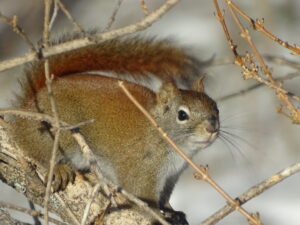
Red Squirrel by Steve Reid
What is the Subnivean Zone?
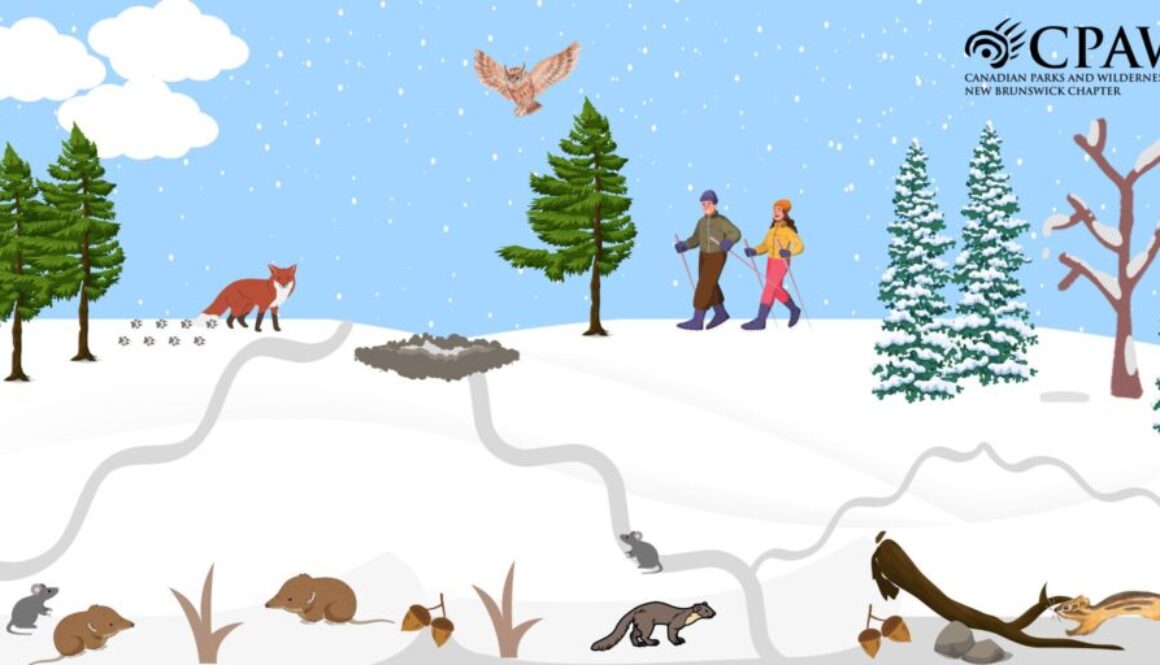
The space in between the snow and the ground is called the subnivean zone. The subnivean zone is formed in two ways:
As snow falls and it piles onto dense vegetation, rocks, branches and logs, the snow does not directly touch the ground. This makes a layer of space between the ground and snow.
The ground is warmer than the surrounding air because it gets heat from the earth’s core, causing the lowest layer of snow to turn from a solid into water vapour! The water vapour then re-freezes creating a hard roof-like structure with space underneath.
The hidden habitat is almost like an apartment building! The subnivean zone has a maze of tunnels and rooms, and it is not only used for shelter from the cold –some small mammals even use these spaces to store food, use the washroom, sleep, and even eat.
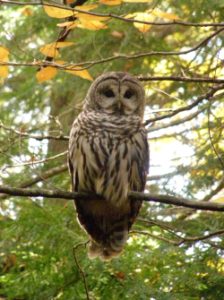
Barred Owl, photo by Steve Reid
Who lives in the Subnivean Zone?
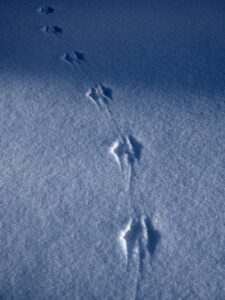
Many of New Brunswick’s small mammals use this hidden habitat. Chipmunks, Deer Mice, Shrews and Pine Marten, among many others. Without the Subnivean space, animals that stay throughout the winter months would have no home, no safe space to eat or sleep – it ultimately affects their survival.
Not only do small mammals rely on this habitat but larger mammals and birds like Foxes, Owls and Coyotes do, too. They can use their keen sense of hearing to find food in the subnivean zone, and this is an extremely important food source.
Climate Change and the Underground Habitat
Climate change is causing the weather to swing in extremes, especially in the winter months. An increase in warmer temperatures is causing less snowfall, and shorter winters.
The biggest threats that climate change poses to the subnivean zone are:
The length of time the Subnivean zone exists
The quality of habitat and shelter for the subnivean dwellers
Photo by Steve Reid
As the winters are getting warmer, the amount of precipitation coming down in the form of snow is decreasing and instead, is coming in the form of rain. Think of this as a “snow drought”. With a lack of snow, the subnivean dwellers do not have enough room to be underneath the snow and it can make them colder! Without the shelter of the habitat, they are vulnerable to cold temperatures and wind. Increasing rain and snow melt can also flood the tunnels and ruin food that has been stored under the snow.
Although the subnivean zone is under stress because of climate change, there is one important step that can help the animals – Protected Areas!
Protected Areas:
Provide enough space for wildlife to adapt to a changing environment.
Lessen the impacts of climate change.
Keep habitats connected and stop habitat loss.
Reduce the impact of extreme weather.
CPAWS New Brunswick works across the province to encourage our government to protect more nature through protected areas. Click here to learn more.




 See
See 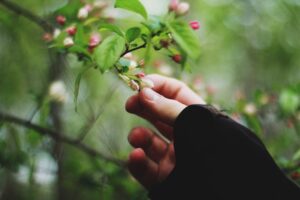 Touch
Touch 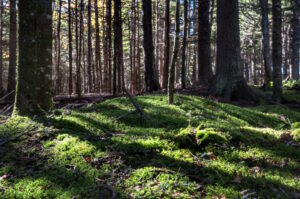
 Taste
Taste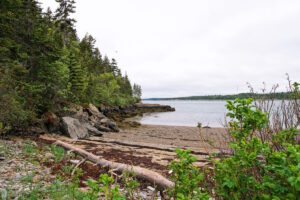
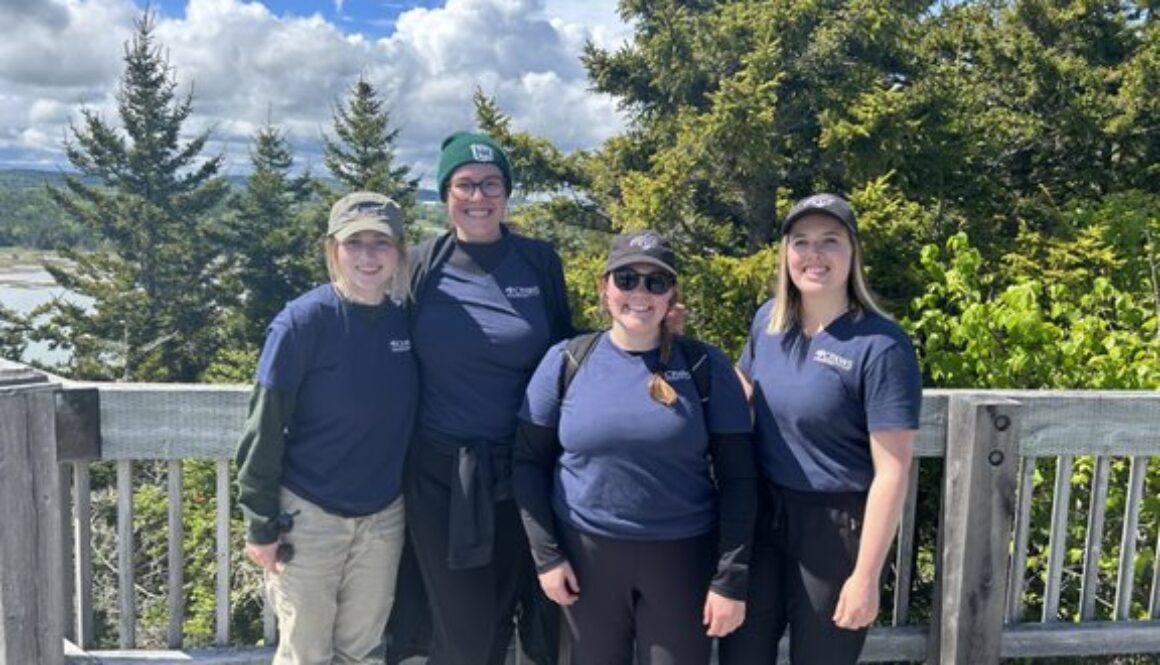
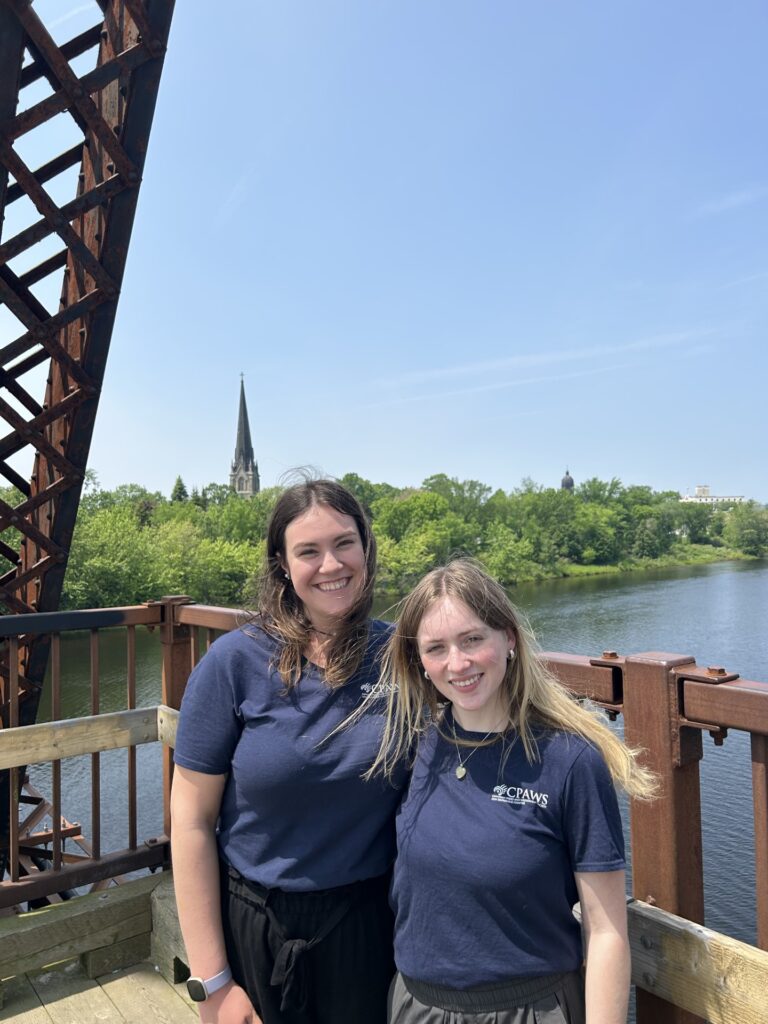 What is your favourite way to enjoy nature in New Brunswick?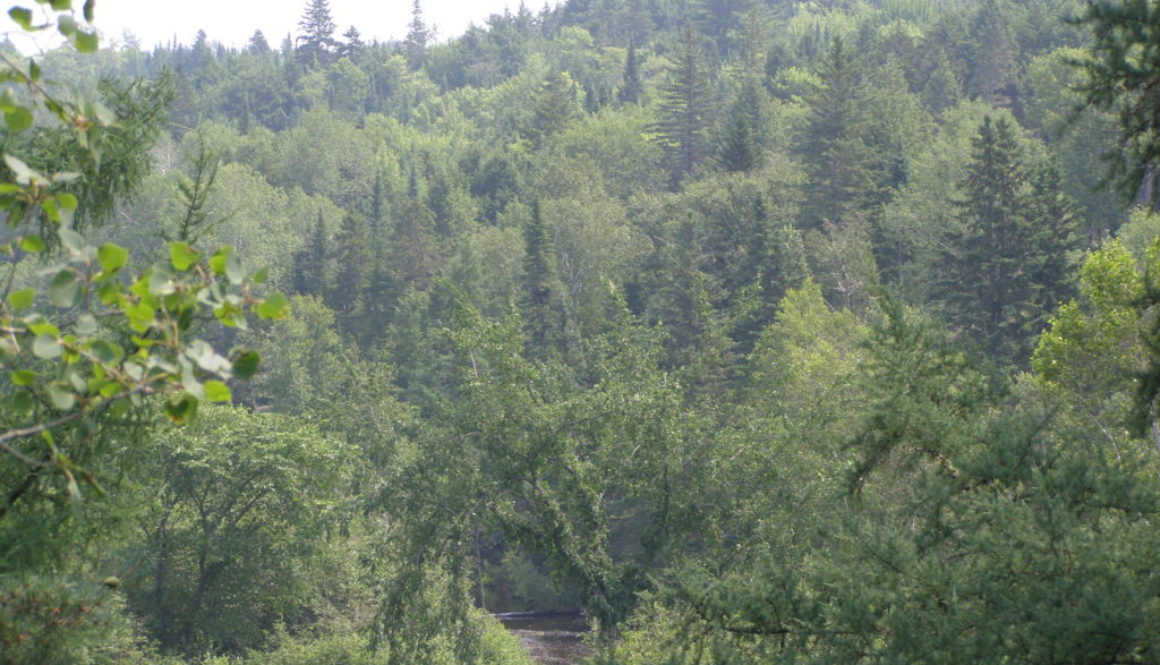
 3. Support Indigenous Conservation