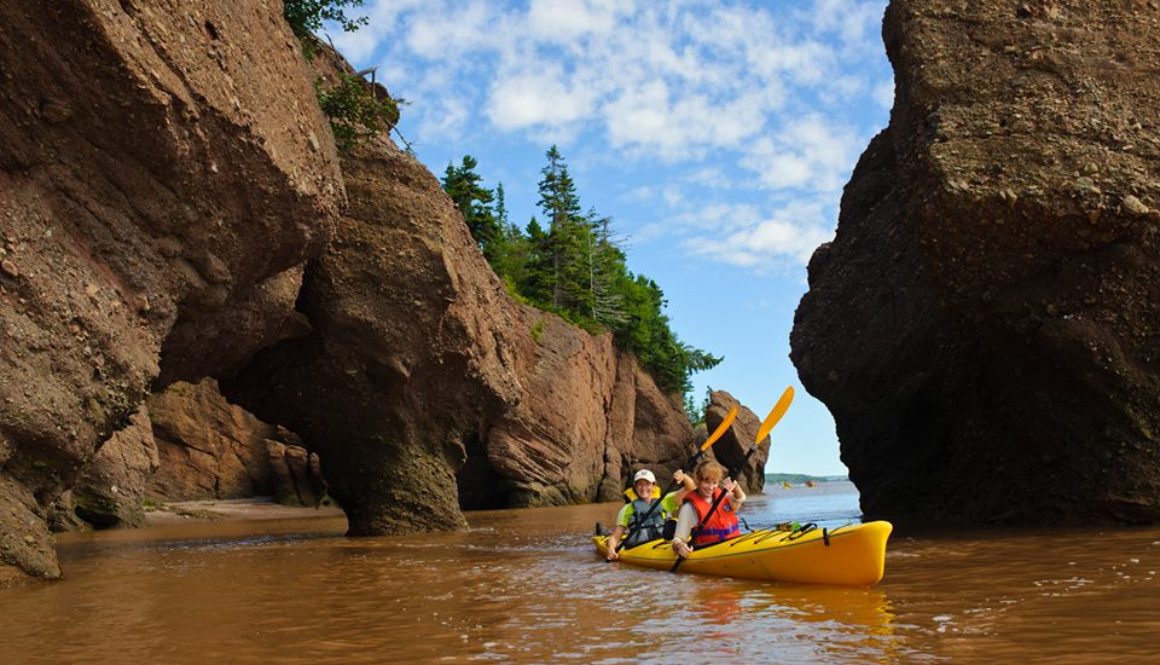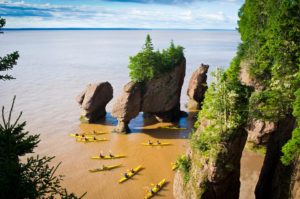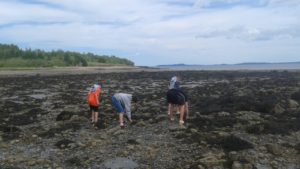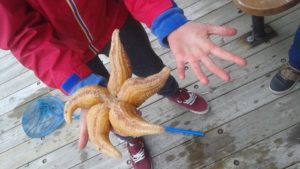

A deep breath of salty air, the shimmer of schooling sardines, the unmistakable sound of a whale’s blow: this is what comes to mind when I think of the Bay of Fundy. My Bay of Fundy. Our Bay of Fundy. As New Brunswickers, many of us have warm memories of the Bay, from enjoying the delicious catch of the day to exploring the ocean floor at low tide. We can all agree that the Bay of Fundy is a special place in our province, which is just one of many reasons why it should be protected! Read on as I highlight just five of the reasons why CPAWS-NB is advocating for a network of Marine Protected Areas (MPAs) in this favourite New Brunswick place.
A minke whale breaches near Head Harbour, New Brunswick, Canada.The Bay of Fundy is a rich ecosystem that is teeming with wildlife thanks to a phenomenon called “upwelling”. The strong tides of the Bay create intense mixing from the water’s surface to the deep depths, bringing nutrients that have settled on the ocean floor back to the surface where photosynthesizing plankton and algae can combine nutrients with the sun’s energy to grow. Upwelling triggers a chain reaction in the food web, creating new life and supporting the migratory wildlife that we welcome home to the bay each summer. Protecting habitats in this ecosystem means ensuring that year-round resident wildlife and visiting fish, sharks, whales, and birds can all thrive into the future.
The impacts of climate breakdown are becoming more apparent each year as Fundy waters warm [1]. Changes in temperature, ocean currents, and ocean chemistry are being driven by climate breakdown, impacting ecosystems at multiple scales from the growth and development of individual organisms, like fish and corals, to large-scale changes in the food webs of the Atlantic Ocean [2]. These changes are concerning not only for ecosystems, but for the many families and communities in our region who depend on oceans for work and wellbeing. MPAs, especially a network of MPAs, are our strongest tool for ensuring oceans remain healthy and resilient to climate breakdown [3].
Lobster fisherman hauling traps in the Bay of Fundy, by Nick HawkinsThe heritage, culture, and economy of New Brunswick are entwined with the Fundy coastline. Many New Brunswickers develop strong ties to the coast through family traditions: visiting Hopewell Rocks each summer, enjoying lobster on special occasions, taking a stroll down the St. Andrews wharf. The Fundy coastal region spans the traditional territories of the Mi’kmaq, Maliseet, and Passamaquoddy Peoples who relied and continue to rely on oceans for cultural practices. The ocean sector in New Brunswick provides tens of thousands of jobs in diverse industries from fisheries and aquaculture to tourism to shipbuilding [4]. It is undeniable that healthy oceans are important to the prosperity of our province, and we need MPAs to protect our futures.
The Bay of Fundy is exposed to many threats and faces building pressure from industrial activities. Talk of tidal turbines, LNG terminals, and expanded aquaculture put this important ecosystem at risk of negative impacts affecting the wildlife that make the Bay of Fundy special and unique. Despite these growing concerns, the Bay of Fundy still has just one small coastal MPA in Musquash Estuary supporting conservation! As industries look to expand and climate continues to breakdown, a network of MPAs that strongly protect the ecosystem from harmful impacts should be a top priority for the Bay of Fundy.
Sea star and sea urchins photographed off Deer Island Point, New Brunswick, Canada. By Nick HawkinsThe Bay of Fundy is internationally recognized as a unique ecosystem where balancing conservation and sustainable use is essential. Since 2007, the Bay has been designated as a Biosphere Reserve by the United Nations Educational, Scientific, and Cultural Organization (UNESCO). In 2011, the Bay of Fundy featured as Canada’s only candidate in a worldwide campaign to name the New 7 Natural Wonders of Nature! New Brunswickers, Canadians, and people from all around the world know that the Bay of Fundy is a special place that not only deserves protection, but one that offers many benefits by being strongly protected.
The new CPAWS 2019 Report on Protecting Canada’s Oceans calls on Canada to “dare to be deeper” by protecting 30% of our oceans by 2030. With Canada on track to achieve the 10% protected area target for oceans by 2020, in the coming decade we need to work harder than ever to set aside an additional 20% for nature. Scientists around the world agree that 30% protected area is the minimum needed to ensure that plants, animals, and ocean ecosystems thrive into the future [5]. At CPAWS-NB, our aim is to see that the Bay of Fundy is included in Canada’s 30%.
Read our recent news release on progress for protected areas in New Brunswick and listen to a CBC Shift interview with our Executive Director, Roberta Clowater here.
Join us this Saturday, June 8 on UNB Fredericton campus to celebrate World Ocean’s Day with a free viewing of Blue Planet II. Let us know you’re coming here!
Check out the new CPAWS 2019 Report on Protecting Canada’s Oceans here.
Learn more about the Bay of Fundy through beautiful photos in a storymap here.
Add your voice to our campaign to protect the Bay of Fundy here.
[5] Dinerstein, E., Vynne, C., Sala, E., Joshi, A.R., Fernando, S., Lovejoy, T.E., . . . & Wikramanayake, E. (2019). A global deal for nature: guiding principles, milestones, and targets. Science Advances, 5, eaaw2869.
Julie Reimer is a PhD student at the Memorial University of Newfoundland and a Board Member of CPAWS-NB. Having worked in the whale watching industry in New Brunswick and conducted her Masters research on conservation planning for the North Atlantic right whale, Julie is an advocate for MPAs in New Brunswick. Julie’s current research attempts to see the “bigger picture” of conservation, reaching beyond protected areas to understand the synergies between conservation actions and ocean industries. To connect with Julie, visit http://juliereimer.wixsite.com/hello.
June 3, 2019, Fredericton – A report released today by the Canadian Parks and Wilderness Society (CPAWS) finds that Canada has made more progress in the past three years in protecting its ocean territory than ever before in the country’s history.
In New Brunswick, about 2000 km2 of fisheries closures in the Gulf of St. Lawrence are now being managed as marine refuges to protect juvenile lobster habitats and Miramichi Bay salmon populations.
“CPAWS New Brunswick is pleased that more of the oceans around our province are being managed with greater focus on long-term protection. We are encouraging governments to work together to improve the levels of protection for these marine refuges, so we can rely on them to protect all ocean life from all kinds of damaging developments. This is especially important for locally important lobsters, wild Atlantic salmon, endangered winter skate, and the food sources for North Atlantic right whales,” says Roberta Clowater, Executive Director, CPAWS New Brunswick.
Among countries with similar extents of ocean territory, Canada now stands in the middle in terms of proportion protected. Canada made a commitment to protect 10 percent of its ocean territory by 2020 when it signed on to the latest UN Convention on Biological Diversity action plan in 2010.
However, in early May, the International Science-Policy Platform on Biodiversity and Ecosystem Services released a report showing that species’ rates of survival have rapidly worsened in the past few decades. In response, CPAWS is declaring that Canada now needs to set a larger goal of protecting 30 percent of its ocean territory by 2030.
“Thirty percent is the minimum that scientists recommend we protect to give marine species the best possible hope of survival. As we document, this goal is absolutely achievable for Canada, given the amount of preliminary work that has already occurred to identify future marine areas for conservation. Eventually we need to get to 50%. What is required is the political will to keep moving forward. We already know that Canadians strongly support increasing the level of ocean protection,” says Sabine Jessen, National Director of CPAWS’ Ocean Program.
The CPAWS report contains a detailed blueprint for how Canada can achieve 30% ocean protection by 2030.
CPAWS also congratulates the federal government for amending its policies and rules for new marine protected areas this year to ensure that all harmful practices to wildlife are prohibited within their borders.
“This policy change was long overdue and we’re extremely pleased to see it happen. We are strongly recommending that the government apply these new policies and rules to all of Canada’s existing marine protected areas and refuges, ” adds Jessen.
Canada has one of the largest ocean territories and the longest coastline of any nation, bordering the Atlantic, Pacific and Arctic oceans and covering nearly six million km2.
As Canada’s voice for wilderness, CPAWS has been a strong advocate for improved marine protection for the past 25 years, working in partnership with all levels of government, community groups, Indigenous Peoples and scientists.
In New Brunswick, CPAWS has been working with local communities and all levels of governments since 2004 to encourage and support more long-term marine conservation. Clowater adds, “Next steps for ocean conservation in New Brunswick include working on marine protected areas networks in the Bay of Fundy and Gulf of St. Lawrence. This should include the former Shediac Valley Area of Interest, off the northeastern coast of New Brunswick, which has been the center of North Atlantic right whale feeding activity for the past three years, in addition to being spawning and nursery grounds for Atlantic cod and yellowtail flounder.”
-30-
For interviews, please contact: Roberta Clowater, rclowater@cpaws.org ; phone: 506-452-9902
New Brunswick is home to hundreds of bird species, many who migrate south in the winter, then return to New Brunswick to nest and raise their young in the spring. This makes New Brunswick an amazing place for both amateur and professional birdwatchers! As our migratory friends return to their summer homes, get familiar with some of their unique traits and be prepared to keep an eye (and an ear) out for them throughout the spring and summer months!
Ruby-throated Hummingbird
The only hummingbird native to the Maritimes, the Ruby-throated Hummingbird appears in New Brunswick in mid-May and stays into September. Males have emerald green heads and backs, while females are green-grey. Both have white bellies, but only males have the iridescent ruby throats that give the species their name. These tiny birds can usually be found along the edges of woodlands, or in orchards and gardens. Sightings are increasing around humans as hummingbird feeders become more popular.
Olive-sided Flycatcher
Listed as a threatened species in Canada, the Olive-sided Flycatcher can be found in New Brunswick between May and September. Coloured mostly greys and whites, their most distinctive features are their crested heads and long wings. They prefer to live in moist forests and the edges of wetlands, bogs, and beaver ponds, and tend to perch in the highest branches they can find. The beaver pond trails at Mactaquac Provincial Park provide this kind of habitat, and offer an opportunity to see beavers, frogs, ducks, and many other species.
Bicknell’s Thrush
Bicknell’s Thrush is also a threatened species in Canada. With a small population and a very limited range, the best place to find these elusive birds is in Mount Carleton Provincial Park, where Bird Studies Canada has run surveys to learn more about this rare bird. These birds are mostly brown above and white below, with brown speckles across the throat and breast. They spend winters in the Dominican Republic then migrate north, arriving in New Brunswick in late May. They prefer young, dense forests made up of fir and spruce.
American Robin
The arrival of robins is one of the surest signs of spring, as robins are one of the most familiar and most common birds in New Brunswick! Their bright red breasts and brown backs make them quite distinct, and you can often see them hopping around lawns and fields searching for insects and worms. Robins arrive in New Brunswick as early as March and linger until November, when they head south to visit our neighbours in the United States.
Northern Parula
The Northern Parula is one of 38 species of warbler that have been recorded by our friends at Nature NB in their Birds of New Brunswick list. Grey-blue above, with yellow throats that fade to white bellies, the Northern Parula loves damp, mature forests. Old trees covered in mosses and lichens are their favourite, as they commonly use “old-man’s beard” lichen in their nests. Try Fundy National Park, Mount Carleton Provincial Park, Sugarloaf Provincial Park, or the Carriage Road hiking trail in Herring Cove Provincial Park for mossy forest environments to sight these birds. Parulas arrive in New Brunswick in May and stay until October.
Magnolia Warbler
Many warblers share similar colours with the Magnolia Warbler, with greyish backs and yellow around the throat, though the Magnolia Warbler’s yellow extends all the way down their bellies. The Magnolia Warbler is one of the most common warblers in the province, appearing in May and staying until October. They prefer to nest in younger pine forests, like those that grow up on old farmland.
American Redstart
Another common warbler in New Brunswick is the American Redstart. Like the Northern Parula and the Magnolia Warbler, Redstarts return to New Brunswick in May and stay until October. Unlike these warblers, they will happily nest in neighbourhoods with lots of taller trees and shrubs, as well as forests. Redstarts are quite distinctive among New Brunswick’s warblers, as they have a solid black head and throat, with splashes of red on their shoulders and back.
Purple Finch
Purple finches are common sights in both woodlands and neighbourhoods with bird feeders, and some will brave the winter weather to stay in New Brunswick all year round, though most prefer to migrate south in the fall, reappearing here in April or May. For a park-like setting where these smaller birds can be common, try the New Brunswick Botanical Garden in République Provincial Park. Male purple finches are easy to spot, with their bright reddish-purple heads and backs. Females are mostly brown, with brown speckles across a white breast and belly. They are fairly easy to confuse with other species of finch or sparrows. Look for a slight crest or “peak” on their heads – if its there, it’s a purple finch!
New Brunswick’s provincial parks provide important habitat for forest-loving birds and opportunities for human visitors to meet them! CPAWS-NB hopes you will take advantage of the parks to get closer to nature this spring and summer. Remember that the parks are meant for all New Brunswickers and visitors to enjoy, and that we are responsible for taking care of our environment. When you visit, be sure to take all garbage and refuse with you when you leave, keep dogs on a leash and clean up after them, and respect nature by leaving it in the park. We want all of the migratory visitors to enjoy the parks as much as we do!
All you need to begin bird-watching in New Brunswick is a pair of binoculars and a spirit ready to get outside and start your birding adventure!
Visit here for more information on New Brunswick Provincial Parks.
A full listing of birds who regularly, occasionally, and rarely visit New Brunswick. Published by The New Brunswick Museum, as a project of the New Brunswick Bird Records Committee.
A partnership between Bird Studies Canada, the Maritime provinces, and the Canadian Wildlife Service, this atlas documents bird who regularly breed in the Maritimes, including photos, descriptions, maps, and more.
Ruby-throated Hummingbird Photo by Matt Tillett/ Wikimedia Commons/ CC-BY-2.0
Olive-sided Flycatcher Photo by Bettina Arrigoni / Wikimedia Commons/ CC-BY-2.0Bicknell’s Thrush photo by Aaron Maizlish/ https://www.birdwatchingdaily.com/ CC-BY-2.0Northern Parula photo by User:cuatrok77/ Wikimedia Commons/ CC-BY-2.0Magnolia Warbler photo by Andy Reago & Chrissy McClarren/ Wikimedia Commons/ CC-BY-2.0American Redstart photo by Andy Reago & Chrissy McClarren/ Wikimedia Commons/ CC-BY-2.0Purple Finch photo by Andy Reago & Chrissy McClarren/ Wikimedia Commons/ CC-BY-2.0
Spring is in the air and the natural world is waking up, bringing cheery sounds, fresh smells, and new babies into our backyards. New Brunswick is home to all kinds of special animals, each with their own unique way of raising and protecting their young. Animals take on diverse strategies to ensure that their offspring survive: some species stay with their new babies for as little as a few weeks, while others stay together for a few years; some species stick close by their young to watch over them, and others leave them on their own to trick predators.
Mother Nature has produced lots of animal Super-Moms who keep our wildlife populations growing. In honour of Mother’s Day, let’s celebrate these 7 amazing mothers in New Brunswick’s animal kingdom!
1. White-tailed deer – White-tailed deer will typically give birth to one or two fawns, but can have up to three fawns if the conditions are right. Until a fawn is strong enough to keep up with its mother, the doe will hide it and leave it alone while searching for food. The doe cares for their young by drawing scent away from the new fawn so that predators will not be able to find it as easily.
Photo “Bear Time 01” by Ken McMillan is licensed under CC BY 2.0
2. Black bear – Like deer, a mother black bear will leave its cubs while hunting and collecting food. Whenever possible, Mother Black Bear will leave her cubs at ”daycare”, leaving them at the base of a white pine tree. This way, she can make a nest for her cubs at the base of the pine, and her cubs are able to climb the tree at the first sign of danger.
3. Brown-headed Cowbird – Brown-headed cowbirds are known as “nest parasites” because females don’t actually build a nest of their own. Instead, this bird lays its eggs in the nest of other species, often a species that produces smaller eggs than its own! Brown-headed cowbirds rely on the parenting skills of other bird moms for their offspring to survive, selecting the best adoptive mothers to feed and care for their fast-growing chicks.
Harbour seal pup, West Isles Bay of Fundy photo by Nick Hawkins
4. Harbour Seal – Unlike many species of seal, the harbour seal does not forego eating while she is nursing her pup. Mother seals are very attentive during the nursing period, playing with pups and teaching them how to swim and fish; however, after 4-6 weeks when the pup is weaned, the mother pays it no mind and will seek a new mate.
5. North American porcupine – Porcupines are very independent animals, being solitary for most of the year. Young porcupettes can survive on their own just two weeks after being born and learn to climb trees shortly after! Our local North American porcupines will continue to nurse their young for 3-4 months, which is a long time for a member of the rodent family.
Atlantic puffin, Machias Seal Island photo by Nick Hawkins
6. Atlantic Puffin – Atlantic Puffins build their nests in-land and must travel long distances to the coast to hunt for food. Though both the male and female puffins are involved in raising chicks, the female does most of the hunting while the male primarily guards the nest. Mama Puffin catches an average of 10 fish per trip, and has to make the trip several times a day to keep the growing chick fed! That’s a lot of trips to the grocery store!
7. Mallard Ducks – To keep their babies cozy and warm, the female mallard duck will pluck down feathers from her own breast to line the nest and cover the eggs. Once Mother Duck has laid her eggs, she rarely leaves the nest until her ducklings hatch, about 28 days later. At this point, the hard work is just beginning! The mother will lead her ducklings to water within the first 24 hours of being born, increasing their chance of survival. The nest can be located several kilometers away from the water, but this Super-Mom will guide her ducklings safely to the nearest water.
Moms of the natural world come in all shapes, sizes, and parenting styles, from helicopter moms to adoptive moms to fiercely protective moms. All of these mothers have one thing in common: they go to great lengths for their babies thrive! CPAWS-NB wishes a Happy Mother’s Day to all moms of the world, furry, winged, and otherwise!
Jess Baxter is the Program Support person at the Alzheimer Society of New Brunswick and a volunteer of CPAWS-NB. As an avid nature lover, Jess enjoys getting outdoors and spends her free time hiking, camping and exploring New Brunswick. Jess is passionate about environmental and animal welfare and is excited to be contributing to the CPAWS-NB blog!
For decades protected areas have been championed as the best way to preserve the natural world from harmful human impacts. Protected areas ensure healthy habitat, allow plants and animals to thrive, and keep ecosystems functioning. In addition to benefiting nature, protected areas provide lots of benefits to our wellbeing and health. As the world’s second largest country, Canada has an important responsibility when it comes to protecting wilderness!
A new survey of over 2,000 people from across the country has found overwhelming support among Canadians for protected areas, ensuring space for wildlife and preserving our natural landscapes [1]. When researchers asked Canadians about just how much should be protected, most survey participants thought that between 45 and 51% of Canada’s land and sea area, and the planet at large, should be set aside in protected areas. This research shows that Canadians believe in the value of protected areas, but also that current targets in Canada and beyond for protecting nature fall short of our expectations.
Targets set by the United Nations Convention on Biological Diversity call for 17% protected area on land and 10% in marine and coastal areas by 2020. Canada has set the same targets and several other conservation goals for the coming year. As target deadlines fast approach, efforts to increase the coverage of protected areas around the world has increased, though national and global coverage still falls short of targets. This new research also revealed a gap between how much of Canada’s nature is currently protected and how much the surveyed Canadian’s believed is protected. While most survey participants believed that between 20 and 25% of Canada are currently protected, as of 2017 only 10.6% of terrestrial and 7.7% of marine environments were protected [2].
Map of Canada’s protected areas by the Conservation Areas Reporting and Tracking System of the Canadian Council on Ecological Areas (CCEA), accessed from https://ccea.org/download-carts-maps/.
It is likely that many Canadians believe our wilderness areas to be healthy and protected from urban sprawl and industrial development, but total protected area in Canada was only 9.5% as of 2017 [2]. It is clear that we need to take urgent action to meet current conservation targets – and be looking past 2020 to much more ambitious targets. If 93% of Canadians agree that protected areas are needed to ensure our special landscapes are healthy and abundant for the future [1], It is not beyond our grasp to see 50% of Canada, on land and at sea, protected for nature, for all its benefits.
CPAWS-NB is committed to working with Indigenous Peoples, and the provincial, federal, and territorial governments to increase protection of Canada’s wilderness. Now is the time to stand up for nature and tell our communities and leaders just how important protected areas are to New Brunswickers and Canadians alike!
You can support CPAWS-NB in our conservation mission with a donation!
Read the research paper here (access may be restricted).
Julie Reimer is a PhD student at the Memorial University of Newfoundland and a Board Member of CPAWS-NB. Having worked in the whale watching industry in New Brunswick and conducted her Masters research on conservation planning for the North Atlantic right whale, Julie is an advocate for MPAs in New Brunswick. Julie’s current research attempts to see the “bigger picture” of conservation, reaching beyond protected areas to understand the synergies between conservation actions and ocean industries. To connect with Julie, visit http://juliereimer.wixsite.com/hello.
Insects are tremendously important to a healthy planet—they are pollinators, supporting plants in creating new life, they are a food source for plants, animals, and humans, and they are crucial for recycling nutrients important to all life on earth. They are the most diverse group of animals in the world, with more than 900 thousand kinds of insects making up about 80% of all of the world’s species [1]! They are also one of the most threatened groups, being in fast decline all around the globe.
A recent study of worldwide insect loss finds a dramatic and very concerning rate of decline, so much so that the scientists predict a possible extinction of 40% of the world’s insects in the next 20 to 30 years [2]. The proportion of insect species with declining populations is double that of all species with a backbone, like mammals, birds, and fish [2]. One third of all insect species are threatened by extinction as habitats are lost due to intense agriculture and urban expansion, pollution and pesticide use continue to be the norm, disease and invasive species continue to spread, and climate continues to break down [2, 3]. This research should have us all on edge.
Photo by Steve Reid
Insects are often the “primary consumers” in an ecosystem, turning the sun’s energy captured by plants through photosynthesis into another form that supports the rest of the food web. A rapid loss of insects might mean less food for birds, small mammals, and even fish as many insects, such as dragonflies, have an aquatic life stage. Making matters worse, losing native insect species might open the door for non-native species to become invasive, causing further problems for local forests and forestry – similar to the negative impacts of the emerald ash borer, an invasive and destructive insect in North America. As climate continues to break down, temperatures and humidity that are so important to insects will also continue to change. This means that insects might behave differently, which might be bad news for local crops. If insects don’t behave in the same ways that we’ve come to expect, crops might not be pollinated resulting in fewer fruits and vegetables produced. Abundant and diverse insects are absolutely essential to a productive and sustainable agriculture industry.
There are other industries in New Brunswick that depend on bountiful crops, like the livestock, poultry, and dairy industries. New Brunswick’s agricultural sectors provides more than 13,000 jobs in the province and supports a more than $1 billion industry [4]. With some New Brunswick crops being highly dependent on pollinators, like apples, cranberries, blueberries, and beans [5,6], the loss of insects is a serious concern. Beyond economics, a threatened agricultural sector means more risks for food and water security, the wellbeing of animals, and strong protections for our ecosystems [5].
Photo by Steve Reid
When we design protected areas, we need to carefully consider all species and their role in creating a healthy ecosystem. CPAWS-NB is advocating for a network of protected areas that includes all of New Brunswick’s most important flora and fauna for sustaining a healthy ecosystem, and a network that makes ecological sense so that all species, including insects, can survive and thrive. At home, you can support your friendly insect neighbours by building gardens full of local species, by avoiding weeding, and by ditching chemical products.
You can help CPAWS-NB and support our work in protecting New Brunswick’s nature with a small donation! Take action here!
References:
[1] Smithsonian Institute. (2019). Numbers of Insects: Species and Individuals. Department of Systematic Biology, Entomology Section, National Museum of Natural History. Retrieved April 7, 2019 from: https://www.si.edu/spotlight/buginfo/bugnos.
[2] Sánchez-Bayo, F. & K.A.G. Wyckhuys. (2019). Worldwide decline of entomofauna: A review of its drivers. Biological Conservation, 232, 8-27.
Julie Reimer is a PhD student at the Memorial University of Newfoundland and a Board Member of CPAWS-NB. Having worked in the whale watching industry in New Brunswick and conducted her Masters research on conservation planning for the North Atlantic right whale, Julie is an advocate for MPAs in New Brunswick. Julie’s current research attempts to see the “bigger picture” of conservation, reaching beyond protected areas to understand the synergies between conservation actions and ocean industries. To connect with Julie, visit http://juliereimer.wixsite.com/hello.
Getting outside and immersing ourselves in the local flora and fauna can help to relieve us of our ailments, both physical and mental, as we take in vitamin N – N for Nature. Scientists have invested lots of research hours in understanding the links between nature and our health. Experiencing a green space, either in a wilderness area or the urban nature of our cities, can reduce the risk of type II diabetes, cardiovascular disease, high blood pressure, and stress while boosting the immune system and improving our overall happiness and well-being [1]. As our understanding of these benefits grows, doctors are now even prescribing exposure to nature as a way to ward off some symptoms of illness!
Photo by Peter Reimer
Ecotherapy, also called nature therapy or green therapy, might be just what the doctor orders to reset, refocus, and recharge. When you try ecotherapy, you might be meditating in a wilderness setting, getting some exercise in the great outdoors, working a garden, or working on a conservation project, like restoring marshes or installing bird boxes. Ecotherapy can have lots of benefits for physical and mental health, in addition to improving the sense of routine, gaining and sharing knowledge and skills, and providing opportunities to socialize in safe communities [2]. An unintended outcome of ecotherapy is that it might help to create more environmental stewards by increasing public exposure to nature. As nature heals us, we might become more invested in protecting our wilderness as we have a deeper appreciation for the wild world around us [3]. Experiences in nature are important as we navigate an increasingly busy world, and they might be most important for youth.
In his famous novel Last Child in the Woods, author Richard Louv describes “nature deficit disorder” and explains how today’s youth are not getting enough vitamin N. Playing outside can help kids to be physically fit as they engage in active play – throwing, running, skipping, jumping, while improving their sensory skills as they analyze their surroundings, their learning abilities and creativity, their social awareness, and their attention span [4]. As the snow melts and the weather warms, make a commitment to playing outside, getting messy in nature, and breathing the fresh spring air.
Photo by Steve Reid
There are so many benefits of nature for folks of all ages, and all you have to do to experience these benefits is get outside! If you can, visit a wild forest, riverbed, or coast outside of the city. A walk in the wilderness can reduce anxiety and negative feelings, like guilt, anger, fear, or a struggling self-image, even more than a similar walk would in the city and, better yet, the effects last longer [5]. Now that we are starting to thaw from a long winter, a long hike might be just what you need to shake the last of the winter blues. If you think you might be Vitamin N deficient, make a plan to visit a park near you this weekend!
References:
[1] Twohig-Bennett, C. & Jones, A. (2018). The health benefits of the great outdoors: a systematic review and meta-analysis of greenspace exposure and outcomes. Environmental Research, 166, 628-637.
[2] Wilson, N., Fleming, S., Jones, R., Lafferty, K., Cathrine, K., Seaman, P., & Knifton, L. (2010). Green shoots of recovery: the impact of a mental health ecotherapy programme. Mental Health Review Journal, 6, 4-14.
[3] Burls, A. (2007). People and green spaces: promoting public health and mental well-being through ecotherapy. Journal of Public Mental Health, 6, 24-39.
[5] Bratman, G.N., Daily, G.C., Levy, B.J., & Gross, J.J. (2015). The benefits of nature experience: improved affect and cognition. Landscape and Urban Planning, 138, 41-50.
Julie Reimer is a PhD student at the Memorial University of Newfoundland and a Board Member of CPAWS-NB. Having worked in the whale watching industry in New Brunswick and conducted her Masters research on conservation planning for the North Atlantic right whale, Julie is an advocate for MPAs in New Brunswick. Julie’s current research attempts to see the “bigger picture” of conservation, reaching beyond protected areas to understand the synergies between conservation actions and ocean industries. To connect with Julie, visit http://juliereimer.wixsite.com/hello.
Canada is the second largest country in the world, but only the 38th most populated. Most Canadians live within 200km of the United States border, leaving the majority of the country as sparsely populated, or home lands for Indigenous peoples. The eight largest countries in the world, including Canada, together make up half of all land on Earth, but only 3% of all countries! The world’s largest nations have an important role in conservation, simply because of their size. As countries all around the world start to value and protect nature, what will Canada’s role be?
A new study describes the impact of the eight largest countries in conservation, based on having some of the world’s most important ecosystem characteristics, including wilderness area, accessible freshwater, productive oceans, habitat for migratory birds, storing carbon in soils, and support for species shifts in response to climate breakdown [1]. The researchers argue that these countries have the biggest opportunity and responsibility to act as leaders in conservation – because what they do matters most to conserving these ecosystem characteristics! Throughout their analysis, Canada is consistently among the most important countries when it comes to conservation.
Figure from Coristine et al. (2019) on global contributions to important ecosystem characteristics, showing that few countries have a significant role in conserving these characteristics.
In this study, Canada is reported to have the most wilderness area of any country! It’s important to know that much of this land is the homeland and territory for Indigenous peoples, and they have aboriginal and treaty rights that need to be honoured and respected. We also have an enormous responsibility to protect this wilderness, which will support wildlife and the delivery of globally important ecosystem services. Canada also houses a significant portion of the world’s freshwater supply and has a responsibility to carefully manage our water resources. This includes ocean resources, since Canada has the second largest continental shelf where ocean animals and human activities are abundant. In Canada’s north, soils of the boreal forest and tundra store mass amounts of global carbon. Protecting these soils will be critical in the fight against climate change. Finally, the size of Canada from north to south means that the country has the ability to support and protect species as they shift in response to changing environments. It is clear from this research that Canada should be living up to our potential position as a Conservation Super-Nation!
Photo by Peter Reimer
The policies we support and the actions we take in Canada to protect these ecosystem characteristics will be critically important to Canada and beyond. We have an opportunity as Canadians, in the spirit and intent of reconciliation with Indigenous peoples, to demonstrate leadership in conservation. This will help us act on our important role in protecting the world’s wildlife and creating sustainable lifestyles. As New Brunswickers, we must do our part to protect wilderness and water.
New Brunswick ranks 11th in its total area as the third smallest province in Canada. Small but mighty, our province is home to diverse ecosystems from land to sea: hilly landscapes, dense mixed forests, extensive rivers, numerous lakes, wetlands, and, of course, our coasts and oceans. It is no surprise with these rich habitats that New Brunswick is also rich in plants and animals, being home to more than 6000 species. By protecting our remaining wilderness and working to restore ecosystems from land to sea, New Brunswick can help wildlife at the local scale to support national and global conservation efforts.
While Canada may be a Conservation Super-Nation, it is up to all of us to ensure that we take that responsibility seriously. CPAWS-NB is dedicated to working with provincial, federal, territorial, and Indigenous governments to ensure that protected areas are a priority in New Brunswick and Canada. We are working hard to conserve our wilderness for today and tomorrow.
You can support CPAWS-NB in our conservation mission with a donation!
Add your voice to a CPAWS conservation campaign today!
Read the research paper here (access may be restricted).
Flockhart, D.T. T., Fraser, K., Orihel, D., Otto, S., Palen, W., Polfus, J.L., Venter, O., & Ford, A.T. (2019). National contributions to global ecosystem values. Conservation Biology, doi: 10.1111/cobi.13284.
Julie Reimer is a PhD student at the Memorial University of Newfoundland and a Board Member of CPAWS-NB. Having worked in the whale watching industry in New Brunswick and conducted her Masters research on conservation planning for the North Atlantic right whale, Julie is an advocate for MPAs in New Brunswick. Julie’s current research attempts to see the “bigger picture” of conservation, reaching beyond protected areas to understand the synergies between conservation actions and ocean industries. To connect with Julie, visit http://juliereimer.wixsite.com/hello.
Evidence of climate change is all around us: global average temperature is rising, wildfires are becoming more frequent and more common across Canada, snow and ice are melting faster, and flooding is becoming more severe. As we humans adapt to climate change, we are discovering new and innovative ways to reduce our carbon footprint, protect our natural environment, and respond when disaster strikes. But what do all these changes mean for our furry and not so furry friends?
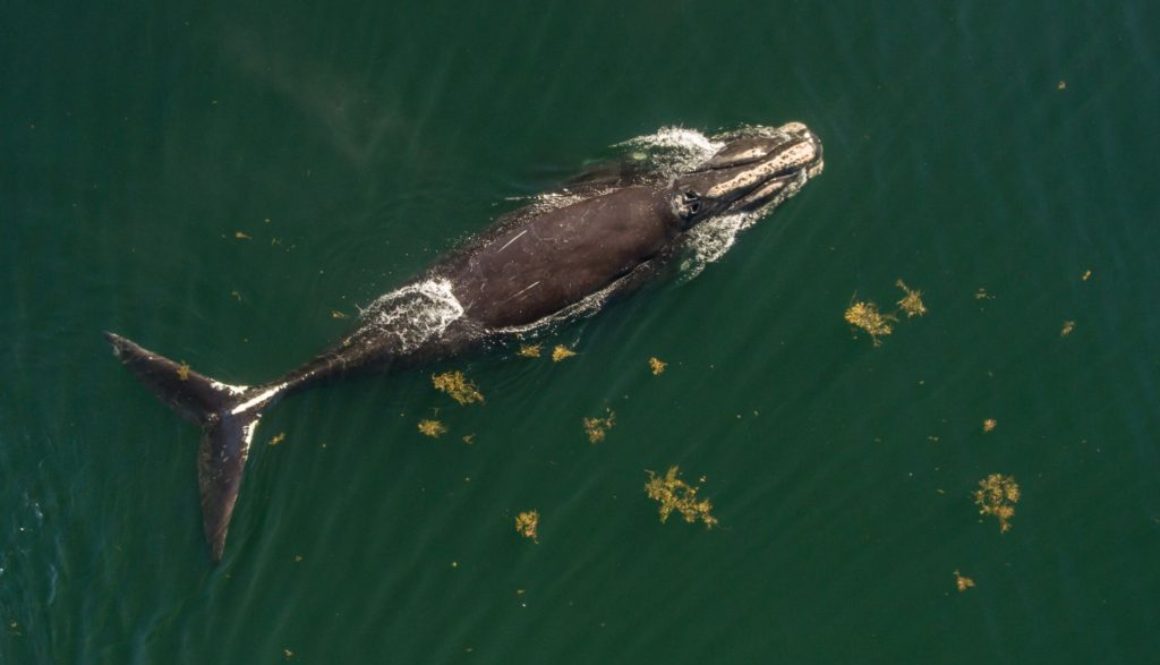
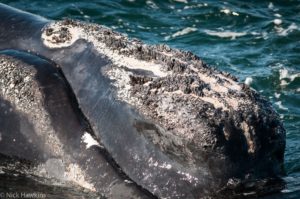
North Atlantic right whales (Eubalaena glacialis) , Photo by Nick Hawkins
As environments continue to shift, animals, too, are finding ways to adapt to these many changes. New Brunswick is a part-time home to many migrating species, from songbirds like orioles, thrushes, and warblers to large and endangered mammals like the North Atlantic right whale. As seasons continue to shift, animals are being forced to change their migration patterns to survive. If a species waits too long to migrate, it might be trapped in one environment and unable to make the journey. Species are finding new ways to adapt to these shifts in seasonality, overcoming climate change obstacles to complete their migrations.
Pink salmon of the Pacific Ocean are one of several species migrating earlier in response to climate change. Researchers at the University of Alaska at Fairbanks confirmed that the migration period of pink salmon is a genetic response rather than an environmental one1. This means that the salmon are triggered to migrate by their genes rather than environmental conditions, representing a true adaptation! Since pink salmon are a short-lived species, typically surviving two years, they are more likely to adapt to climate change quickly compared to longer living salmon species. With time, other migrating fishes, like Atlantic salmon, may come to possess genes that trigger an earlier migration.
Snowy Owl in Flight, Photo by Justin Dutcher, Dutch Elms Studios
For many species, their survival depends on the changing of their coat or plumage. As winter comes later and spring comes sooner in a changing climate, are species able to keep up? Animals are triggered to change their coat by the amount of daily sunlight, not the amount of snow2. So while our snow may melt earlier in the spring, the days do not grow longer at the same rate, leaving snowy owls snow white in a brown and grey forest. Research suggests that some species may be able to evolve to keep up with climate change. In a study of almost 200 wild hares, researchers at North Carolina State University found evidence of variation in when the hare’s coat changes color3. This could mean that the species is on the verge of adaptation to climate change! With time and a protected habitat, species may be able to adapt to seasonal changes and evolve to shed their fur and feathers earlier in the year.
For some species, a declining population occurs for many reasons: prey are not available, the species is over hunted or fished, habitat is lost to development, and new challenges emerge from climate change. For some species, the best available response to these pressures is to interbreed with other species, called species hybridization. There is evidence of species hybridization in many places around the world, including Canada! Researchers have found genetic evidence of interbreeding between southern and northern flying squirrels in Ontario following a series of warm winters that caused the southern flying squirrel to move northward4. Interbreeding between species typically produces offspring that are not as strong as the parent species, should the offspring survive at all. Often, if a hybrid offspring survives, they are not able to reproduce. While hybridization might be one adaptation pathway, there are a lot of hurdles for new hybrids species to overcome to survive and thrive in the face of climate change.
There is no question that many species are finding ways to adapt in ever-shifting environments; however, while many species are managing to survive, few are able to thrive. Should their environments shift at faster rates as climate change progresses, animals may not be able to adapt and evolve quickly enough. This is another reason why CPAWS-NB is advocating for a network of protected areas on land and at sea: to give our wildlife the best chance to adapt to climate change in protected habitats and healthy ecosystems. Protected areas will support native New Brunswick species as they slowly change their behaviours and their genes adapt to survive and thrive in shifting environments.
1 Kovach, R.P., Gharrett, A.J., & Tallmon, D.A. (2012). Genetic change for earlier migration timing in a pink salmon population. Proceedings of the Royal Society B, 279, 3870-3878.
Jess Baxter is the Program Support person at the Alzheimer Society of New Brunswick and a volunteer of CPAWS-NB. As an avid nature lover, Jess enjoys getting outdoors and spends her free time hiking, camping and exploring New Brunswick. Jess is passionate about environmental and animal welfare and is excited to be contributing to the CPAWS-NB blog!
It can be a tough time of year to get outside, unless it is to shovel again, between snow storms, blizzards, and coats of freezing rain, but with only four more weeks of winter (according to Shubenacadie Sam), February might be the last month to really enjoy the crisp quiet of a winter morning or the fresh air of new snowfall. Winter is a really dreamy season, which is perfect for the festivities of February 14! Whether you’re celebrating with a partner, enjoying Galentine’s Day with a best girlfriend, or practicing self-love today, embrace nature this Valentine’s Day on one of these perfect outdoor dates.
1.Try star gazing
Starry Night, Photo by 白士 李, Creative Commons Licence 2.0
On a cool and clear night, star gazing is a date activity not to be missed. If you can, head out of the city to escape the bright lights. As a Dark Sky Preserve, Mount Carleton Provincial Park may be the perfect place for this date night during a winter camping adventure! Bring a blanket and a thermos full of your favourite hot drink to really cozy up while you take in the sights and sounds of a winter’s night. Before you head out, read up on what stars and planets you can see this month to impress your date (or yourself).
2. Go for a bike ride
Yes, you read that correctly. With ample snow, New Brunswick is the perfect province to have a go at winter fat biking. You can rent a fat bike at three provincial parks and two national parks in New Brunswick, making it an easy and adventurous date activity. Don’t forget to look for signs of wildlife while you ride, and take breaks to really appreciate the nature around you!
Parlee Brook Amphitheatre, Photo by Mairi Simmonds
3. Enjoy a winter hike
Saving your Valentine’s Day celebrations for this weekend? If the weather cooperates, take your loved one(s) out for a winter adventure! Strap on your snowshoes, rent a pair, or opt for your boots to hike one of these top New Brunswick trails. Don’t forget to bring water and some snacks. Maybe even pack a zero-waste winter picnic; keeping food chilled won’t be a problem this time of year!
4. Go sledding
Sledding blends the nostalgia of childhood with simplicity— maybe you want to save learning to ski or snowboard for a second date. After this week’s fresh snowfall, bundle up, grab an old toboggan, and head out to your favourite sledding hill. Combine this date with #2 at Mactaquac Provincial Park, which is open until 9 p.m. Wednesday to Sunday and features a lit sledding hill!
5. Hit the beach
This idea might sound crazy, but beaches in the winter can be so special. You’ll want to dress warm and for all weather before you head out for a peaceful stroll. Enjoy the whisper of the breaking waves and breathe in the crisp salty air. New Brunswick’s coasts are beautiful all year round! Remember that seas are rougher in the winter, and you’ll want to carefully respect the tide and keep your distance.
As the days slowly grow longer and the frigid wind starts to ease, embrace the natural winter wonders of New Brunswick; before we know it, summer will be here again! Remember that winter comes with its own set of hazards, so take the appropriate precautions to stay warm and safe outside in this slippery season. This Valentine’s Day give Mother Nature a big hug and get outside with your partner, Galentine, friends, or family to show all the love you have for New Brunswick’s wilderness!
For more ideas of things to do outside this winter, catch up on this CPAWS-NB blog post.
CPAWS-NB wishes you a loving, happy, and nature-filled Valentine’s Day!
Julie Reimer is a PhD student at the Memorial University of Newfoundland and a Board Member of CPAWS-NB. Having worked in the whale watching industry in New Brunswick and conducted her Master’s research on conservation planning for the North Atlantic right whale, Julie is an advocate for MPAs in New Brunswick. Julie’s current research attempts to see the “bigger picture” of conservation, reaching beyond protected areas to understand the synergies between conservation actions and ocean industries. To connect with Julie, visit http://juliereimer.wixsite.com/hello.