Check out CPAWS New Brunswick’s list of gifts that give in more ways than one – they help local businesses and organizations stay afloat, and they support the good works these individuals and companies do to encourage protection of wildlife and nature in New Brunswick.
1. Philip Lee’s book, “Restigouche – The Long Run of the Wild River”, comes highly recommended by our Executive Director, Roberta Clowater, who has said it’s the book she would have liked to have written about the Restigouche, if she were an author. It captures both Philip’s personal canoe journey inspired by the river he loves, and the stories of the many peoples who have called this place home. He doesn’t shy away from illuminating the changes we need to make if we want to conserve this river treasure and live more in harmony with nature. Perfect for your outdoor enthusiast, conservationists and those who want to learn more about the rarely-told stories of this part of New Brunswick. To buy a copy go to Goose Lane Editions, or ask for it at a local bookstore.
2. Gift certificates from Arpin Canoe: Arpin Canoe Restigouche has been a stalwart partner in the Keep Restigouche Wild campaign, and we can vouch for the high quality canoeing experiences they provide. They are a long-time ecotourism pioneer in New Brunswick, still doing it right. To contact Arpin Canoe, click here to learn more about Arpin canoe and contact them to buy a certificate .
Photo by Roberta Clowater
3. Gifts from our whale watching partners: We can happily recommend these whale-watching companies out of Saint Andrews on the Bay of Fundy, who all provide excellent tours. They are small, family-run businesses who are doing valuable work to educate the public about the special wildlife and nature of the Bay.
Quoddy Link Marine Whale and Wildlife Cruises – link to website
Island Quest Marine Whale and Wildlife Cruises – link to website
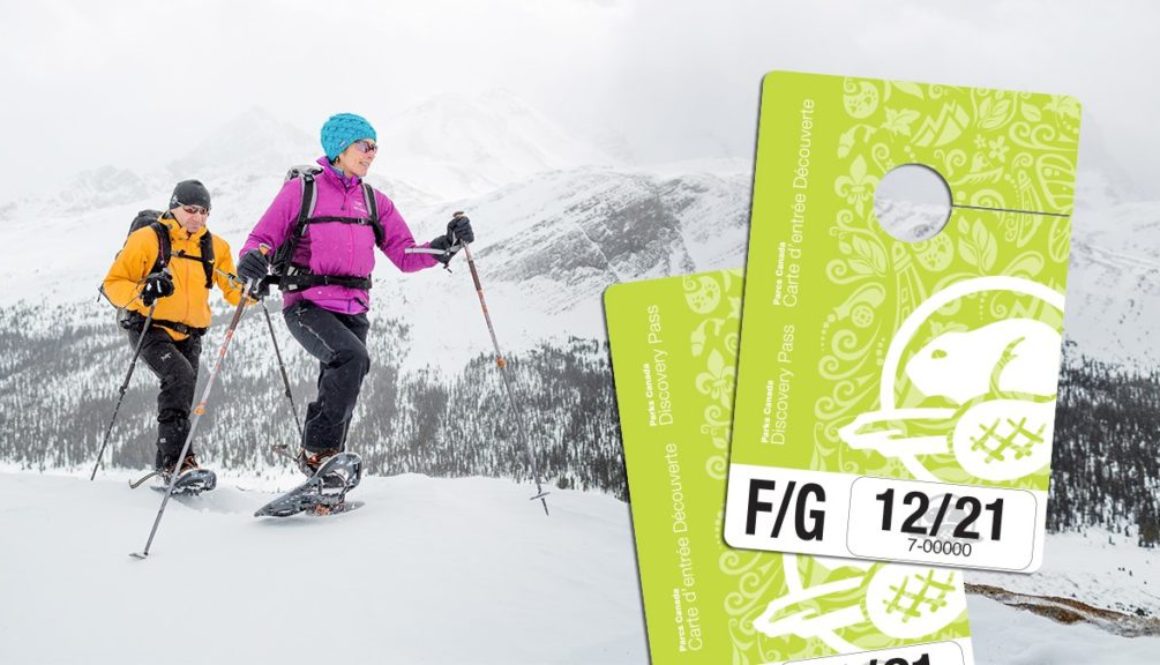
4. National Park Passes: Looking for the perfect gift for the nature-lover in your life? Why not give the gift of a full year of campfires, stargazing, connecting with history and nature, and so much more by giving a ParksCanada 2021 DiscoveryPass. Your purchase contributes towards conservation efforts!
5. Or purchase a Gift Card from NB Provincial Parks here.
Photo by Erinn Sharpe
6. Buy a New Brunswick Wildlife calendar: If you act quickly, you might be able to snap up one of Arielle DeMerchant Nature Photography’s calendars, which showcase her close encounters with all kinds of New Brunswick wildlife. Here’s a link to her Facebook page.
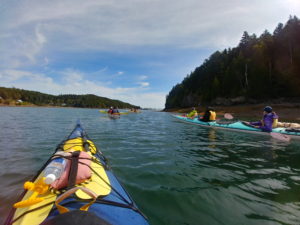
7. Sea Kayaking excursions: CPAWS New Brunswick encourages you to look into a sea kayaking excursion with Seascape Kayak Tours, whose founder, Bruce Smith, is a leader in adventure tourism and takes great care to be respectful and ethical in our marine wilderness. Here’s a link to Seascape Kayak Tours website.
8. Looking for a gift for a kid in your life? “Henrietta’s Nightlight” is a lovely book about exploring the woods, by Fredericton-based author Alice Whitney. Sold by Chocolate River Publishing or a local bookstore near you!
Photo by Amanda Frank
9. Give the gift of time to the bird lover in your life, plan a trip to participate together in a Christmas bird count this year! Audubon’s 121st Christmas Bird Count takes place between Monday, December 14, 2020 through Tuesday, January 5, 2021, see herefor more information and a full interactive map from Birds Canada to find a bird count near you.
10. Consider making a donation to CPAWS NB in someone’s name, donate here. Your donations allow us to do our work to ensure that Canada’s natural spaces are evergreen!
While walking through your local forest, have you ever paused to take a closer look at all of the living things around you? Have you ever wondered what plant medicines grow here, at home in New Brunswick? Have you pondered the healing properties that our native plants can offer? This August, I was swept away by the magic of nature while on a Wabanaki Tree Spirit Tour and Medicine Walk in Fredericton. Hosted by Cecilia Brooks and her son Anthony, together we explored the many sacred, native plants that grow in our region.
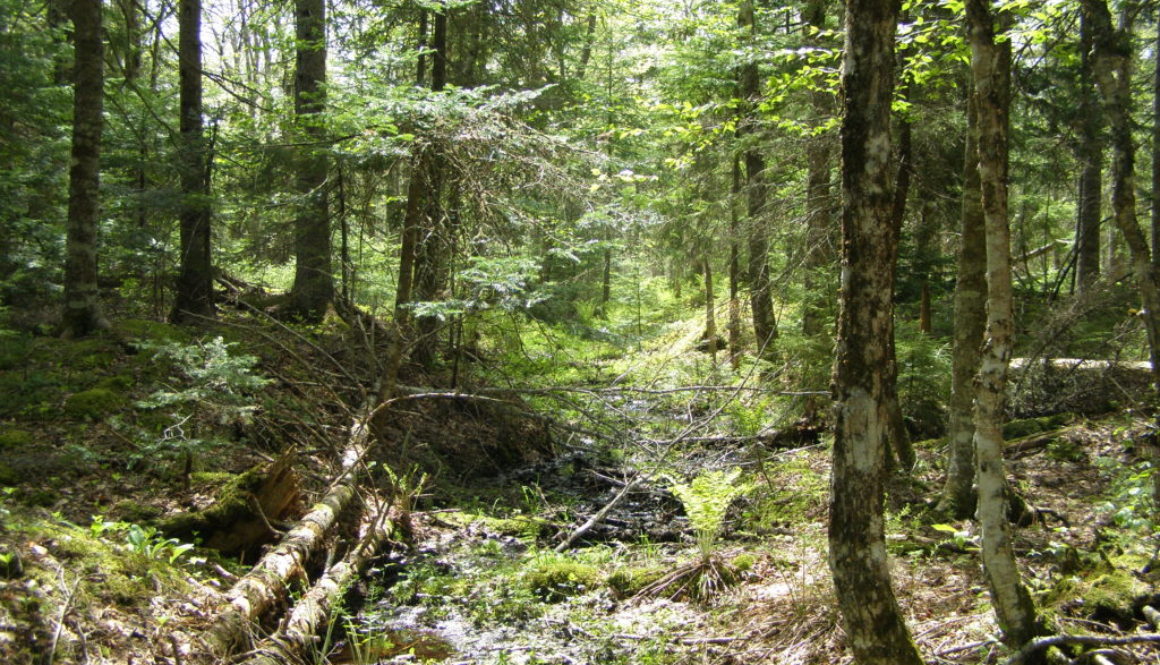
We began our tour with an offering of Tobacco. Cecilia explained that in their culture, tobacco is used as an offering and a way to give thanks. We placed the tobacco in our left hands, bringing the leaves closest to our hearts. After our offering, we began our medicine walk along the winding paths of Odell Park.
I grew up in Fredericton, and visit Odell Park regularly. This is a place I thought I knew, but after our walk, I now see this place with fresh eyes. Our local plants embody so much wisdom and history that most of us are unaware, yet these plants have been used for thousands of years by Indigenous Peoples. Like Jack-in-the-Pulpit, a local plant with the green berries that has a number of edible and medicinal uses. It’s corms, the bulb-like part that grows underground, have been used to treat coughs and tuberculosis! Other parts of the plant have traditionally been used as remedies for stomach gas, asthma, and rheumatism. This little plant, sometimes easily overlooked, is growing merely a few steps off of the main walking trail! [Always be cautious with medicinal plants – please don’t try to use these as remedies if you don’t know exactly how to prepare them, or which parts are safe!]
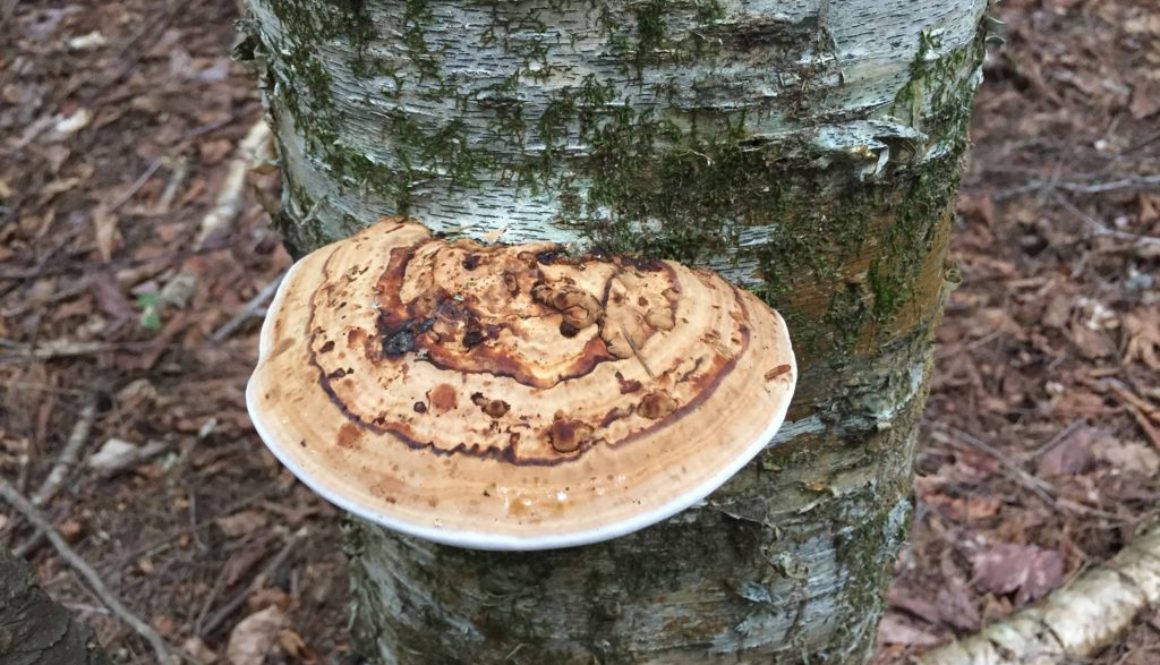
We also saw lots of fungi on our walk and, although some are toxic to humans, others like the Dye-Makers Polypore, can be used as a vibrant textile dye! Anthony, who studies mushrooms and is very knowledgeable about fungi, says that he often finds himself asking what purpose the mushrooms are serving, rather than how they can serve him. Many fungi are food for wildlife and are an important part of a healthy forest. Seeing our local plants as cogs in the ecosystem wheel, seeing their worth in nature beyond how we can use them, is a lesson we can all take to heart.
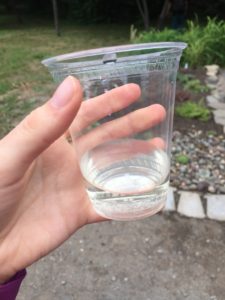
Following our walk, Cecilia served us homemade balsam fir tea. Balsam fir is our provincial tree in New Brunswick, an evergreen species that, on average, can contain three to five times more vitamin C than the best oranges! Cecilia explained that Indigenous Peoples have historically used evergreens that were readily available in New Brunswick to treat scurvy, which is caused by a vitamin C deficiency. This tea can be made by simply adding fir tips to a cup and pouring hot water over them, then waiting patiently as the tea steeps. This was a nice and refreshing treat, after our walk!
This special experience is one that I won’t soon forget. To see a familiar place through a new lens and to meet common plants again with a new purpose, is to visit nature in a way I had not done before. Not only was it fascinating to learn about the many edible and medicinal plants that grow in our province, but, as Cecilia says, the walking and connection with others sharing in this experience is the medicine itself. For anyone wanting to expand their knowledge of our local trees, plants, and fungi and their innate value and purpose, go walk with Cecilia and Anthony on a Wabanaki Tree Spirit Tour in Odell Park!.
Be sure to follow @WabanakiTreeSpirit on Facebook to keep up with their work!
Grace Hickey is a third-year student at St. Thomas University. She is pursuing a double major in Environment and Society and Women’s and Gender Studies, which encompasses her passions for social and environmental justice. She has worked as a Conservation Outreach Assistant for CPAWS NB for the last two summers and continues to volunteer as part of the Canadian Wilderness Stewardship Program. She loves spending time in nature and exploring all of the beautiful wilderness New Brunswick has to offer.
While the world still grapples with the coronavirus pandemic, it is heartening to note that the conservation of the natural world remains on the front burner for the international community. This week, in advance of the United Nations Summit on Biodiversity, the national leaders of 74 nations affirmed their commitment to working together to solve the issues of biodiversity loss, the degradation of forests, lands and waters, pollution and climate change. On Monday, Canada’s Prime Minister Trudeau signed the “Leader’s Pledge for Nature”, a framework of actions for nations to take during the United Nations’ Decade of Action.
What is the “Leaders’ Pledge for Nature“?
The aspirational goal is to “achieve the vision of Living in Harmony with Nature by 2050.” The pledge contains 10 different actions (or sets of actions, in some cases) to bring about change and conservation. They are, briefly:
Responding to current health and economic crises in ways that are green and fair to all,
Committing to the full implementation of the Convention on Biological Diversity,
Ending “silo thinking” by recognizing that all of the issues we face are interconnected and must be dealt with collectively,
Transition to sustainable patterns of production, consumption and sustainable food systems,
Meeting the goals set by the Paris Agreement on climate change,
Ending crimes against the environment,
Mainstreaming biodiversity considerations into policies at all levels of governance,
Addressing health and environmental sustainability in an integrated fashion,
Strengthening financial and non-financial means of implementing reform, and
The design and implementation of policy that is science-based.
More detailed explanations of the actions can be seen in the full 4-page Pledge for Nature.
Who has signed the pledge?
At the time of writing, 74 nations had signed, including Norway, Germany, France and New Zealand, to name a few. You can check www.leaderspledgefornature.org for updates to the list, as (hopefully) more sign on. Regrettably, Prime Minister Trudeau noted at the time of signing that Canada is the only one of the world’s 10 largest countries to sign.
What does this mean for Canada, and for New Brunswick?
Canada has committed to protecting 25% of its land and 25% of its ocean by 2025, and plans to protect at least 30% by 2030. CPAWS is involved and keeping a close eye on in this initiative, both at the national and provincial levels.
Many of our CPAWS NB supporters have raised your voices in support of nature protection – by writing letter, signing petitions, and voting for nature. Your actions are making a difference, and these commitments from our national leaders show it. At CPAWS NB, we will continue to work hard to hold our governments accountable for taking strong action to protect nature, on land and sea. You can learn more on our website, www.cpawsnb.org.
It was a dark night. The sky was cloudy, obscuring the moon that we could usually depend on to light up the beach in front of us. Our eyes, still used to light from the campfire we had just put out, struggled to make sense of the familiar path. We stumbled some over the rocks in the sand. I offered my grandmother my arm as we continued up the beach, thinking of nothing except reaching the camp at the end of the sand and crawling into my warm bed. I barely glanced at the dark saltwater that stretched for miles without interruption to my right, though I could hear the waves lapping against the shoreline. It was my grandmother who called out softly for my younger sister and I to stop.
“It’s very dark,” she said slowly, “and just the right time of year. Maybe, just maybe, the water will glow tonight.” In a moment, my exhaustion disappeared, and I excitedly turned to meet my sister’s eyes. Neither of us had ever seen the water sparkle as it does only a few nights a year, though we had been coming to the camp on the small island just off the coast of St. George, New Brunswick since we were months old. We had heard many stories from older members of my family, and it was a dream of ours to experience it for ourselves.
“glow” by the-photon-trap is licensed under CC BY-NC-ND 2.0
Grandma warned us not to get our hopes up, but it was too late. Without hesitation, we changed paths and started moving towards the water, taking care over the slippery seaweed and jagged rocks. With her decades of familiarity with the beach, Grandma kept up, and it wasn’t long before we were standing at the water’s edge. In unison, my sister and I each picked a rock out of the sand and hurled them forward, breaking the surface. Water splashed my toes, but that wasn’t why I gasped. For an instant, it was as though we were looking at a different world. The water erupted into brilliant sparkles, revealing the outlines of shapes beneath the waves.
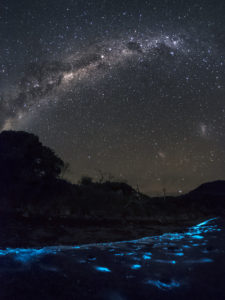
Sleep pushed far into the back of our minds, my sister and I spent an hour on the dark beach, throwing more rocks and eventually rolling our pants up and wading into the Atlantic Ocean. The water lit up as we moved and followed our legs in a dazzling stream that petered out behind us as we walked deeper into the gentle waves. Having seen the phenomenon many times before, Grandma eventually grew tired of admiring the starry water and continued up to the camp. My sister and I lingered on the beach after our legs had grown numb from the cold saltwater, watching the water flicker as it rocked against the shore while we chatted about what we had seen. We shared the opinion that phytoplankton are some of the coolest sea creatures on the planet!
Plankton are any type of free-standing organism that drift through the ocean currents, serving as a valuable food source for many animals. Plankton is broken into two categories: zooplankton, tiny floating animals, and phytoplankton, tiny floating plants. Many species of plankton can light up the water with their ‘bioluminescence’, but one group of phytoplankton, called dinoflagellates, are particularly well known for their bright night-time presence. Dinoflagellates glow when the water that surrounds them is disturbed as a defence mechanism. The flash of light they release is meant to scare away predators that might want to eat them, or to attract larger predators that might eat their attackers.
“Protoperidinium depressum (light micrograph)” by FWC Research is licensed under CC BY-NC-ND 2.0
A small miracle by tiny organisms, phytoplankton like dinoflagellates can only spark at certain times of the year. Water, weather, and nutrient conditions must be just right, and the phytoplankton have to gather in groups of millions or billions! It takes over 100,000 tiny dinoflagellates per every one litre of water to create the starry effect I saw on that dark August night. The night must be a deep dark to see the beauty of the phytoplankton’s faint flash, and the days must be hot and long with lots of sunlight. Much like a solar lamp charging through the day and lighting up at night, these tiny drifting plants need energy from the sun to glow. This means they are most often seen in the late summer months, and only in the shallow shoreline where the sun can easily reach them during the day.
To experience the shocking beauty of bioluminescent phytoplankton for yourself, head to the beach on a dark night during the summer months and cross your fingers. It may take years but witnessing the glittering beauty of this natural miracle first-hand is more than worth the wait!
Maddie Carr is a third-year student at the University of New Brunswick pursuing a major in Interdisciplinary Leadership Studies and a minor in Environmental Studies. She is currently a Conservation Outreach Assistant with CPAWS NB. The opportunities she has received here to expand her knowledge on the importance of protecting and appreciating natural areas is preparing her for her future goals of supporting conservation work in the environmental non-profit sector. Maddie firmly believes that those who experience nature want to protect it, which is why she spends a lot of time exploring wild areas like New Brunswick’s parks and encourages others to do the same!
What do you think of when you hear the word “habitat”? Do you think of the forest? Of the Ocean? Of the faraway deserts, grasslands, or frozen tundra? All these large areas are important habitats for many different kinds of plants and animals, but habitats don’t have to be classified so generally. The only requirement for an area to be considered as habitat is that it has enough space, food, shelter, and water to entirely support at least one plant, animal, or other organism throughout its life.
Photo by Maddie Carr
Habitats can be as big as a forest or as small as a single dead tree that is home to many insects who can find everything they need to live within its trunk. That same tree might be only a part of the habitat needed to support a bird that nests in the tree. The bird finds shelter in the tree, but ultimately depends on a much larger section of the forest to find food, water, and mates. Different species have their own unique habitat requirements. Some species are “habitat generalists” and can survive in a variety of places, while others are very specific in their needs.
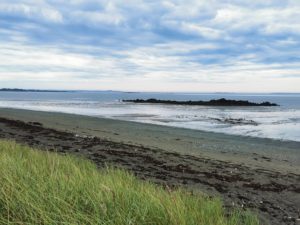
Many types of coastal creatures are “habitat specialists”, who have strong preferences for temperatures, exposure to air, level of salt in the water, and more. When we protect habitats, it is so important to include these seaside spaces that are home to specialist species. Some of these habitats you might see every time you visit the beach, but have not reflected on their purpose or importance to many types of shoreline plants, animals, birds, and more. Let’s explore three types of shoreline habitats that can be found from the beaches of New Brunswick!
1. Intertidal Zone
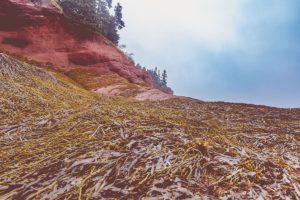
The intertidal zone is a big habitat, made up of other smaller habitats, that you have probably walked over many times, especially if you have ever visited the Bay of Fundy. Our special Bay has the highest tides in the world and therefore the world’s largest intertidal zone! The intertidal zone is what you might think of as the seashore. At low tide, its rocky or sandy surface is exposed to the air and, in most cases, walkable by beach goers. It’s where you go to do some beachcombing, looking for shells and sea glass. At high tide, the intertidal zone is covered in water and becomes part of the ocean again! To humans who can only survive on land, or fish that can only survive underwater, living in the intertidal zone would be impossible. For many ocean species who are unable to travel to deeper water, but require access to the ocean to eat or breathe, the intertidal zone is the perfect habitat.
Photo by Tony Webster from Minneapolis, Minnesota / CC BY-SA 2.0
Shelled species like crabs, limpets, and snails are well suited to the upper areas of the intertidal zone, where the water is shallowest at high tide. While the water is covering their habitat, they can hunt and move freely without fear of large, deep water predators. Then, when the water has retreated, they can hide beneath rocks or seaweed and rely on their shells for protection from inland predators. Further down the tidal zone, immobile marine animals like barnacles and mussels, who need water to breath, can fill their shells with water while the tide is up and enjoy a few hours of relief from aquatic predators while the water is down. Similarly, many types of seaweeds and algae that grow in the intertidal zone have adapted ways of surviving while exposed to the air. Some of these plants can lose 60-90% of their moisture while the tide is low, becoming quite brittle in the hours before the ocean rises when they can reabsorb all the moisture they need to survive. When it comes to the intertidal zone, there is always more than meets the eye! Next time you visit the beach, keep your eyes alert for the many species that call the beach home while your stroll.
2. Mudflats
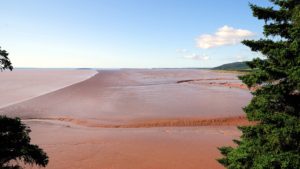
Mudflats are exactly what they sound like: muddy, flat areas near the edge of the ocean that are saturated with both salt and freshwater. They are a part of the intertidal zone, but species that rely on sand or rock cover cannot survive in their sticky depths. They form in inlets or bays that are sheltered from larger waterways or harsh storms that wash sediment away from beaches. Sediment and dirt accumulate over time in these areas, building up to create, sometimes quite deep, stretches of mud. Mudflats might look void of life, but they are actually teeming with coastal species!
Photo by Taxiarchos228 / CC BY-SA 3.0
Species that can survive where oxygen is limited, like clams, mud shrimps, worms, and insects, live beneath the surface in mudflats. Many types of shoreline birds feed on these species, with legs and feet specially adapted to walk on or through the dense surface and beaks able to penetrate the mud. Mudflats are also the perfect habitat for many different types of bacteria, all of which have different and important roles in the ecosystem. Some bacteria break down plant matter into a form that smaller coastal animals can easily eat, while others break down contaminants in runoff from land-based water, which would otherwise reach the ocean.
Despite their empty looking appearance, mudflats are an incredibly important habitat, and one that has often been neglected or threatened by development. Next time you see a stretch of mud at the beach, imagine the many species who depend on this habitat to survive!
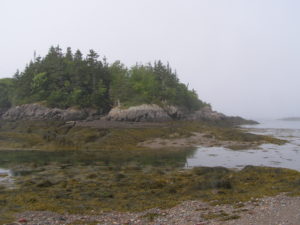
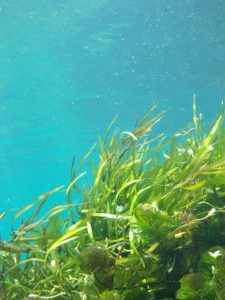
Kelp forests are not as easily seen while walking along the beach. This habitat exists underwater, in shallow areas along the coast where sunlight can still penetrate the water to allow for photosynthesis, the process in which kelp and other plants create the food they need to survive. Since kelp need cool temperatures to grow, many patches of kelp forest can be found in the cold ocean waters of New Brunswick. A variety of New Brunswick marine animals depend on these aquatic forests for their habitat.
Some small crustaceans, like crabs, and invertebrates, like sea stars, can spend their entire lives in kelp forests, feeding on algae or their fellow inhabitants, and using the kelp as shelter from predators. Kelp forests are frequented by species of worms, snails, plankton, small shrimps, anemones, and jellyfish, and many larger sea and land animals rely on kelp forests as a component of their habitat. Fish, like cod and haddock, seals, and many types of seabirds can be spotted searching for food, hiding from predators, and seeking shelter from storms in these patches of algae.
As climate breakdown progresses, kelp are threatened by warming waters. Kelp forests in our region are deteriorating, as threats from human activities and stressors accumulate. It is important to protect existing pockets of this important habitat now, while we work to preserve ocean conditions that will allow new forests to emerge and thrive!
For a little more information about life among the kelp, check this out.
For many of us, when we think of a day at the beach we picture sandy toes, salty hair, and the sounds of joy as we soak in a dose of Vitamin N (for Nature). What we might not think of is the diversity of habitats, and the species they contain, that call our beaches home. The next time you visit a favourite New Brunswick beach or picturesque coastal town, look to where the land meets the water and remember the important habitats and ecosystems living just below the surface. What might be out of sight, doesn’t have to be out of mind, and we at CPAWS-NB are working hard to ensure these habitats are protected now and into the future.
Support the work of CPAWS-NB with a donation today!
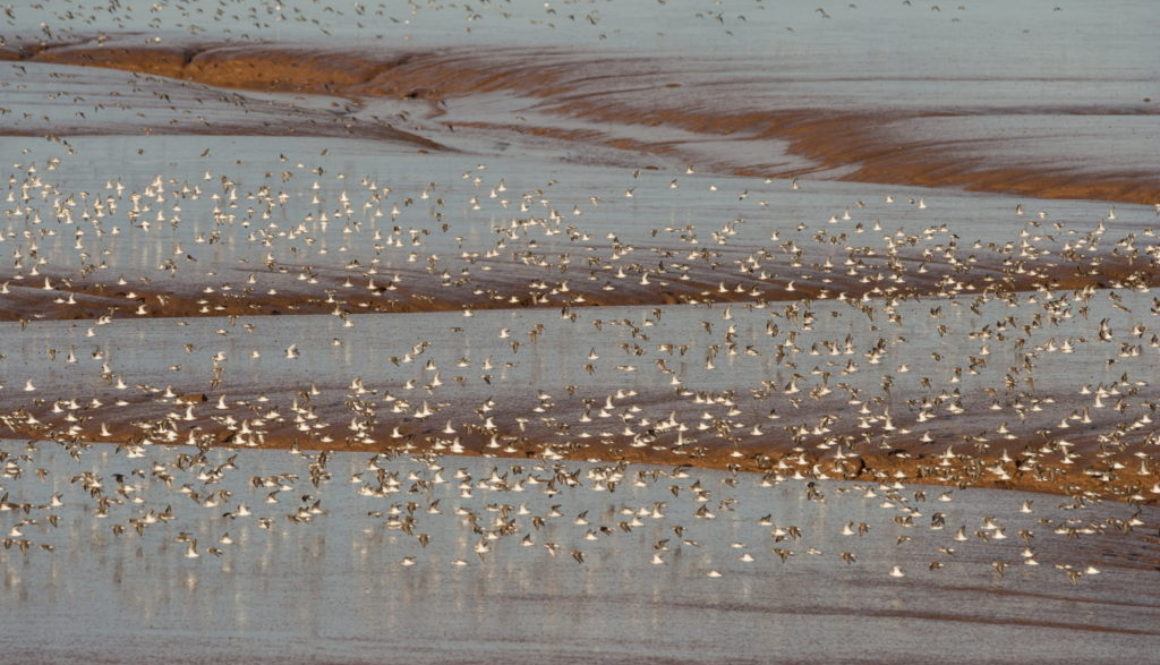
Sandpipers in Johnson’s Mills, Bay of Fundy, header photo by Nick Hawkins
Maddie Carr is a third-year student at the University of New Brunswick pursuing a major in Interdisciplinary Leadership Studies and a minor in Environmental Studies. She is currently a Conservation Outreach Assistant with CPAWS NB. The opportunities she has received here to expand her knowledge on the importance of protecting and appreciating natural areas is preparing her for her future goals of supporting conservation work in the environmental non-profit sector. Maddie firmly believes that those who experience nature want to protect it, which is why she spends a lot of time exploring wild areas like New Brunswick’s parks and encourages others to do the same!
It’s summer: the days are luxuriously long and the sun’s heat drives us to refreshing beaches, cool forests, and damp wetlands. This year, we’ve faced new challenges as we connect with nature, perhaps more deeply than ever before. Behind the scenes, a team of dedicated summer students breathes new life into CPAWS-NB as we bring conservation to you and to our communities.
Please join us in saying welcome to Maddie and Grace! We are so fortunate at CPAWS-NB to attract bright people with big talent and a passion for New Brunswick’s wilderness. We sat down (figuratively) with our summer students to learn what inspires their love of nature and what drives them to work as Conservation Outreach Assistants in our team.
What makes you passionate about conservation and wilderness in New Brunswick?
Maddie
Maddie: I grew up in a rural area and my favourite playground as a child was the forest that surrounded my house. Interacting so closely with New Brunswick wilderness from such a young age has made me incredibly passionate about protecting natural areas. I want future generations to be able to enjoy the same outdoor activities that I have always loved. I want them to be able to get outside in more places than even I, which is why I think that CPAWS-NB’s mission to expand the number of parks and protected areas in the province is so crucial!
Grace: I developed a strong connection with nature at a very young age. Since I was a kid, I have spent ample time outdoors, exploring our beautiful province with my family. Over the years, I have been privileged with various opportunities through my education and work that have allowed me to learn more about the need for conservation and protection of our natural areas and wildlife here in New Brunswick. Having this knowledge and love for nature has made me all the more passionate about working to protect our incredible wilderness for future generations.
What do you love about working with CPAWS NB?
Maddie: Working in the environmental non-profit sector has been a long-standing dream of mine. So, my favourite thing about working with CPAWS-NB is learning first-hand how an environmental non-profit works and helping CPAWS-NB work towards an important mission that aligns with my own personal values. There are many other parts of this position that I also look forward to daily! My amazing co-workers, interesting work assignments, and opportunities to explore New Brunswick parks and protected areas are all awesome components of this summer job.
Grace
Grace: CPAWS-NB is such a remarkable organization, and I have been fortunate to work with them for two consecutive summers! What I love most about CPAWS-NB, and our team, is their unwavering commitment and dedication to ensuring the best possible measures are taken to protect the wilderness that is our home and life force. CPAWS-NB works tirelessly to engage our community in the rewarding work that we do, so that everyone has the opportunity to join in this important dialogue and have their voices heard. My favourite part of my job, is sharing my love and passion for nature with our community. Even though that may look a bit different this year, as we are unable to host large public gatherings, we have been able to continue to reach people virtually. I love encouraging folks to cultivate their relationship with nature and enjoy the beautiful wild spaces that our province has to offer!
What are your plans for school/work after your work period with CPAWS NB?
Maddie: In the fall I will beginning my third year at the University of New Brunswick, where I am pursuing a degree in Interdisciplinary Leadership Studies with a minor in Environmental Studies. I plan to spend next summer on the small Greek island of Samos, where I will be completing a marine conservation internship and gaining hands on experience with protecting natural areas. After I graduate, my dream is to work with an environmental non-profit right here in New Brunswick!
Grace: After I finish my work with CPAWS-NB this Summer, I will be returning to St. Thomas University for my third year in the Bachelor of Arts Programme. I am currently working towards a double major in Environment and Society and Women’s and Gender Studies.
How do you like to get out and enjoy New Brunswick’s nature? (15 words)
Maddie: My favourite thing to do in New Brunswick nature is take my dog for hikes!
Grace: My favourite way to enjoy and experience New Brunswick’s nature is by going for nature walks, hikes and bike rides and spending mindful moments outdoors.
We are lucky here at CPAWS-NB to have the help of Maddie and Grace all summer long! With their focus on protecting nature for future generations to enjoy, their energy resonates through our team as they work to shares all things conservation, wilderness, and wildlife with you—our supporters and our community.
Check our Facebook page for regular updates on CPAWS-NB events.
Julie Reimer, CPAWS NB
Julie Reimer is a PhD student at the Memorial University of Newfoundland and a Board Member of CPAWS-NB. Having worked in the whale watching industry in New Brunswick and conducted her Master’s research on conservation planning for the North Atlantic right whale, Julie is an advocate for MPAs in New Brunswick. Julie’s current research attempts to see the “bigger picture” of conservation, reaching beyond protected areas to understand the synergies between conservation actions and ocean industries. To connect with Julie, visit http://juliereimer.wixsite.com/hello.
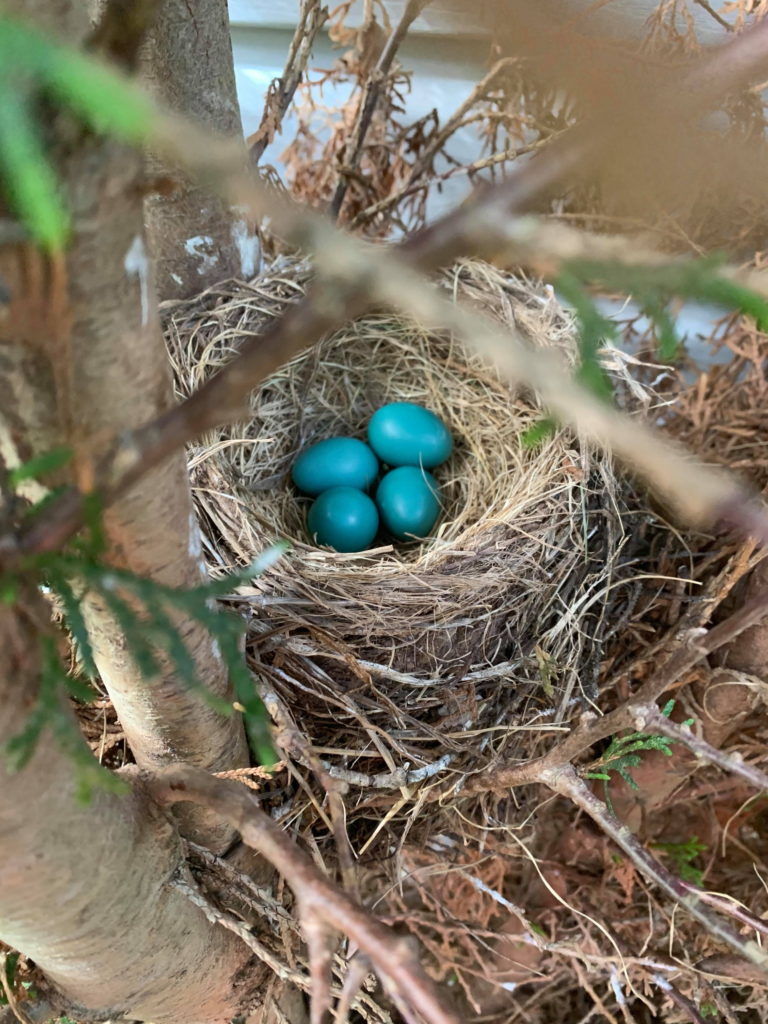
Every year at our home in rural New Brunswick, we are fortunate enough to have front row seats to watch all kinds of wildlife living and playing in our backyard. Our favourite sights to see, by far, are the birds. Our spot is frequented by loads of different birds, so we keep our eyes and ears on alert for the swooping flight of pileated woodpeckers, the vibrant colour of blue jays, the quick song and loud calls of finches and cardinals, and most frequently, the signature blue of new robin eggs!
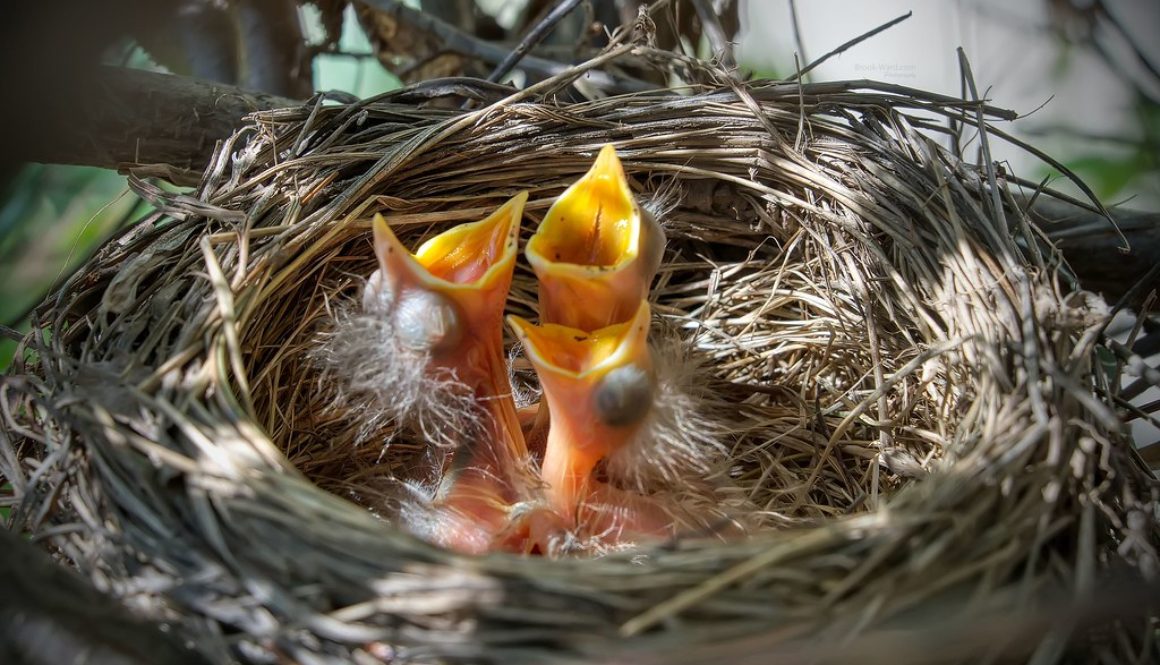
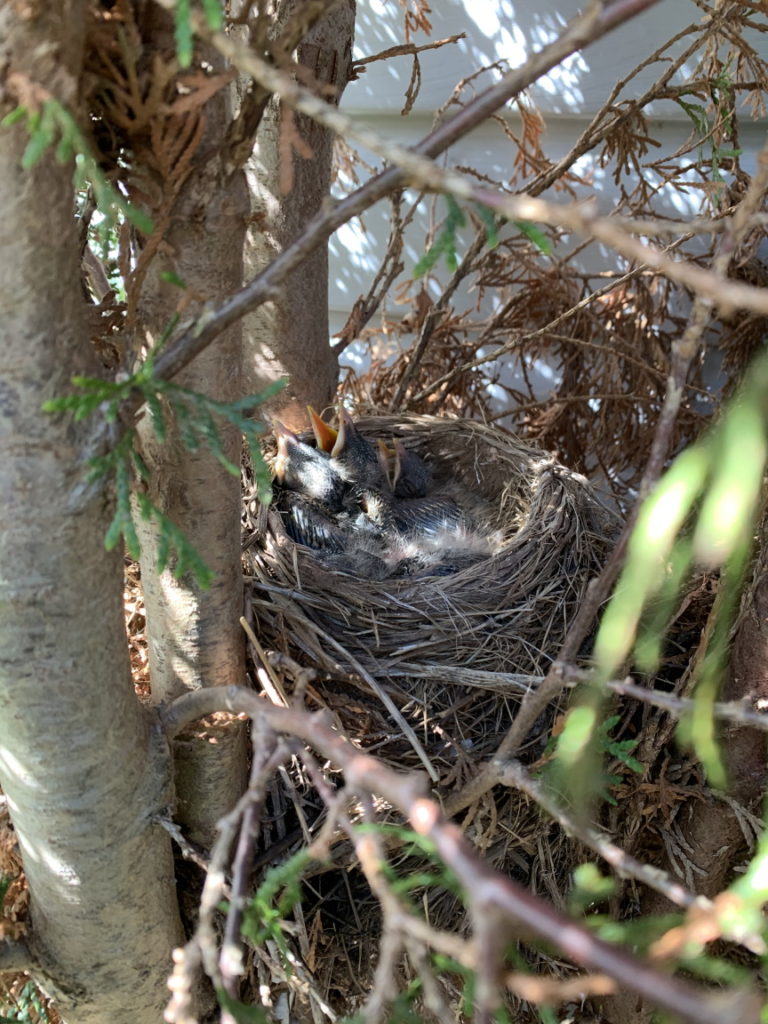
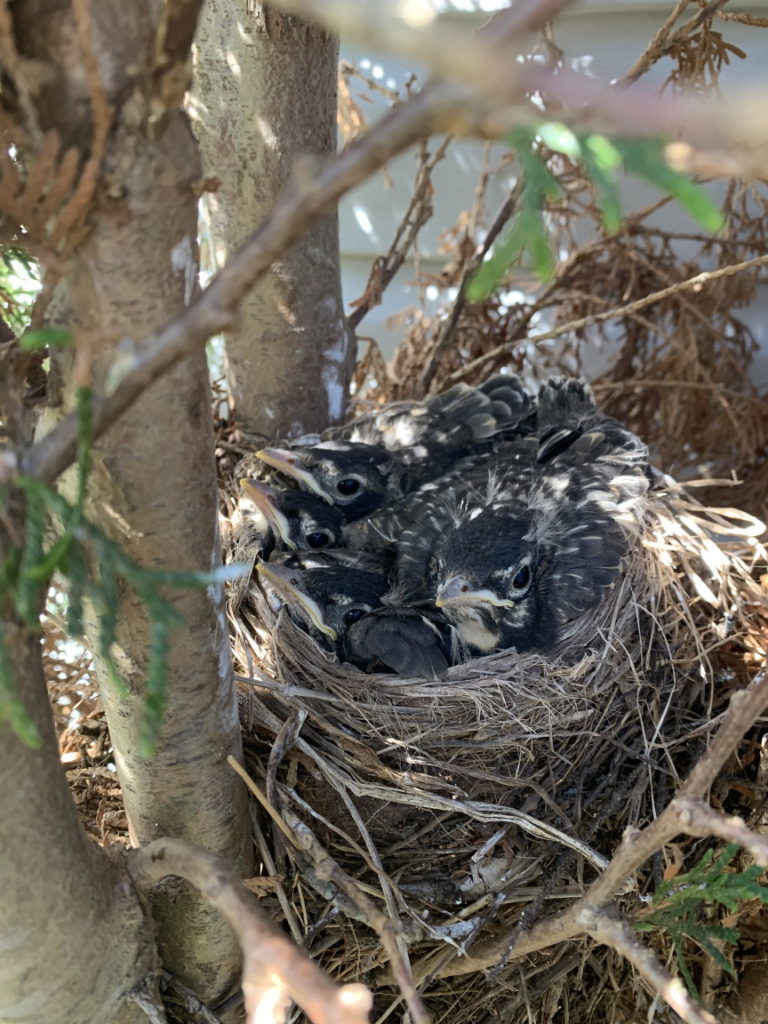
Robins have been nesting near, and sometimes on, our house since we moved here six years ago. We always notice them, especially as a first sign of spring, but we don’t usually pay them much mind. But this year, things were different! Since we have been spending all of our time at home, this year we had the pleasure of watching baby birds go through each stage of early life when a pair of robins nested just outside. We watched as the female robin built her nest in one of the best spots, in my opinion: a tall cedar hedge against our house. We woke up to freshly laid eggs, and then we watched from a safe distance as the baby birds grew from nestlings to fledglings, eventually leaving their nest as summer started to settled in.
Baby birds are not only precious, but they make for a great teachable moment for adults and children alike about wildlife sharing our communities, whether rural or urban. The rule of thumb for baby animals you might encounter is to simply leave them alone[1]. Sometimes, it looks like they have been abandoned—this is especially true for baby deer[2], but really, the mother has left them briefly to eat and replenish. The babies are safe from predators while mom is away because they have no scent! Sometimes it can be hard to leave nature be, but through evolution and adaptation our wild species are well prepared. During an unexpected and unseasonably late snowstorm this May, I was worried about the baby robins out in their nest, but the next morning we discovered that all was well. Animal moms are tough like us, and they know just what to do for their young ones.
Another rule of thumb to follow for the wildlife in your backyard is to avoid feeding them[3]. When we feed wild animals, they become dependent on us as a regular food source, which can lure more dangerous wildlife into your backyard! Not only does it bring this risk, but feeding wildlife can increase the risk of disease transmission, can bring wildlife closer to busy roads, and can result in malnourishment when we’re feeding inappropriate foods, like feeding bread to ducks[4]. The exception when it comes to feeding wildlife are bird feeders with proper feed, which are generally considered to be safe[5]. In my yard, we don’t have any bird feeders, but my children love to watch the birds gather worms from the ground on a rainy day!
Watching wildlife in our backyards is exciting! Witnessing these tiny miracles can teach us about nature and how to value and respect it. To our surprise, just a few days after watching these robins fledge the nest, we woke up to one new egg in the nest. Then, to our greater surprise, suddenly three more eggs joined it! Keep searching for signs of wildlife in your yards and nearby nature spaces—you never know what sights you might get to enjoy next!
All photos in this post were taken from a safe distance using a zoom lens.
As of July 10, 2020, the second clutch of eggs have fledged the nest— and then, another egg appeared!
Kelsey Wierdsma holds a Master of Environmental Management and is the Conservation Coordinator at CPAWS NB. She’s a homegrown New Brunswicker and is passionate about building community support for protected areas. Her work in the non-profit sector has given her an outlet to make real change and educate others about the important work that needs to be done in New Brunswick and beyond.
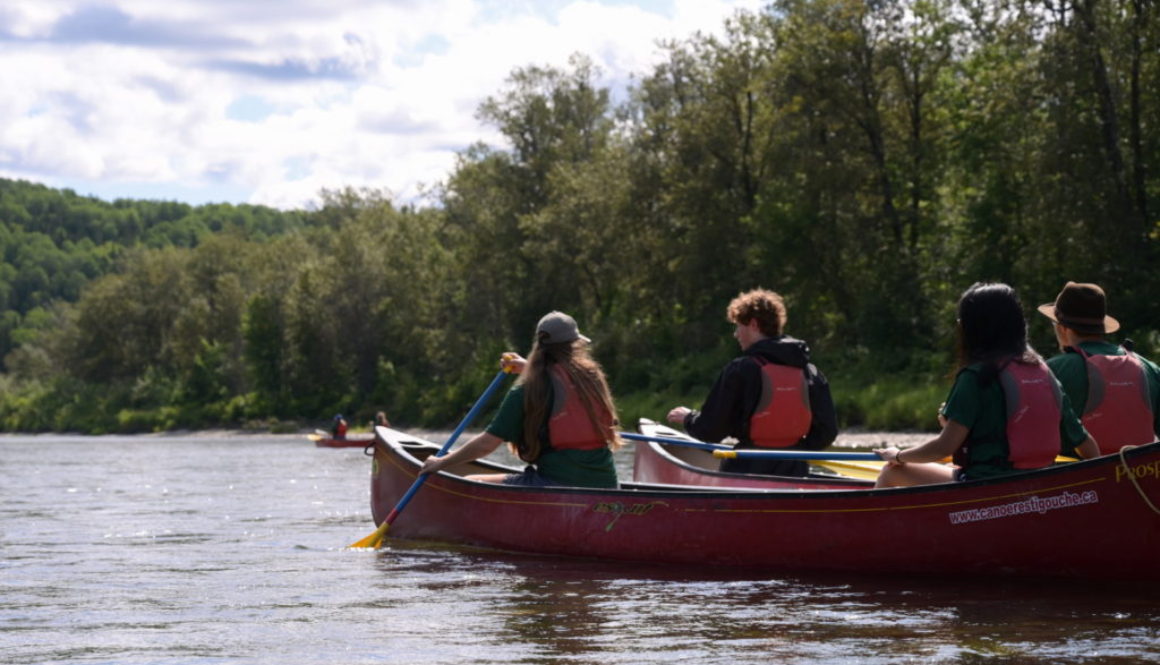
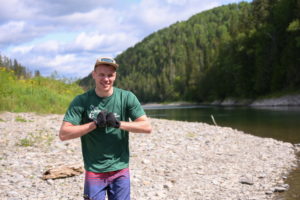
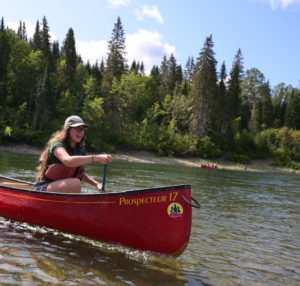
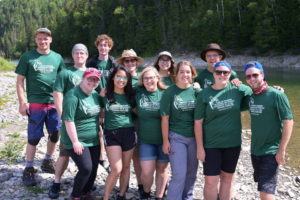
On a bright sunny day, with the cicadas calling and the gentle waves washing ashore, 10 young New Brunswickers set out on the Restigouche River as Canadian Wilderness Stewards. Last August, the first cohort of volunteers with the Canadian Wilderness Stewardship Program (CWSP) explored this special place in our province – a beautiful watershed that CPAWS NB is currently working with government to see become a protected natural area. The volunteers engaged with local experts and guides over two days, and took part in a canoe expedition on the pristine waters of the Restigouche, all while learning about the conservation challenges and needs of the area.
Kurt Stewart
Kurt Stewart and Lauren Verner shared their favourite things about the Restigouche trip with us, and we hope these will get you excited and ready to explore New Brunswick’s wilderness. This natural wonder of the province truly inspired them, and us, to rediscover what New Brunswick has to offer!
For Kurt, his time on the Restigouche was the perfect opportunity to relax and be in the moment, “I have wanted to visit the Restigouche for some time and this was by far the best way to experience it.” He enjoyed learning about the beautiful river and its history from André Arpin, ecotourism operator on the Restigouche and one of our program presenters. For Lauren, “experiencing the Restigouche River first-hand reminded me why conservation in New Brunswick is so important.”
Lauren Verner
CPAWS NB is excited to see the province working towards creating the Restigouche Wilderness Waterway Park, a sentiment shared by our volunteers. As Lauren says, establishing a waterway park ensures that “it will remain pristine, beautiful and breathtaking for generations to come.” Both Kurt and Lauren understand the importance of protecting the Restigouche wilderness for the many species that call the area home. “We have so many beautiful spaces in our province, like the Restigouche, that are not only valuable to us intrinsically, but are valuable habitats for wildlife” added Lauren.
Ecotourism is the industry we need to turn to in keeping business thriving in the Restigouche. For Kurt, hearing the ecotourism story of Arpin Canoe Restigouche was especially inspiring. “To understand how ecotourism is a viable career is great,” he noted, especially since he would like to own a similar business someday.
Getting outside and experiencing wilderness is an inspiring adventure, and getting out onto the Restigouche reminded Lauren about her passion for the outdoors and the natural areas of New Brunswick. “I think that passion will translate through into my community project” she said about her plan of creating educational material for schools. Beyond their experience on the Restigouche, each CWSP volunteer is supported by CPAWS in developing conservation and environmental action programs in their communities.
Volunteers of the Canadian Wilderness Stewardship Program at CPAWS-NB
Paddling through the winding and crisp waters of the Restigouche, a group of passionate and eager stewards were called to action. We can’t wait to see where their passions and community projects take them, and to share their progress with you! This summer, we have plans to do it all again!
Are you or do you know someone who is between 18-30 and excited about conservation? Someone who can’t wait for their next adventure into nature? Someone ready to take action to protect New Brunswick’s wild places? We’re recruiting for the 2020-2021 cohort of stewards! You can learn more about the CWSP Program and how to apply here.
Claire Vézina’s lifelong sense of gratitude for nature is what first motivated her to work in the environmental movement. This appreciation for nature led her to complete a Bachelor of Science in Biology and a Bachelor of Arts in Sociology from the University of New Brunswick. At CPAWS-NB, Claire coordinates the ‘Watch Your Paws’ Education Program in both official languages, translates CPAWS NB’s communications to serve our bilingual supporters, and oversees social media engagement.
Happy Oceans Week! As we take time this week to celebrate the oceans, the species they contain, and all of the incredible things they do for our world and way of life, we look to the winding coasts and vast blue Bays of New Brunswick. With 5,500 km of shoreline in salt marshes, sand dunes, and steep, rocky cliffs, our province is home to diverse plants and animals that endure the salty ocean environment.
To the north in the Baie des Chaleurs, you’ll find the very rare maritime ringlet butterfly fluttering along the coast or groundfish, like the threatened American Plaice, living on the ocean floor. To the east in the Northumberland Strait, you’ll find your seafood favourites: scallops, lobster, and oysters. And to the south, the rich and vibrant Bay of Fundy is home to more species than we can count, some more endearing than others. These weird and wonderful wildlife (and one plant) are our picks for 10 More Underrated Species of the Bay of Fundy.
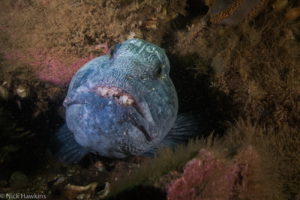
Atlantic wolffish in the West Isles, Bay of Fundy by Nick Hawkins
1. Atlantic wolffish – Certainly a weird and wonderful species, Atlantic wolffish have many teeth in their big mouths, including along the roof of their mouths! This helps them to easily eat tricky prey, like sea urchins and crabs, who have few other predators. By eating up these hardy species, wolffish help to keep their populations in check. Atlantic wolffish help to keep food webs and ecosystems healthy, which makes protecting them and their habitat so important.
2. Copepods – Copepods are a tiny crustacean, a relative of crabs and lobsters, about the size of a grain of rice. They, along with other tiny ocean animals and plants, form the bottom of the ocean food web and keep ocean ecosystems going– one of the reasons why the Bay of Fundy is home to so many species. Copepods are especially important because they are the preferred food of the critically endangered North Atlantic right whale!
3. Rockweed – Rockweed is the general name for a few types of seaweeds found sprawling along the shorelines of New Brunswick. With tiny pockets of air, called “air bladders”, rockweeds are able to float. At high tide, clumps of floating rockweed create a forest-like habitat that many birds and fish use. At low tide, these seaweeds provide protection from predators and the elements for animals like crabs, periwinkle snails, and barnacles.
Northen Gannet -“Basstölpel (Morus bassanus) klar zur Landung” by Thomas Haeusler is licensed under CC BY-NC-ND 2.0
4. Northern Gannet – Northern gannets have amazing eyesight, both in air and water! This large seabird can spy its prey- schooling fish, while soaring high above the ocean. They then dive bomb the water from the sky, causing a splash that can be seen at a distance. The neck and shoulders of the gannet are protected by air cells that inflate prior to their dive- their own built in airbags!
5. Northern barnacle – Another unique crustacean, the Northern barnacle is a small animal that permanently attaches itself to any hard structures found in the ocean: rocks, wharves, and even other animals, like lobsters and whales! This species begins its life as a free-floating larva and later settles onto a surface, solidifying its existence using a cement-like substance that scientists have explored as an alternative to dental adhesive!
6. Moon jelly – A very common jelly that is certainly underrated! You can see moon jellies nearshore from harbours, wharfs, and beaches because this species, like many other jellies, thrive in places highly impacted by people. As our activities increase, competition between moon jellies and other species for food decreases, allowing these populations to boom! As climate change impacts unfold and human activities continue, the moon jelly may just become a most populous species in the Bay of Fundy.
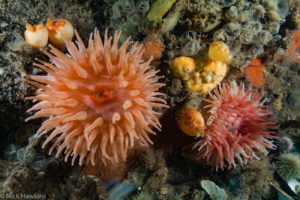
Northern red anemone in the West Isles, Bay of Fundy by Nick Hawkins
7. Northern red anemone – Most of us conjure up bright images of coral reefs when we think of anemones (thanks, Finding Nemo), but we too have anemones right here at home! Northern red anemones can grow up to 15cm in diameter and use their tiny tentacles to catch, sting, and then eat prey like crabs and small fish. These beautiful creatures are animals, not plants, but they’re unique in their ability to reproduce by simply diving their body in half!
8. American eel – Technically a fish, American eel are the only “catadromous” fish in North America. This means that American eels spawn and are born in the ocean, but mature in freshwater lakes and rivers. Because they can live in so many places, some say that American eels have the widest diversity of habitats of any fish species in the world!
9. Porbeagle shark – Porbeagle sharks are just one of many types of sharks that make their way to the Bay of Fundy each year. Porbeagle sharks are close relative to the great white shark, so close that they are often confused when seen in the wild.This shark grows to be up to 2 metres and 300 pounds! Porbeagles are considered as Endangered by the Committee on the Status of Endangered Wildlife in Canada (COSEWIC), but are not yet legally protected by Canada’s Species at Risk Act.
Black-legged kittiwake pair in the West Isles, Bay of Fundy by Nick Hawkins
10. Black-legged kittiwake – So much more than “just a gull”, the black-legged kittiwake nests in tiny crevices in the cliff face, usually far offshore. This small gull, about the size of a crow, with it’s signature black legs dips and plunges into the sea surface to catch small fish. It’s easy to confuse a juvenile black-legged kittiwake with an adult Bonaparte’s gull because of their black bills– it isn’t until adulthood that this bird’s bill turns yellow.
Home to more than 2,000 species of plants and animals, the Bay of Fundy is one of New Brunswick’s most diverse and most exciting ecosystems. Today, our Bay goes without protection and is threatened by human activities and impacts from climate change, including the dangers of warming oceans and shifting food webs. CPAWS-NB is working hard to change this!
With your help, we have been advocating for a network of Marine Protected Areas (MPAs) for the Bay of Fundy. A network of MPAs would protect the most important habitats and species in this ecosystem and, with other and larger MPAs in the Scotian Shelf and Northwest Atlantic, could help to ensure that oceans remain healthy and productive long into the future.
Courtney Piercy holds a Bachelor of Science in Marine Biology and a Bachelor of Education, and is currently the Marine Education Coordinator at CPAWS NB. Growing up, Courtney had many opportunities to experience our province’s nature- inspiring her to work in the environmental field. She has ample experience in environmental education on the Bay of Fundy, having worked in the whale watching industry since 2012. From this experience, she has seen first-hand how important it is to expand ocean conservation in New Brunswick!
Julie Reimer, CPAWS NB
Julie Reimer is a PhD student at the Memorial University of Newfoundland and a Board Member of CPAWS-NB. Having worked in the whale watching industry in New Brunswick and conducted her Master’s research on conservation planning for the North Atlantic right whale, Julie is an advocate for MPAs in New Brunswick. Julie’s current research attempts to see the “bigger picture” of conservation, reaching beyond protected areas to understand the synergies between conservation actions and ocean industries. To connect with Julie, visit http://juliereimer.wixsite.com/hello.
I don’t know about you, but after a long winter with toddlers constantly getting sick – as toddlers do, spring is a welcomed season in my house! Just as spring marks a new beginning for wildlife, it’s also a new beginning for us. We start to get outside more, colds and flus take a backseat, and we can reasonably look forward to summer! But this year, things feels a little different.
You don’t need me to explain to you what it’s been like—we’re experiencing this together, an ironic sentiment since isolation can make us feel disconnected and uncertain. It’s especially hard for children who desperately need routines. My children are 2 and 4. They are used to going to daycare, seeing friends, and spending time with their grandparents. With the loss of this (and many other) routines, we are trying to find what our new normal looks like.
In times of stress and worry, I have always turned to nature to cope. Nature is constant. It is well known that spending time in nature reduces anxiety and stress[1]. These past months, I seem to have forgotten my coping method. Maybe it was the uncertainty around where we could go to be with nature, or maybe the thought of leaving the safety of our yard was too much. As a family, we spent time exploring our yard and woods but after more than a month, even this wilderness became monotonous.
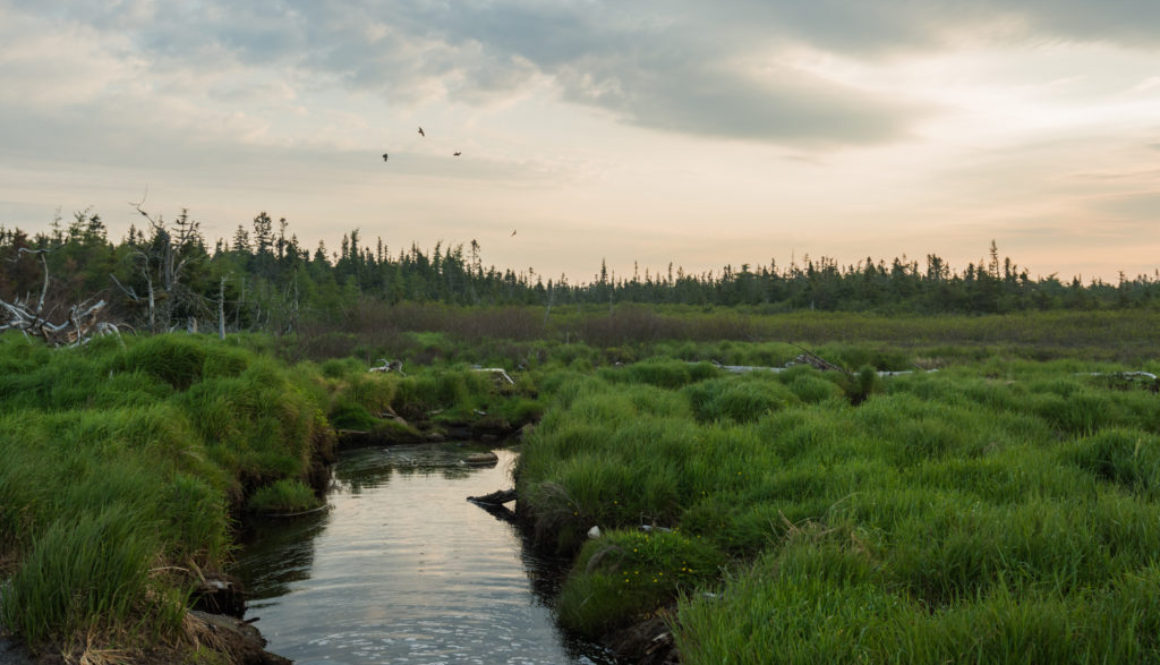
When it was announced that we could once again safely explore public parks and trails, my family immediately tugged on our boots to visit our favourite local spot: The Gateway Wetland Trails in Oromocto. We used to come here weekly, if not more often, and stepping onto the gravel trail felt comforting and energizing. I felt welcomed home by the splash of ducks and woodsy air, ready to once again walk the trails and bridges. The chickadees and red winged blackbirds were competing with their songs, red squirrels scurried about, and the vibrant marsh reminded me of the crucial role that nature plays in nurturing our souls.
My son and daughter spent the time looking for painted rocks (one of our favourite activities) and searching for beavers (still no luck there). Nothing can compete with their excitement for the outdoors— not even Paw Patrol! With muddy boots and windswept hair, their moods and spirits lifted during our walk and stayed high for days after.
It was exciting to be back with nature, and reassuring to see that the Town was encouraging our safe enjoyment with new signs letting the public know how to conduct themselves while using the trail amid this pandemic. All parks and trails will have their own rules and recommendations as more begin to open up, so take care to research and understand what they are before heading out.
I know how precious our natural spaces are here in New Brunswick. I have dedicated my academic and professional careers to help protect it, and I have been privileged enough to be able to access it my whole life. This pandemic has truly shown me how my mood and wellbeing suffer when disconnected from the natural world. Nature provides so much to us, but perhaps none greater than the certainty and comfort it gives during uncertain times.
[1] Spending time in nature can improve your mood and moderate stress, but if you are experiencing severe mental health challenges, please contact your doctor. It is not capable of treating serious mental illness.
Kelsey Wierdsma has a Master of Environmental Management and is the Conservation Coordinator at CPAWS NB. She’s a homegrown New Brunswicker and is passionate about building community support for protected areas. Her work in the non-profit sector has given her an outlet to make real change and educate others about the important work that needs to be done in New Brunswick and beyond.



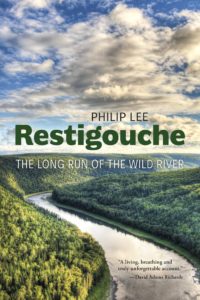 Philip Lee’s book, “Restigouche – The Long Run of the Wild River”, comes highly recommended by our Executive Director, Roberta Clowater, who has said it’s the book she would have liked to have written about the Restigouche, if she were an author. It captures both Philip’s personal canoe journey inspired by the river he loves, and the stories of the many peoples who have called this place home. He doesn’t shy away from illuminating the changes we need to make if we want to conserve this river treasure and live more in harmony with nature. Perfect for your outdoor enthusiast, conservationists and those who want to learn more about the rarely-told stories of this part of New Brunswick. To buy a copy go to Goose Lane Editions, or ask for it at a local bookstore.

 We began our tour with an offering of Tobacco. Cecilia explained that in their culture, tobacco is used as an offering and a way to give thanks. We placed the tobacco in our left hands, bringing the leaves closest to our hearts. After our offering, we began our medicine walk along the winding paths of Odell Park.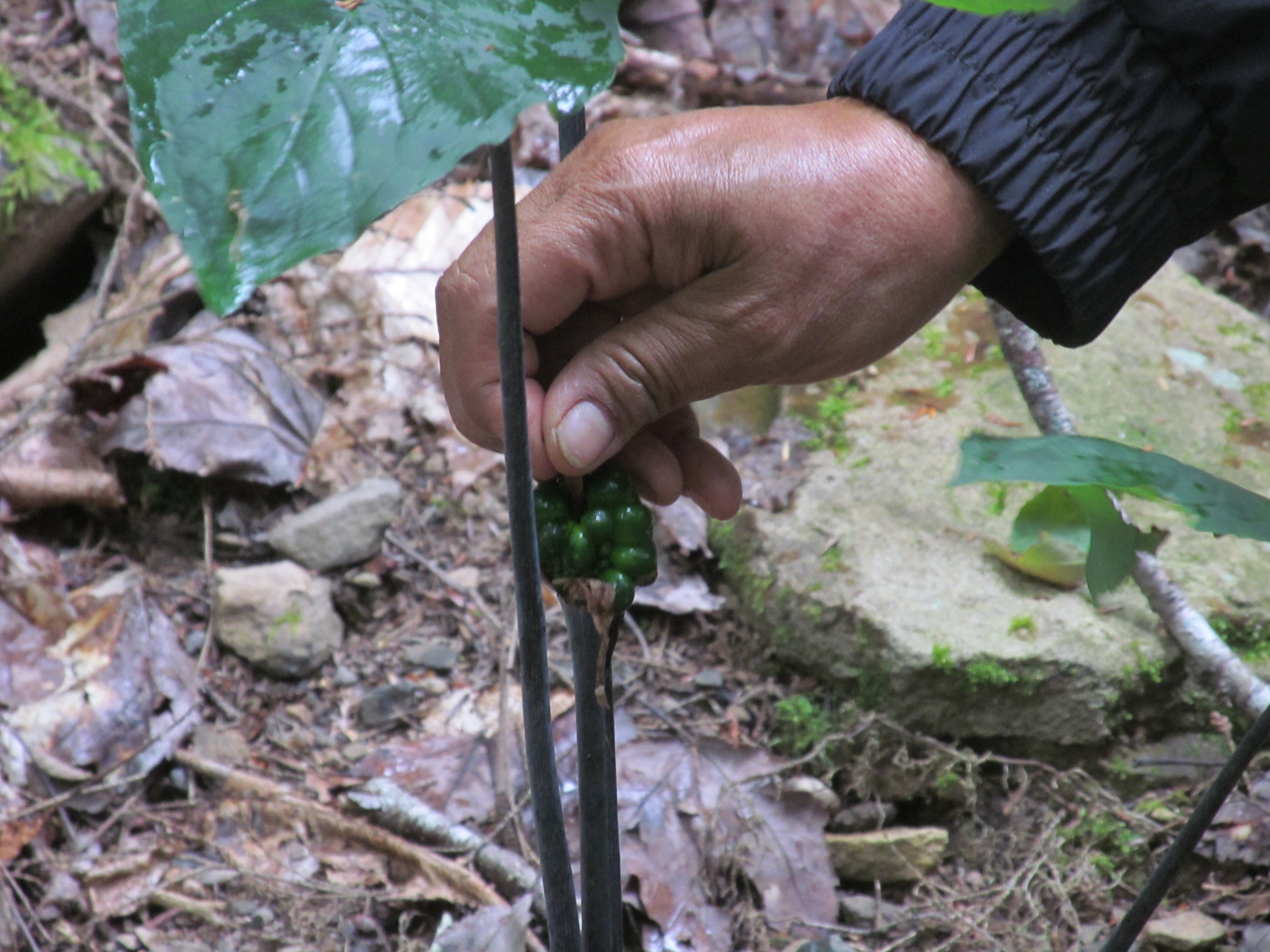
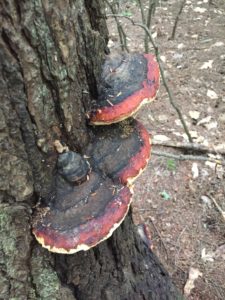 We also saw lots of fungi on our walk and, although some are toxic to humans, others like the Dye-Makers Polypore, can be used as a vibrant textile dye! Anthony, who studies mushrooms and is very knowledgeable about fungi, says that he often finds himself asking what purpose the mushrooms are serving, rather than how they can serve him. Many fungi are food for wildlife and are an important part of a healthy forest. Seeing our local plants as cogs in the ecosystem wheel, seeing their worth in nature beyond how we can use them, is a lesson we can all take to heart.
 This special experience is one that I won’t soon forget. To see a familiar place through a new lens and to meet common plants again with a new purpose, is to visit nature in a way I had not done before. Not only was it fascinating to learn about the many edible and medicinal plants that grow in our province, but, as Cecilia says, the walking and connection with others sharing in this experience is the medicine itself. For anyone wanting to expand their knowledge of our local trees, plants, and fungi and their innate value and purpose, go walk with Cecilia and Anthony on a Wabanaki Tree Spirit Tour in Odell Park!.

 Ending crimes against the environment,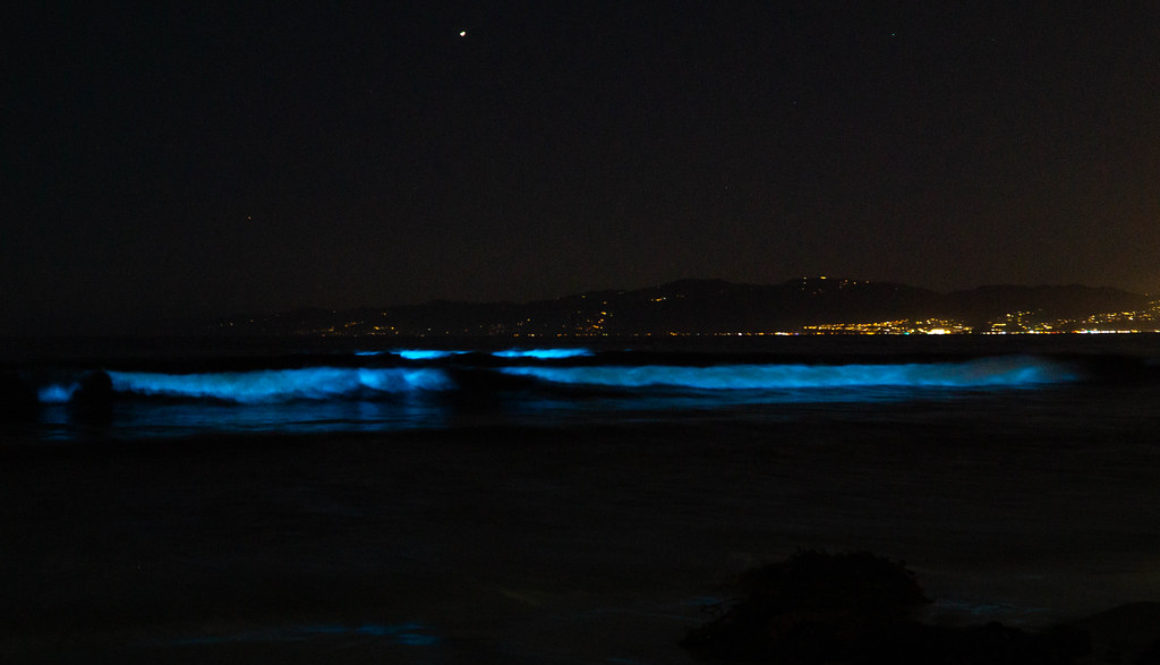


 Some small crustaceans, like crabs, and invertebrates, like sea stars, can spend their entire lives in kelp forests, feeding on algae or their fellow inhabitants, and using the kelp as shelter from predators. Kelp forests are frequented by species of worms, snails, plankton, small shrimps, anemones, and jellyfish, and many larger sea and land animals rely on kelp forests as a component of their habitat. Fish, like cod and haddock, seals, and many types of seabirds can be spotted searching for food, hiding from predators, and seeking shelter from storms in these patches of algae.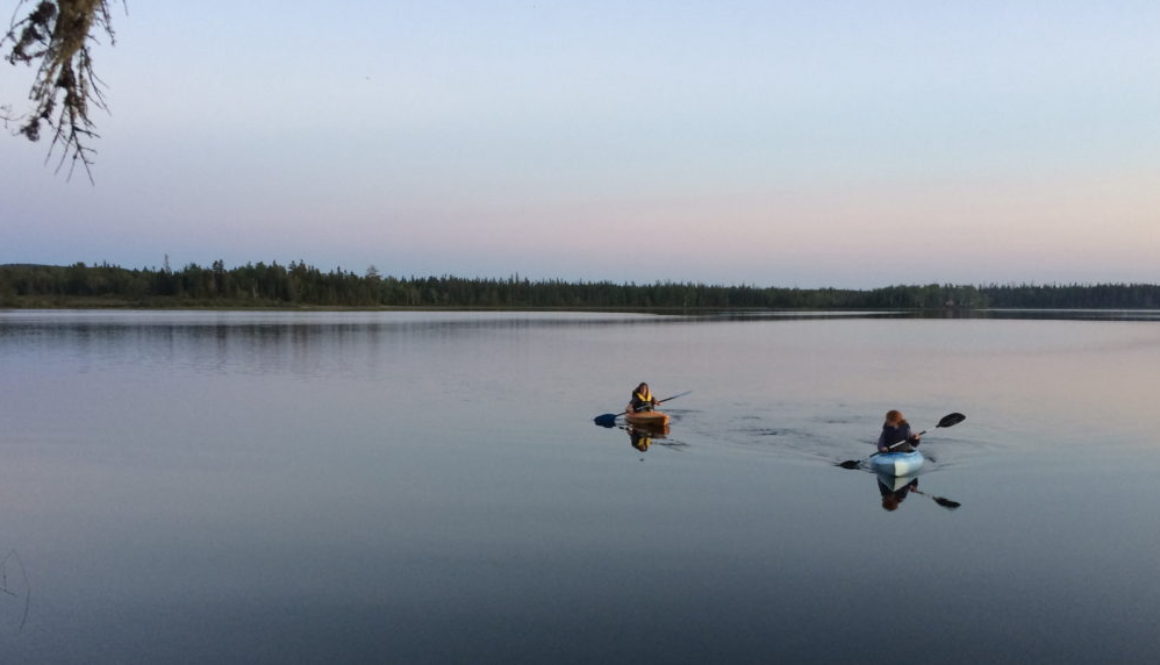





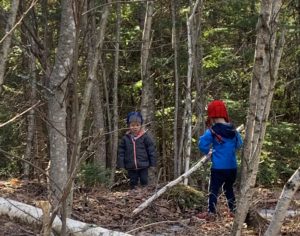 You don’t need me to explain to you what it’s been like—we’re experiencing this together, an ironic sentiment since isolation can make us feel disconnected and uncertain. It’s especially hard for children who desperately need routines. My children are 2 and 4. They are used to going to daycare, seeing friends, and spending time with their grandparents. With the loss of this (and many other) routines, we are trying to find what our new normal looks like.
 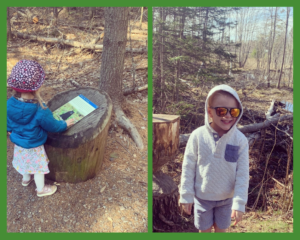 When it was announced that we could once again safely explore public parks and trails, my family immediately tugged on our boots to visit our favourite local spot: The Gateway Wetland Trails in Oromocto. We used to come here weekly, if not more often, and stepping onto the gravel trail felt comforting and energizing. I felt welcomed home by the splash of ducks and woodsy air, ready to once again walk the trails and bridges. The chickadees and red winged blackbirds were competing with their songs, red squirrels scurried about, and the vibrant marsh reminded me of the crucial role that nature plays in nurturing our souls.
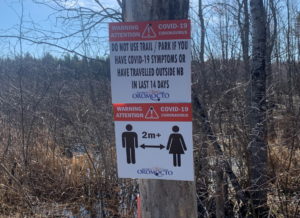 It was exciting to be back with nature, and reassuring to see that the Town was encouraging our safe enjoyment with new signs letting the public know how to conduct themselves while using the trail amid this pandemic. All parks and trails will have their own rules and recommendations as more begin to open up, so take care to research and understand what they are before heading out.